
LeBron James understands the price of basketball freedom
Every era has its defining superstar. Only one has spent two decades changing the NBA’s forecast every time he made a ‘Decision.’

Listen to this story
Editor’s note: This story was published July 1. LeBron announced Friday he is signing with the Philadelphia 76ers; ESPN’s Shams Charania reported the deal is for two years and $8 million.
Whether LeBron James beat the Los Angeles Lakers to the punch in saying goodbye first is more a matter of storytelling style. From the outside looking in, the idea of professional “comfort” has always seemed boring to James. The needle he has moved, like no other athlete this century, has been most intoxicating when the world around him felt — well, uncomfortable. Including now.
Because, now what?
Golden State? Miami, again? Cleveland, for a third time? New York, maybe?
“A king can’t be a true king if he hasn’t conquered a true empire,” Knicks superfan and podcaster Joshua Christie said in his own sales pitch. “That empire is New York.”
Washington — wait, what? Really? — perhaps.
To understand where the next chapter of LeBron James’ career will land in a matter of days — or hours — is to understand the totality of it.
In 2003, when LeBron was a newly minted high school graduate, the then-18-year-old phenom filmed a detailed but overlooked mini-documentary for ESPN’s The Life. In it, he rode around in his customized Hummer H2. This was the same vehicle that caused him one of the biggest controversies of his lifetime — which, in the grand scheme, is pretty impressive. He spoke to fans while driving and rapped along to JAŸ-Z’s 2001 classic album The Blueprint.
Then, just weeks before his life in inner-city Akron, Ohio, changed forever, he delivered an impromptu review of the H2.
“But if anyone wanna invest in one, the gas is crazy,” James said. “Take you $40 to fill this thing up, man.”
Forty bucks.
That’s how long LeBron James has been in the public eye. This was after his culture-shifting Sports Illustrated cover, and even longer after James officially put his name on the national radar at adidas’ ABCD Camp in the summer of 2001.
LeBron James has been playing basketball on the highest levels imaginable for so long that $40 for a tank of gas sounds as unrealistic as imagining a high school senior forgoing college to go straight to the NBA.
He’s been around long enough for what was once futuristic to now feel nostalgic. He’s been around long enough to see the NBA go from cable to social media to streaming and the intricate negotiating wars that came with him as the centerpiece. He’s seen newspapers succumb to “sources” telling insiders breaking news. He’s been in the league long enough to play against Kevin Willis, who was drafted in 1984 — the same year LeBron was born — and will soon play against (or with!) 2026 No. 1 overall pick AJ Dybantsa, who was born Jan. 29, 2007.
For context, Facebook was slightly less than three years old when Dybantsa was born. LeBron couldn’t even subscribe, because only college students could access it.

Malcolm Griffiths/Getty Images
This was long enough for superstars to enter the league, reach their peak, decline and ultimately retire — all while James continued to make Father Time retreat into its corner, saying, “Cut me.” For nearly a quarter century without pause, every NBA offseason, regular season and postseason has revolved, in many ways, around what LeBron James wants, what he is capable of and what he does next.
That is why James’ current situation, six months shy of his 42nd birthday and a day after he and the Lakers ended their eight-season relationship, remains so polarizing. For better or worse — through debate after countless debate — franchises, media ecosystems, fanbases and critics alike have molded to his motion. The freedom of LeBron James has always made an entire universe so uncomfortable, because the experience he provides is like that of a fingerprint: No human being on Earth can mimic it.
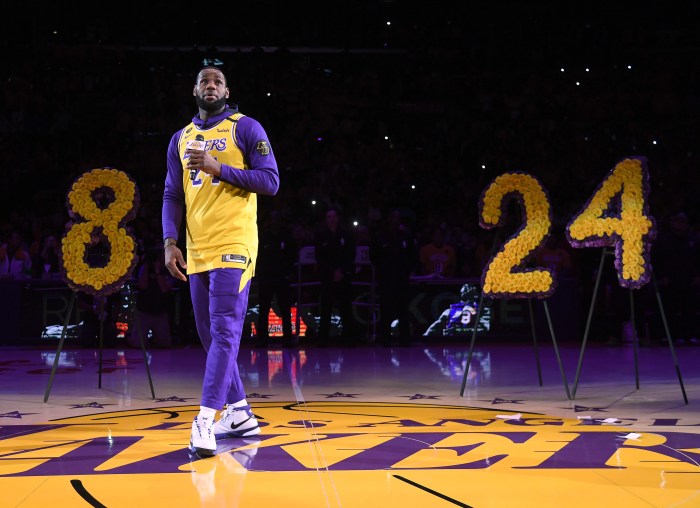
A meltdown in 2011. The greatest comeback ever in 2016. A championship in 2020 under circumstances none of us, hopefully, have to experience again — during a global pandemic and with the Lakers and sports as a whole reeling from the tragic helicopter crash that claimed the lives of nine people, including Kobe Bryant and his daughter Gianna.
LeBron James has won and lost in the most epic of fashions. Nothing he does results in the run-of-the-mill. This entire Truman Show experience that is his public life has only worked because his talent, longevity and luck — to be so healthy for so long — have worked in his favor. It’s only worked because of the support system around him, starting directly at the top with his wife, Savannah. The sports world has had no choice but to adjust, adapt and evolve as James continued to stretch the limits of possibility and improbability.
James’ leverage isn’t what it was in 2010, 2014 or even 2018, but it’s still unprecedented. He still tilts the balance between an elder NBA superstar and just how much a franchise is willing to invest in a once-in-a-lifetime talent.
Reportedly, James asked his agent, Klutch Sports CEO Rich Paul, to inform the league that money is not his motivation. The best fit is. Meaning, theoretically, this is the best chance the great majority of the league has ever had to secure LeBron James’ services. Not just on the court, but for marketing and mythology purposes for what figures to be James’ swan-song chapter. This is about the most valuable commodity in American sports — who long since elevated past employee to being his own nine-figure brand — treating himself as such.
James, much like his free-throw percentage, isn’t perfect. He’s broken promises, such as never competing in the dunk contest after saying he would. (In fairness, he did say“preliminarily.”) He’s made his missteps as a young man and an elder statesman. He will continue to, because such is the process of being human.
No one ever lives long enough to escape scars. It’s been nearly 16 years since he remixed Bryant’s phrase of “taking his talent” and made it eternal. Even if his time in a Lakers uniform never netted multiple championships, James still cemented a Hall of Fame career in Los Angeles, and will one day earn the vaunted honor of having his No. 23 retired there.
Even before Hollywood, he defined the ethos: star power, success, grief, redemption and power. Basketball was, and still is, the catalyst, but the source of his discomfort is that he challenged, broke and remolded decades-long assumptions about what access to power was supposed to resemble.
This isn’t to say he was without flaws or without setbacks. Whatever James did for the idea of “player empowerment” pales in comparison to the superhighway he paved for himself. He arrived as a teenager from the projects of Akron, Ohio, and leveraged unprecedented value — spanning far beyond basketball accolades, but into an empire fitting of his “King James” nickname.
Harry How/Getty Images
No matter where this next chapter takes us or how it ends, and no matter the rumors or what sources close to James may insinuate, what’s written in stone has already been cemented.
The landmark debut. More NBA points than anyone who’s ever lived. Eight consecutive Finals appearances. The MVPs and Finals MVPs. The Olympic gold medals. The game-winning shots. The “First 48” in Detroit. The LeStare in Boston. “BLOCKED BY JAMES!” in Oracle. Understanding his worth and bending free agency to his will for nearly just as long. It’s not babying James. It’s not pacifying him either. No player to ever touch a basketball has had, or will ever have, a career as intoxicating as this. It’s an anthology you have to see to believe it was written in real time.
Never say never in sports, but if James can make Father Time reconsider applying for a new job on LinkedIn, the word “never” should be counting its days, too. Records fall, except maybe James’ when it’s all said and done. Icons pave the way for future icons. But this? What we’ve seen? It’s different.
A major criticism of James is that he never played his entire career with one team. That sort of stability should be celebrated and admired, like Bryant in L.A., Tim Duncan in San Antonio or Dirk Nowitzki in Dallas. That’s far more a product of luck than loyalty. Had one thing gone differently in each of those cases, history would be singing a different tune. Michael Jordan’s clashes with the Chicago Bulls’ front office are part of the reason why his six rings are so godlike.
James’ legacy is different. The ability to shift the league’s GPS at his behest is his. He’s more than influential. He’s climate control.
Regardless of how his career ends or how many seasons remain, James has already authored an anthology unlike anything sports has ever seen. No player has been this good for this long. No player has accumulated more points. And perhaps most importantly, no player has demonstrated what free agency can become when the greatest player in the world understands the full extent of his worth.
During James’ rookie season, months after his episode of The Life, he sat down with the late Stuart Scott of ESPN.
“What scares you the most about your future?” Scott asked.
“Maybe not fulfilling a lot of other people’s dreams. [It’s] so much riding on me. They may look at me a different way if their dreams don’t come true,” James said then. “But then again, I don’t look at it that way. I look at it as myself making sure that I get better as a player and as a person every day.”
Twenty-three years and a lot of gray hair later, much of James’ basketball life sits in the rearview. Very few speed limit signs exist. At some point, one of those exits he’s avoided or ignored altogether will demand his swan song. Hopefully, he allows himself the grace that comes with what we know now as a “farewell tour.” He’s had JAŸ-Z record diss songs on his behalf and been a satellite figure in the Drake and Kendrick Lamar nuclear fiasco. He’s campaigned for Barack Obama and even found a way to make a Space Jam sequel and a new House Party installment.
Nevertheless, the pressure that demanded an 18-year-old change the game never subsided. Expectations only became more daunting and more biblical. Debates around James fed industries and careers. He not only dealt with the pressure, but he let it — and the task of overcoming it — become part of his life’s soundtrack.
History will remember the championships, the Finals record and the teams — including this third, and perhaps, final “Decision.” One galaxy in James’ massive universe, however, kicked subjectivity to the curb long ago.
The present shows what history will long remember: LeBron James didn’t break any system.
He created his own.