
Chris Johnson’s ALS revelation a reminder of grace needed for Black athletes
Former running back’s interview with Michael Strahan a space for dignity, humanity that could impact thousands, if not more
Listen to this story
Chris Johnson’s stillness is so powerful that it numbs me.
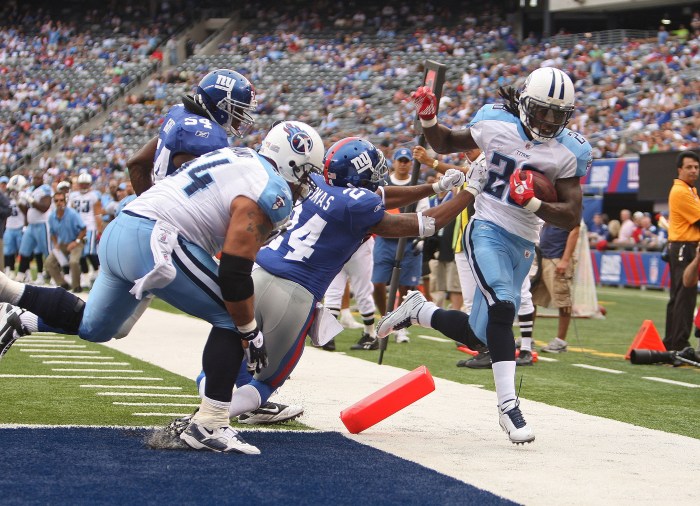
His eyes are doing all the talking for him. You have likely heard by now that Johnson, nicknamed “CJ2K” after running for more than 2,000 yards with the Tennessee Titans in 2009, has been diagnosed with ALS. It is a revelation more stunning than his transformation from a college player known mostly as a returner at East Carolina into one of the NFL’s great running backs and home run threats.
“How do you process it?” interviewer Michael Strahan, awash with survivor’s guilt, asked Johnson on “Good Morning America.”
“Honestly, I don’t know if you ever fully process it,” Johnson responded. “At first, you’re in shock, then you realize you have two choices: you can give up, or you can fight.”
Looking back at Johnson’s career, all of the talk about his “dreadlocks,” which will be referenced as loc’d hair from here on out, along with the discussion about the gold teeth he wore, feels trite now.
They were distractions only to folks who didn’t love the depths of Black folks and who refused to understand that Black Southern culture informed the country.
As it turned out, the way professional men of great meritocracy chose to style their hair and accessorize their smile didn’t matter. Johnson and his compatriots wore their defiance, for better and occasionally for worse, with the attitudes of the people who influenced them. Not just their mothers and fathers, but the larger-than-life figures in the community.
“It’s more of a culture thing,” he said in an interview with Kyle Odegard in 2015. “Where I come from, all the people that we looked up to when we were younger, those guys had gold teeth. It’s a thing in our culture, especially down south.”
It was fitting that a few of Johnson’s NFL brothas promptly responded to the heartbreaking news of his diagnosis with courage and much-needed levity. Marshawn Lynch, himself a target of wayward narratives and stereotypes, rebirthed the viral “Ice Bucket Challenge” in the spirit of ALS awareness, along with fellow Florida native Edgerrin James, Adam “Pacman” Jones and Vince Young.
“I stand [with you]. And I’m here for you. … Love and respect,” Lynch said before being doused with ice. Again, the numbness was apparent, then Lynch stood up and shook the ice out of his locs like a brotha from Oakland should.
“So start taking care of y’all mentals, y’all bodies, and y’all chicken,” Lynch famously said some years ago.
Doctors delivered Johnson that message and his diagnosis in a more abrupt sense, he relayed to Strahan: “Get your affairs in order.”
Mike Ehrmann/Getty Images
There is a numbness that has not been discussed — the way we commodify Black athletes to sell goods and convey ideas.
Strahan faced criticism for not asking Johnson a question that would have been provocative, yet carries a seemingly obvious answer: “Do you regret playing football?”
Granted, it’s a question that could be asked in good faith and with good reason. Studies have linked the head trauma associated with playing football to neurodegenerative diseases such as ALS, and research published in October suggested “reverse causality,” meaning brain and head trauma from playing football might be attributed to “subclinical ALS.” Please read those sentences again, because we should not become numb to that element of uncomfortability.
But Strahan’s interview was not the place or space for that clinical or critical analysis. His was a space for dignity and humanity, which he managed in spite of his own visible shock and hurt.
The tell is in the moments with the “GMA” hosts back in the studio after the interview had aired. Strahan, fully immersed in the teleprompter he was reading from, might as well have been thousands of miles away. It took a tearful Robin Roberts to appreciate the gravity of the situation.
“Admire. … You said you admire him still,” Roberts said before she gave Strahan an affirmative pat on his knee. “Great job, Michael.”
This is a grace often unafforded to Black athletes and Black men.
Some years ago, Johnson and Strahan might have met under more brutal terms at the line of scrimmage, but grace allowed for a dialogue that impacted thousands of lives, if not more. This interview doesn’t remove the importance of critical assessment, but reinforces the need for it — to protect Black children and Black men from the dangers of football.
The personal decision I’ve made for my two sons (8 and 5 years old) is that they won’t play the sport, but what if they decide as teenagers to pick it up? That will be a tough conversation to have, and I will ultimately support their dreams.
But again, outside of the framework of Strahan’s interview, that becomes a discussion about age limits for football players, the possible mandate of Guardian helmets, and eventually, the financial and healthcare protections for players that extend beyond their professional careers (including college).
This was Johnson’s moment, and Strahan landed the plane well. We needed to know that Johnson was a loving and present father for his four children — and still is, as Roberts so eloquently put it. My heart goes out to his wife, Brittany, a proud caretaker showing a strength that a select few can imagine.
Watching your loved ones get sick or incapacitated is a painful and numbing endeavor. But committing to their dignity and well-being as a caretaker requires a reservoir of strength and power that feels supernatural.
My maternal aunt and her husband, my uncle, took care of my late grandmother who had Alzheimer’s for more than 20 years. I’ve watched the dignity that Andscape’s own Justin Tinsley has expressed in this medium and others about the matriarchs in his family, most recently with Anderson Cooper about how his grandmother “taught me how to grieve.”
Many times, there’s grief within the framework of caretaking, but it would be irresponsible to leave this column with such hurt. It’s a culture thing, remember? Our culture has taught us to make a way out of no way, to cling to hope even when your grip isn’t as strong as it used to be.
“I want people to know that I’m still me. ALS has changed what my body can do, but it hasn’t changed who I am,” Johnson said. “People sometimes look at the physical disability and assume you’re not still the same person inside. I still think the same. I still dream…”