
Len Bias: Remembering the person 40 years later
Since his death in 1986, the former Maryland star has been reduced to a tragic symbol. He’s more.

Listen to this story
Those of a certain age still feel Len Bias, the symbol.
He was a local phenom who grew into the distinction. The hometown kid from Landover, Maryland, who went on to not only star at the University of Maryland, but also erect entirely new imagination ecosystems there.
His battles with the University of North Carolina’s Michael Jordan became an immediate, godlike meeting of the minds that now lives on grainy footage via YouTube. His perceived destiny was to be the architect of an extended dynasty with the Boston Celtics as the No. 2 pick in the star-crossed 1986 NBA draft.
How he’d allow legends like Larry Bird and Kevin McHale to age gracefully while he cemented his own legend. How his fatal cocaine overdose became a headline so crippling it completely supercharged America’s already supercharged war on drugs and Black bodies, the impact of which still lingers 40 years after the celebratory-turned-grieving night in Washington Hall.
Simply put, Len Bias, the symbol, remains the single most painful “what if” in sports history.
“His life and gift have been reduced to cocaine and squandered opportunity instead of brilliance and charisma,” said Dr. Imani Perry, an African American Studies professor at Harvard University and a 2023 MacArthur Fellow.
Yet, what about Bias, the 22-year-old young man who shouldered the weight of the world and the hopes of many he’d never meet? The guy who’d give you a ride to grab a burger just because he was hungry. The guy who, if you caught him away from campus hoopla and conversations that endlessly revolved around his pro potential, would always talk about faith. Not in an intensely spiritual way. But in a way that made his gratitude evident.
“I believe in God,” Bias would say in private moments. “I owe my life to Him.”
There was the mischievous smile. The playful exuberance. The innate gift to never make those around him feel invisible, despite his massive star power. All of these qualities — all wrapped in one elegant All-American body. Basketball, much like life, in the 40 years since Bias’ death, is painfully familiar and wholly unrecognizable. The further his death distanced in the rearview, the more comfortable it became to remember him as a cautionary tale.
It’s not incorrect. He is one. But it does overshadow an agonizing truth. Lost in everything, including time, was not the symbol, but the person.
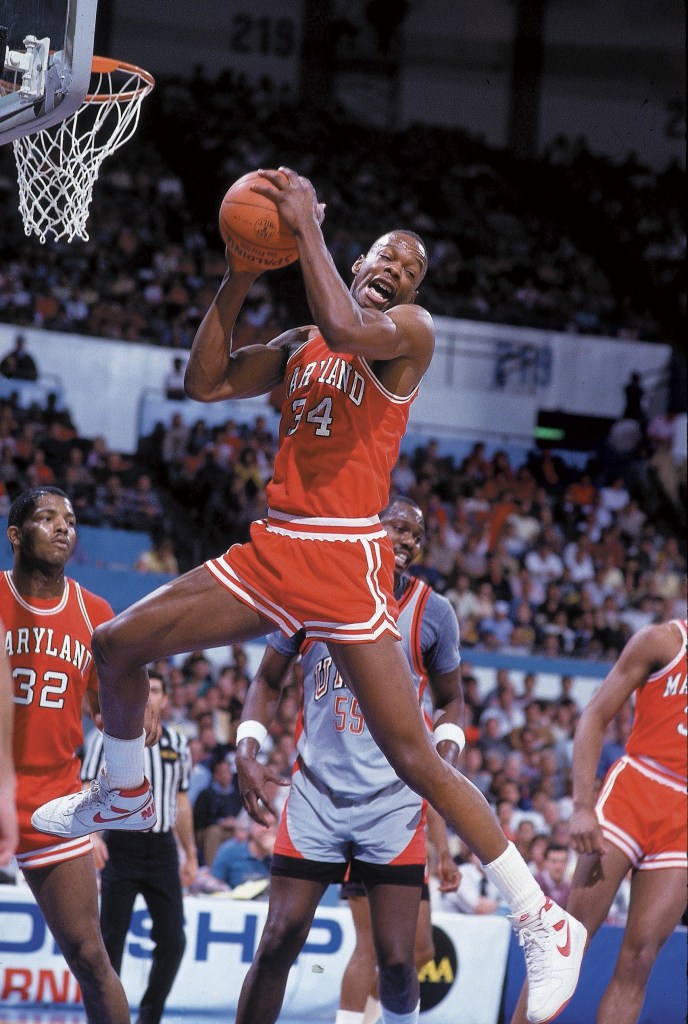
Richard Mackson/Sports Illustrated via Getty Images
Listening to Scott Van Pelt discuss Len Bias is akin to hearing a gifted jazz musician agonize over music minus chain-smoking cigarettes and drowning in whiskey. Before he became the legendary ESPN personality and broadcaster, Van Pelt was a scrawny kid who called College Park, Maryland, his collegiate home, just like Bias.
He doesn’t go as far as to call Bias a close friend. He hooped with him a few times. And whenever Bias would even acknowledge his presence on campus with a dap or “wassup,” being acknowledged by Prince, Michael Jackson, Eddie Murphy, or any icons of the time wouldn’t have been a higher honor. Van Pelt calls him “Leonard” because that’s what famed Terrapins head coach Lefty Driesell called Bias.
“He’s like the fish story that’s real,” Van Pelt said. “You put your hands out and you’re like, ‘I caught a fish this big.’ With each syllable, your hands are getting wider apart. [Bias] was that. And because he passes, he’s frozen in time as the rest of us become older. It only magnifies the intensity of the pain of what might have been and the pain you know his family endured.”
Bias died in 1986. His brother, James aka “Jay,” was gunned down at Prince George’s Plaza mall — a five-minute drive from UMD’s campus — just weeks before Christmas in 1990. Their mother, Dr. Lonise Bias, channeled a parent’s worst nightmare into becoming a powerful and visible figure in the area, focusing on community and youth advocacy. She died earlier this year. Bias’ father, James, survives but battles health conditions. The Bias family committed itself to sanity in a life that had robbed them of so much.
It all traces back to that fateful night 40 June’s ago, a chain reaction that doesn’t seem real nearly a half-century later. If you loved Bias, personally or simply for the enjoyment that his talent brought into your life, the pain is eternal. And numb.
Van Pelt heard the news at a 7-Eleven in Olney, Maryland, right off Georgia Avenue, holding a Big Gulp. The lathered-up sweat on the back of his neck still feels damp, thinking back to such a hot summer’s day.
“Bias is dead, man,” Corey Salveson, his college roommate and high school friend, told him.
“I remember every detail,” Van Pelt tells me, the crack in his voice stressing the emotional toll that’s lived with him every day since.
In a world before social media, the news spread on campus with the speed of an internet rumor. Only it wasn’t a rumor. Lenny, or Leonard, or Bias — however you connected with him then — was gone.
Myriam Léger didn’t know Bias until roughly a year before, when she transferred to Maryland. Mutual friends brought them together. McDonald’s runs were guilty pleasures. She still hears Bias from the driver’s seat of his car.
I’m on my way. Jump in!
Faith brought deeper conversations out between them. Where the world saw a once-in-a-generation ballplayer, Léger saw a friend and, in her words, a “big teddy bear.”
The next several weeks were a blur. A gutting, unhealed blur.
“His wake was wrapped around the block of the church. I was the next person literally to be let in to see the viewing and they shut it down, which I think was for my good,” Léger recalled. “Then they came out with the casket … I remember my knees giving out. I just remember the wailing and screaming in a massive line behind me.”
The emotional baggage never subsided. It became part of life’s rhythm.
“I don’t think we could process at that age. We were college students, and we didn’t know how to feel. But it took years before the campus could recover,” Léger said. “For us students, it took years, a lot of time, before we really could. What we really needed was counseling. Life pushed us on.”
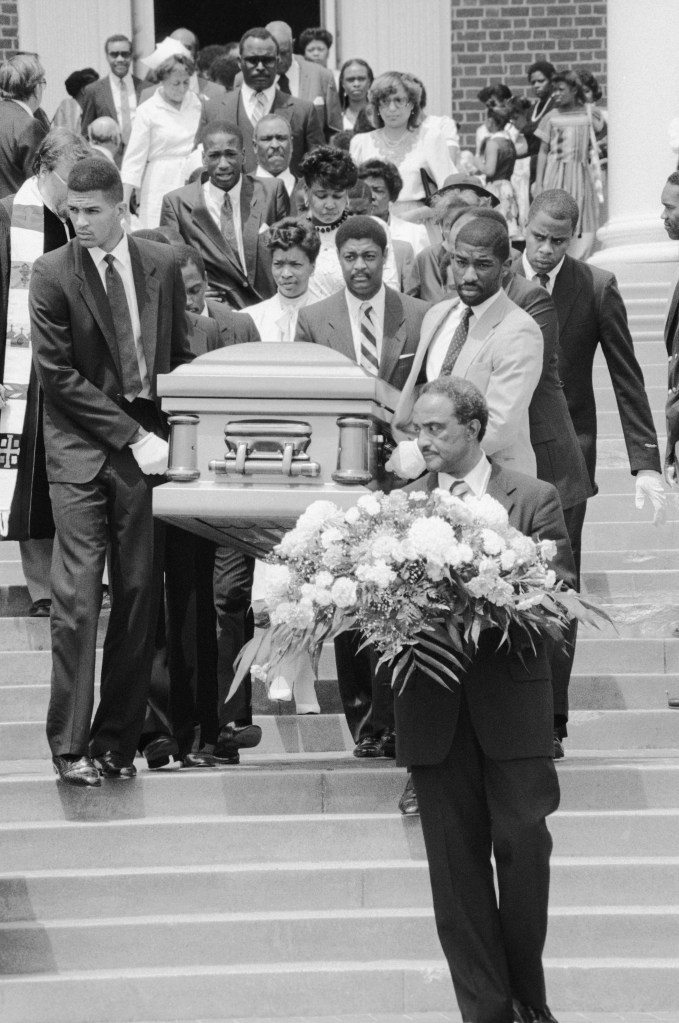
Bettmann
The urban legend of what happened the night of June 19, 1986, hasn’t gone anywhere. Bias’ friend and pickup basketball comrade, Brian Tribble, was acquitted a year later of supplying the potent batch of cocaine — allegedly straight from former Washington, D.C., drug kingpin Rayful Edmond.
In reality, Bias was no different than many other college students, then and even now. College students experiment with drugs. The great majority never lose their life as a result, and the great majority aren’t considered basketball unicorns. It doesn’t justify any decisions made, and certainly, the aftermath no one saw coming. But it does provide context.
Toxicology reports showed neither alcohol nor other drugs were present in Bias’ system at the time of his death. The dope wasn’t “stepped on,” by street standards. This was powerful cocaine, as pure as one could find in the D.C.-metro area. Bias had no previous heart conditions, meaning the seizures and cardiac arrest he suffered were a direct result of the coke.
In other words, what happened to Len Bias was a freak accident with the gravest of consequences.
Nevertheless, as the years passed, empathy took a backseat to intense moral judgment.
“I don’t feel sorry for Len Bias, not in the slightest,” the late Bobby Knight told a collection of top high school players in 1990. “He had his own mind and his own body to take care of and just wasn’t smart enough to do it. … Somewhere along the way, he wanted to be one of the boys. He wanted to be cool. Well, he was so cool that he’s cold right now. That’s how cool he was.”
Those who knew him vehemently oppose the notion that Bias’ life is defined by the mistake that cost him his.
“Leonard wasn’t some dope fiend, man. He was doing the Tony Montana, what you thought you were supposed to do. Lenny doesn’t know what he’s doing, does too much, and he’s dead,” Van Pelt said. “It’s a tragedy any time a life is cut short. But in this case, the fact that it was his own doing just magnifies it to the nth degree. And the fact that 40 years later, I feel compelled just to make this clear: This wasn’t some dude that had a drug problem. He made a tragic mistake, and it cost him as profoundly as any mistake could. But the wreckage, man, it’s just hard to even describe how heavy and hopeless it felt because there was no fixing the hurt that everyone was feeling, that we still feel.”
What’s been lost is a person Van Pelt, Léger and others have been haunted by every day since. Everyone was proud of Bias, but so many understood that fame was an element of his new world he was still trying to come to terms with. Before his death, he was — respectfully — goofy. He enjoyed life. He enjoyed people. He enjoyed those little moments you don’t always get whenever you’re the marquee attraction in every room you walked into.
Bias was a college kid. As normal as any college kid could be in 1986. The only distinguishing quality was his fame. He was expected to be a savior on a franchise that had just won the NBA Finals and boasted an embarrassment of future Hall of Famers.
“The Celtics were in so many ways a symbol of Boston as a racist city,” said Perry, who was a 13-year-old living in the city then, “and Len Bias was so dazzling it seemed like a page might be turning.”
Where basketball could take him and change the course of his family’s life was a constant thought. He was a student on the brink of transitioning into life’s next great big phase: adulthood. Every college graduate understands that weight. Bias’ journey was playing out on the world stage.
“He was more unsure and insecure. I definitely saw him in that space sometimes when we would just talk one-on-one, where he didn’t feel like he had to just always smile and be on,” Léger said. “He had his doubts. I can tell you that.”
What no one saw coming is how America would come to eulogize, and ultimately stereotype, Bias. He morphed into a drug story and a point of political leverage. His story became about race and the legislation enacted soon after his body was placed in the ground. Exactly 131 days after Bias’ death — and a week before a critical 1986 midterm election — The Anti-Drug Abuse Act of 1986 was signed into law by President Ronald Reagan.
It immediately became known as the “Len Bias Law.”
“His death could’ve simply been understood as heartbreaking,” Perry said. “[But] the ‘80s were one long backlash against the Civil Rights revolution.”
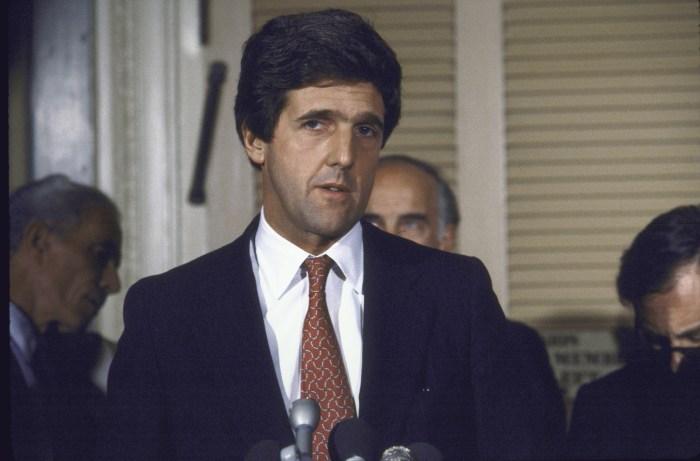
Cynthia Johnson/Getty Images
Though Bias died from a powder cocaine overdose, the law brought into further light the epidemic of crack cocaine and its grossly disproportionate impact on Black communities. This was first lady Nancy Reagan’s “Just Say No” America. Drugs were bad. Death from drugs was horrible. And any challenge to that had to be dealt with immediate consequences. The law introduced the now infamous “100:1” rule that established the disparity in punishment for dealing crack cocaine and powder cocaine: 5 grams of crack came with a minimum five-year prison sentence, whereas it would take 500 grams of powder cocaine to receive the same sentence.
Crack was viewed as Black, poor and violent. Cocaine was a luxury drug, used by white and affluent Americans.
Before the “Len Bias Law” was passed, Black Americans’ average federal drug sentence sat at an 11% higher clip than that of white Americans. By 1990, that same number had ballooned to 49%.
John Kerry, the former secretary of State, diplomat, and 2004 Democratic presidential candidate, is still haunted by Bias and the carnage that came afterward. At 82 years old, the chaos and commotion live with him. The impact of it all, even more so. A former Massachusetts lieutenant governor who also represented the state in the Senate for nearly 30 years, he remains heartbroken.
“There was this sense of, ‘Everything goes right, everything’s there.’ The hope, promise and exhilaration in all of New England were destroyed. More importantly, this young man was gone,” Kerry told Andscape. “His family was wrecked. Everybody was just dreaming about Bird, [Robert] Parish, and McHale — and then suddenly Len Bias is out there on the court with them. How could things go wrong for Boston?”
Kerry voted in favor of the 1986 bill that historically took on Bias’ name. Over the years, though, his critiques of America’s drug policies grew louder. Two years following the law’s passing, Kerry passionately spoke at a Senate subcommittee hearing on drugs, terrorism, and international operations. He called America’s acts “complicitous” in drug trafficking and spending billions of taxpayer dollars to get rid of the issue.
“It’s mind-boggling,” he said in 1988. “I don’t know if we’ve got the worst intelligence system in the world. I don’t know if we’ve got the best, and they knew it all and just overlooked it. But no matter how you look at it, something’s wrong. Something is really wrong out there.”
Decades later, Kerry’s synopsis on the true cost of America’s drug wars hasn’t gone anywhere. With Bias, he sees a young man reduced to a symbol — a prominent figure in an era of chaos that altered the course of the country’s history and fractured households. An issue that was never truly solved, but paved the way to the next epidemic.
But how did America understand Bias’ death 40 years ago? How did that understanding change? And who has been left to pick up the pieces of a puzzle that seems almost impossible to put together?
When asked, Kerry goes silent. The thoughts are organizing in his head in tandem with the emotions Bias brings out of him. The number of impacts is dizzying. A young man dying — the underlying point Kerry stresses throughout — raised the urgency of drug awareness, but that same urgency trampled on common sense and what really ought to have been done.
“Politics got into it, and inevitably it came at a moment when the country was already troubled by fears of addiction, crime and public health. He became a victim of all the stereotypes,” Kerry said. “This ricocheted throughout the politics of the moment. So many families experienced that pain. A lot of policies adopted in the years that came had unintended consequences.”
He pauses once more.
“The 1980’s drug crisis had big racial dimensions involved. A lot of communities suffered disproportionately. The policy responses that were quickly put into place had unequal consequences. America continues to wrestle with some of those same impacts and questions today. We’ve got an obligation not just to reflect on the dramatic, incredible impact of the superstar and what-if’s about future Celtics teams. Frankly, a lot of that pales in front of the responsibility we all have to remember not just what happened, but to remember what we learned from what happened.”
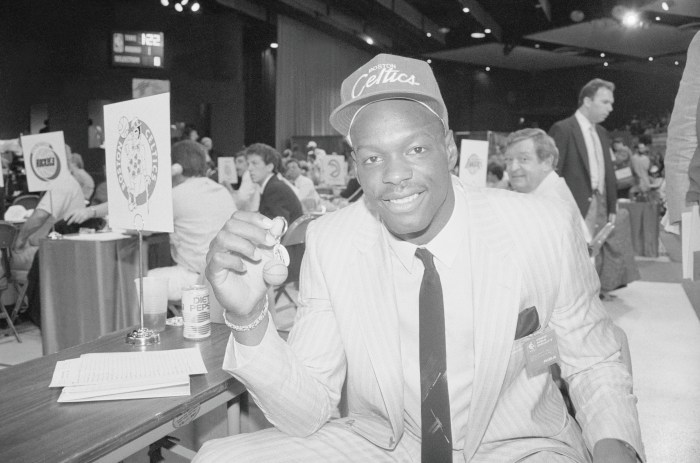
Bettmann
Bias met his final resting place 40 years ago. The late Rev. Jesse Jackson spoke at Bias’ memorial service and grave site, where he pleaded with American youth to abstain from drugs.
The questions that surround Bias, though, have no end date as long as basketball remains a pivotal part of America’s economic and cultural road map.
Would he really have extended Boston’s dynasty? The Celtics advanced to one more Finals following his death (the next season in 1987) and didn’t reach another until winning the title in 2008.
Could he have really altered Michael Jordan’s trajectory? The same Michael Jordan who never feared Bias’ talent but understood how limitless it actually was?
How do we reconcile how it took the University of Maryland 28 years following Bias’ death to induct him into the school’s Athletic Hall of Fame?
Those questions are important, and all part of the larger conversation of telling Bias’ story completely and honestly. Yet, those who knew him and those who lived with and after him wrestle with a different set of scars that never closed and will never heal.
It’s not about the wins, losses, and parades that never came. It’s about Len Bias, the kid from Prince George’s County who had the world at his fingertips and provided hope to so many. It’s about Len Bias, the friend. The son. The chapters they loved writing with him, no matter how small a character they played in his story.
In 1998, more than a decade after Bias’ death, but inside a society still very much dealing with the ripple effects of it, DMX’s “Slippin” placed grief into perspective.
“To live is to suffer. But to survive, well, that’s to find meaning in the suffering.”
For much of his life, and even after his 2021 death, X is immortalized as a transformative artist — but one whose struggles with addiction ran in tandem, and at times overtook, his legacy. Many people remember Bias as cocaine.
Both were so much more than their demons or their endings.
The everlasting tragedy around Bias is remembering the young man who spent exactly 8,250 days on Earth. The young man born four days before President John F. Kennedy’s assassination — and whose death fractured a country in a separate, but equal prophecy. What happened after June 19, 1986, was beyond Bias’ control.
“Perhaps,” Perry said, “we, too, have reduced Len Bias’ life.”
“What gets lost is not the what-if,” Van Pelt noted, “but the what was.”
Len Bias, the symbol, never needed saving. Len Bias, the 22-year-old, did.
He still does.