
WrestleMania 42 showed that WWE’s future is Black
Oba Femi, Trick Williams, and Je’Von Evans lead the new generation of Black men superstars
WWE is in the middle of a transitional period. Stalwarts John Cena and AJ Styles have retired, while old-timers like Brock Lesnar send signals that their time is up. This is nothing new for a company more than 70 years old.
What makes this time different is that the new faces positioned to fill those vacant spots are Black: Oba Femi, Trick Williams, and Je’Von Evans. WrestleMania 42 was not only a coming-out party for the organization’s young Black male talent, but also a statement that WWE is betting on Black for its future.
Oba Femi strutted into WrestleMania ready for combat against Lesnar. Before some audience members could even sit down, he was leaving with a massive victory under his considerably large belt.
What Femi did in his WrestleMania debut isn’t as important as how he did it. Femi dominated Lesnar in a way that says he’s up next. No one in WWE history dominated Lesnar in this fashion. One man got close, but he was never presented as a true threat that intimidated Lesnar.
Femi shook the former WWE champion to his core, and he did it during the portion of the event aired on ESPN for free. That type of televised beatdown over a dominant presence like Lesnar is only reserved for someone a wrestling company sees as a perennial force and a rare talent — WWE didn’t so much turn Femi into a star as it made him into a supernova. That’s not usually a role for Black wrestlers in WWE.
While guys like Booker T, Bobby Lashley, Kofi Kingston and Big E have held one of WWE’s two top world championships at various points in the past, they never received the royal treatment associated with Cena or Roman Reigns.
Champions, yes, but not faces of the company, and barely main characters in their own stories. Their runs ended unspectacularly, and they didn’t remain fixtures atop WWE’s main event scene. Ironically, it was Lesnar who ended Kingston’s run in embarrassing fashion in a match shorter than this sentence.
Kingston’s reign, along with the others, showed the difference in giving Black wrestlers a moment in the spotlight vs. making a long-term investment in them as foundational pieces. Thankfully, WWE listened to its audience this time and seems intent on changing its ways.
Ethan Miller/Getty Images
Fan response not only played a huge part in Femi’s dominance, but it brought Trick Williams onto the WrestleMania stage for the first time.
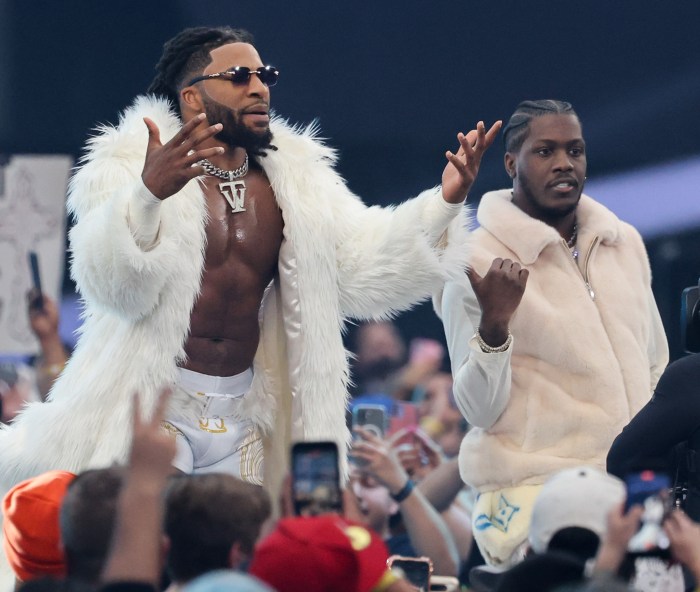
Williams, with Lil Yachty in tow, defeated Sami Zayn for the United States Championship in his very first WrestleMania match. Like Femi, Williams wrapped up his opponent in a relatively quick fashion. The Allegiant Stadium crowd cheered his win like he was the Second Coming. This is saying a lot, considering Williams appeared on SmackDown as a bad guy just four months ago with nothing on his mind but bullying Zayn.
At the time, fans adored Williams’ WrestleMania opponent, but “Trick Willy’s” charisma and mic skills made him nearly impossible to hate. Much like The Rock in 1998, Williams talked himself into superstardom. It’s rare that someone captures the paying masses’ imagination to such a degree that they cheer him and boo a beloved good guy like Zayn, especially as Williams kept doing bad guy things.
WWE saw this and smartly put Williams in situations and on outlets that showcased his gift of gab while fitting neatly with his persona. He sparred with Stephen A. Smith on First Take, made a diss record with Yachty, and broke bread with The Breakfast Club.
The company is investing in Williams by letting him lead the way rather than putting him in someone else’s shoes. Or in Williams’ case, someone else’s “lemon pepper steppers.”
Paul “Triple H” Levesque, WWE’s 56-year-old chief creative officer, recently said he has no idea what half the stuff is that Williams says. But he knows it’s cool, because he feels audiences react to the words. Levesque, to his credit, understands no one should look to him for what passes as relevant for the young audience WWE desires. No one working in management could tell him that when he was Williams’ age (31), so why interfere when he’s on the other side of the desk?
According to Levesque, Williams has the leeway to be himself when speaking to a packed arena.
That type of freedom isn’t granted to just anyone, especially in a corporation where so much money rides on every second of live television. That autonomy, along with rewarding Williams with a major championship victory over someone of Zayn’s caliber at the largest wrestling event of the year, shows how much WWE’s executives trust him and how brightly they view his future. Williams is also the first Black man to capture gold at WrestleMania since Kingston at WrestleMania 35.
Ethan Miller/Getty Images
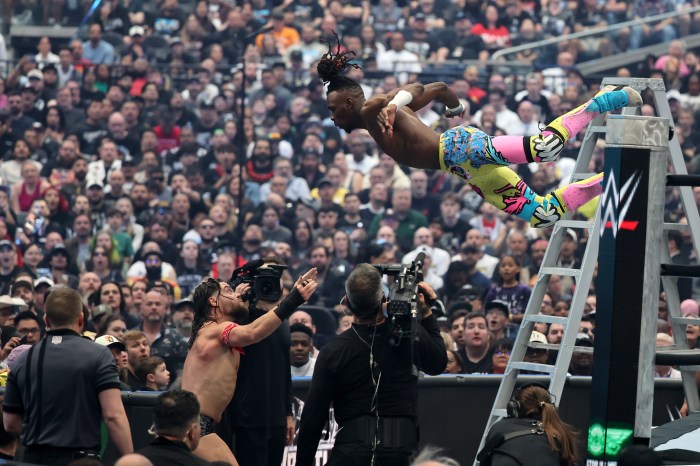
During that same interview, Levesque mentioned two other wrestlers. One was Femi, and the other was Je’Von Evans. Evans just turned old enough to rent a car by himself last year and already worked big matches with Randy Orton, and competed for a shot at the WWE Championship in February. And that’s all before he wrestled his first WrestleMania match, where he competed for the Intercontinental Championship in a ladder match with several notable names.
If Williams’ words left the audience’s mouths agape, Evans let his work in the ring do the talking. To put it simply, he’s one of one. His vertical ability, matched with his daredevil personality, creates viral moments. And it helps that when he does talk, he sounds like himself. He’s not imitating anyone or homaging what’s worked in the past.
To paraphrase Levesque, what we see on camera is the same person Evans is behind the scenes. He, too, got his WrestleMania moment the same night as Williams and Femi. He didn’t get the W, but that’s not the point.
His entrance received one of the biggest audience reactions of the night, followed only by their response to what he did in the ring. It’s no accident the company showcased Evans during Mania’s free hour on ESPN, and also featured him on the card for Cena’s retirement match last December. Whenever all eyes are on WWE, the company ensures Evans is well within everyone’s view.
Evans, Williams, and Femi have one other thing in common besides skin color: NXT, WWE’s developmental brand, incubated them for several years before putting them on a much larger stage. Williams started as muscle for Carmelo Hayes, another rising Black talent. Femi shot to success almost immediately, while Evans’ style made him a fan favorite.
Quiet as kept, NXT is home to many young Black wrestlers, both male and female. The company provides an entryway and platform for talent in ways not afforded to them decades ago. The developmental brand represents WWE’s future. One glance at the Orlando, Florida, establishment illustrates a much more diverse vision than at any time in the company’s history.
These three represent the first wave of Black talent through the door.
Femi’s already called out newly crowned World Heavyweight Champion Reigns, Williams is primed for a long title run, and it feels like when, not if, Evans etches his name on the list of legends who held the Intercontinental Championship.
Those are huge accomplishments in a vacuum, but taken within the larger context, they’re monumental. After all, the last time WWE featured a Black man as a star in a singles match was Snoop Dogg vs. The Miz at WrestleMania 39. No disrespect to the Death Row CEO, but that’s unacceptable.
WrestleMania 42 displayed big moments for young men who carried NXT for several years and now look ready to do the same thing on the main roster. Three different wrestlers present three different visions of Black men in an industry that has historically handled presentational nuance less than well. And they’re all superstars on the rise.
Femi likes to say the future isn’t some “distant thing; the future is now.”
For WWE, that future is also Black.