
Why U.S. soccer is a baffling World Cup underdog
‘Glad to be here’ defines World Cup experience for smaller nations in expanded field, but shouldn’t for United States


Andscape explores the intriguing teams, people and themes around the 2026 FIFA World Cup in North America.
Listen to this story
PHILADELPHIA — Shortly after Haiti lost its World Cup Group C match to Brazil last week, I approached Jean Claude Edwards and his daughter, Tamikha, as they walked back to their hotel.
They were among the few thousand Haitian fans who had attended the match at Philadelphia Stadium, where they celebrated Haiti’s first men’s World Cup appearance since 1974. Father and daughter filtered Haiti’s historic appearance through generational prisms.
Jean Claude, 83, was a 31-year-old single man living in Brooklyn, New York, when Haiti made that inaugural appearance. He remembers the high point of that match against Italy as if it happened yesterday.
Just before intermission, Haitian striker Emmanuel Sanon scored the game’s first goal, giving his team a 1-0 lead.
“When Haiti scored its first goal, I cried,” Jean Claude recalled. “I cried, not because I was in pain, but because I was happy.”
Haiti conceded three times in the second half en route to a 3-1 loss. Two more defeats, and thus an elimination from the tournament, would follow.
But the pride of watching Haiti score that first goal on a world stage would be a sustaining source of pride for Edwards until last October, when Haiti qualified for this year’s World Cup. His daughter, like Haitians across the diaspora, was ecstatic the nation was headed to a second men’s World Cup appearance. She floated from her home in Boston to Philadelphia.
Even though Haiti lost to Scotland in the tournament opener, Tamikha said she thought the Grenadiers might pull off the upset of the tournament and beat perennial power Brazil.
“I was really excited,” she said. “I actually thought we were going to win, that we were going to do something.”
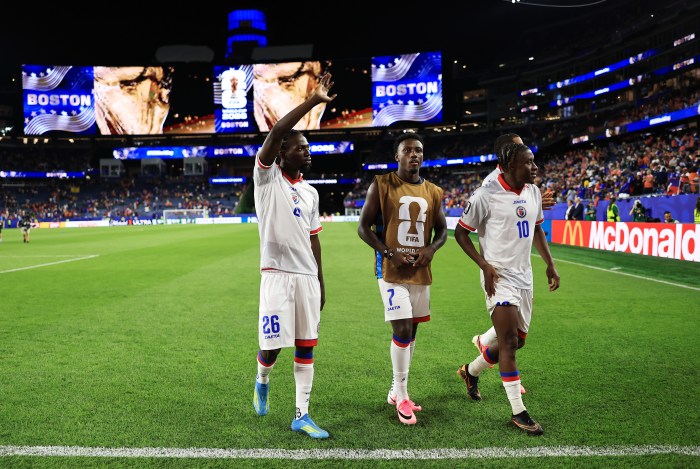
Brazil didn’t let Haiti do anything, and it quickly became apparent the Grenadiers were out of their depth. With the 3-0 loss, Haiti became the first country mathematically eliminated from advancing to the World Cup’s round of 32.
Haiti’s first World Cup experience since 1974 will end Wednesday evening against Morocco, but for Tamikha, the sting of the Brazil loss is softened by the pride of qualifying.
“It was disappointing; it was not the outcomes I wanted or expected,” she said. “But we’re happy to be here.”
For several smaller nations — especially four in particular — that “glad to be here” sentiment defines the World Cup experience.
Buda Mendes/Getty Images
While perennial soccer powerhouses such as Spain, France, Argentina, England and Germany enter the tournament with a goal of adding to their World Cup championship tallies, smaller nations celebrate the victory of simply having qualified.
FIFA expanded the field from 32 to 48 nations for this year’s tournament, the first expansion since 1998, when it grew from 24 to 32. The latest expansion allowed Cape Verde, Curacao, Jordan and Uzbekistan to make their first World Cup appearance.
Critics of expansion argued that the inclusion of nations such as those diluted the quality of the field.
Cape Verde, the smallest nation to qualify for the World Cup, turned that argument on its head.
By achieving a massive 0-0 draw against powerhouse Spain, then earning a 2-2 draw against Uruguay, the Blue Sharks have become World Cup Cinderellas. A victory over Saudi Arabia on Friday would secure Cape Verde a berth in the round of 32; a third draw might be enough to move on, too, depending on what happens in other groups.
Achieving results like these were a far-fetched aspirational dream last October, when Cape Verde qualified for the World Cup. Even during a sendoff rally for the Blue Sharks in Pawtucket, Rhode Island, two weeks ago, fans and supporters expressed the unabated joy of being invited to the World Cup party.
“It’s the first time for us,” Elizabeth Moreira, the city of Pawtucket’s deputy director of administration, told me at the time. “It’s a huge moment for Cape Verdeans all around the world.”
While the underdog story is universally endearing, one of the more baffling variations of the archetype is that the United States is something of a World Cup Cinderella, too.
The U.S. is arguably the world’s greatest economic and military power, but the men’s national team has been a marginal player when it comes to competing in the world’s most popular sport. Why? This is not a new question but a persistent issue that speaks to access, economic barriers, class and priorities that puts the United States at odds with the rest of the world when it comes to soccer.
Before the Haiti-Brazil match, I spoke with Philadelphia-based filmmaker Akbar Majeed, whose new documentary, “Can We Kick It,” takes a deep and often uncomfortable dive into soccer access and development in the United States.
For Majeed, the primary issue is breaking into a system that puts a steep price tag on access.
“It has to do with the pay-to-play model here in the United States,” he said. “It’s really about access. I think the sport was set up in a way to make money on the front end. Soccer is the most accessible sport in the world; it’s the common man sport. Here, the barrier to entry is the resources.”
In the United States, the pay-to-play-model in youth soccer refers to a system in which families pay thousands of dollars annually in club fees, travel expenses, tournament costs, uniforms and training fees so their children can participate.
The model has become the dominant entryway to elite youth soccer in the U.S. In his film, Majeed points out that youth sports in the United States are roughly a $40 billion industry, and that soccer accounts for about 13% of that. That means youth soccer accounts for more than $5 billion annually.
Since 1994, when the United States hosted its last men’s World Cup and triggered a relative soccer explosion here, growth has been fueled in large part by suburban participation, club teams, travel leagues, private coaching and showcase tournaments.
The issue is not how much money the sport generates but who can afford to participate and, secondarily, where and how athletes are developed.
Frederic J. BROWN / AFP via Getty Images
A look at the recent NBA and NFL drafts illustrates how basketball and football have a well-developed U.S.-centric pipeline. Even as basketball becomes more global, the vast majority of the sport’s players come from and are developed in the United States, thanks to a sprawling pipeline that includes schools and clubs.
Majeed grew up in Charlotte, North Carolina, and began playing soccer when he was 10 years old. The sport was never free.
“I started on rec league, $20 to play, then you get identified as somebody who has some speed, you get picked on the better teams, which is mostly white teams. Then it became more expensive,” he said.
Majeed stopped playing around the 11th grade, when he was injured and never got back into the sport. But he never lost his love for soccer.
After graduating from North Carolina A&T University, then earning a master’s degree in sociology at the University of Pennsylvania, he began to wonder why young athletes from inner-city communities who were drawn into the football-basketball pipeline as early as 7 and 8 years old could not be steered toward soccer.
“The pathway to basketball was junior high, which was free; high school, which was free; and if you were [good] enough, you got a scholarship into the top university, which then becomes free,” Akbar said. “So, you look from the grassroots all the way to the pros for those who had the talent, it’s free; and that’s very similar to soccer globally.”
As he traveled the world, Majeed saw firsthand that soccer was the world’s greatest grassroot sport. The more he saw, the more he wanted to produce a documentary about the barriers to developing a true grassroots system in the United States.
“Also seeing that there’s a void here [in the U.S.] in that space,” he said. “But the film really was about all the conversations that you hear us having within the Black soccer community, and the biggest one was, ‘What if our best athletes played?’ We know that’s code for those brothers and sisters that are playing basketball and football.”
Football and basketball have well-developed and long-standing conveyor belts, and they have pipelines that reach deep into the urban community. But that is not the entire story.
There is also a matter of institutional will on the part of the men’s soccer establishment in the United States.
That institution once upon a time didn’t seem to want soccer to look like American football and basketball, and it wanted to preserve soccer in the United States as a staunchly middle- and upper-middle-class sport.
“I don’t necessarily think it’s just the resources,” Majeed said. “I think it’s about, ‘Are you engaging — are you actually actively trying to be a powerhouse in soccer, like we want to be in everything else?’”
The U.S. men’s national team’s best result came in the inaugural World Cup in 1930, when it finished in third place. Our next great moment came 20 years later, when the U.S. upset England in a World Cup played in Uruguay.
After 1950, the United States failed to qualify for any World Cup from 1954-86. Though the 1972 passage of Title IX helped lay the groundwork for the U.S. women’s team to become the class of the world — we won the first women’s World Cup in 1991 and have added three more since, while no other country has more than two — soccer remained a niche sport behind football, baseball, basketball, and even hockey.
The U.S. men returned to the World Cup fold in 1990 and hosted the event in 1994. That triggered the commercial explosion that framed the current U.S. Soccer system.
The United States’ miracle run came in 2002 in South Korea and Japan. Led by players such as Landon Donovan, Claudio Reyna and Brian McBride, the U.S. reached the quarterfinals before losing 1-0 to eventual finalist Germany.
If the current team has unprecedented success, advocates of our pay-for-play system will feel validated. If Team USA fails to go farther than it has in the past, that failure likely will do nothing to change the lucrative pay-for-pay system.
Access to the sport is one major issue, but development — turning great young athletes into soccer players — is another issue.
“Development is a whole other layer, especially on the men’s side — even if you wanted to play, if you had the resources — because so many of our players are being developed overseas,” Majeed said. “There’s urban engagement, but that’s more about where the money is, where we can get nonprofit money to service kids but not really develop them to see how far they could go in the sport.”
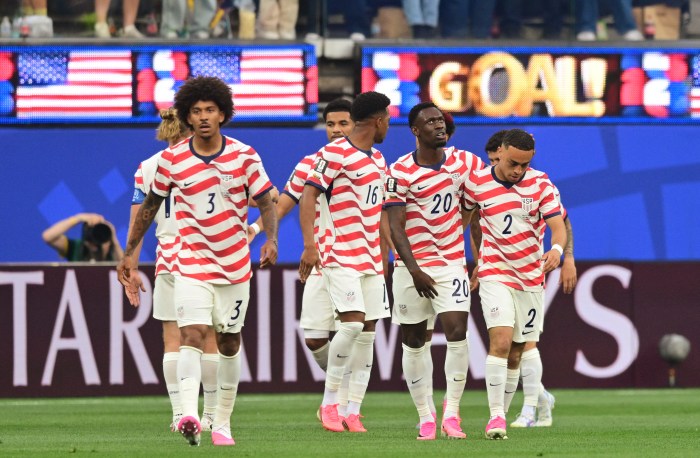
Much of the conversation around the current U.S. team focuses on its geographic, ethnic, and racial diversity. Majeed concedes that when it comes to a Black presence, this may be the United States’ most diverse team.
But there is a caveat. It’s a delicate conversation that involves economics and class divisions even within the Black community.
“I will say yes, it’s the most diverse team,” Majeed said. “There’s a lot of Black players on the team, and I think that’s good to see from optics. When we get into where those players grew up and where they were developed, that’s a totally different conversation.
“That’s the conversation that those in the soccer space are having. Access to everybody isn’t afforded here in the United States. It goes back to money, that barrier of entry just to get into this sport. That’s the conversation that I think will continue to happen after the World Cup leaves.”
So, as we continue to celebrate the World Cup’s smaller nations and first-time participants, we can also celebrate the United States’ rise as a tournament underdog.
Let’s just add the caveat that the United States is a gilded Cinderella.