
New Tuskegee soccer programs provide opportunity for athletes to compete while fulfilling HBCU dreams
University fields men’s and women’s soccer teams for the first time in its 145-year history

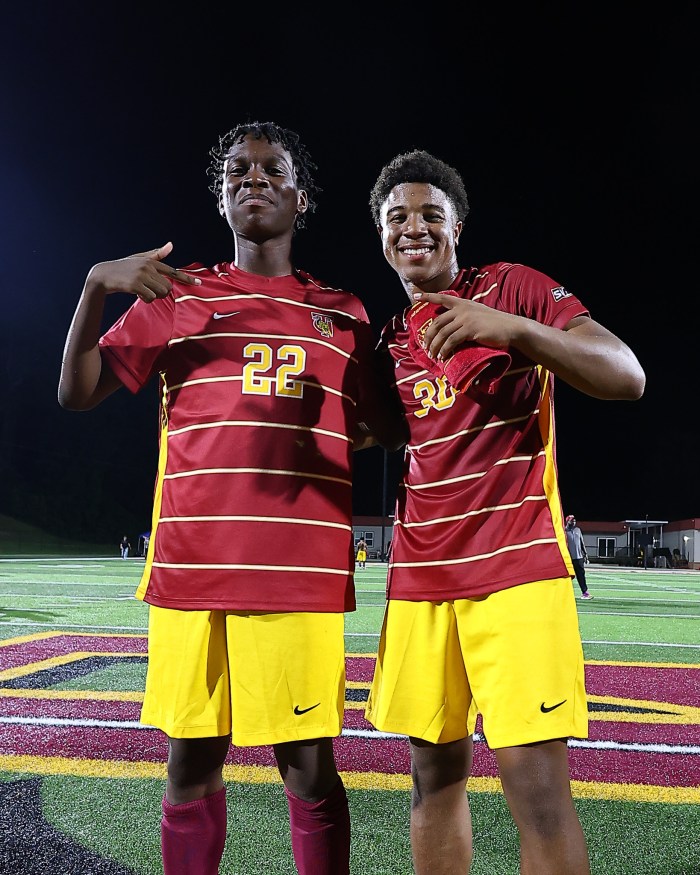
As red smoke filled the air after the inaugural match for Tuskegee University‘s new men’s soccer team, head coach Matthew Tarpley and his players signed photos, crimson-and-gold T-shirts and the game ball.
Though it was only an August scrimmage, for the team and the fans in attendance at the university’s Abbott Memorial Alumni Stadium, the historic moment — the launch of Tuskegee’s new soccer programs — warranted celebration.
For the first time in Tuskegee’s 145-year history, the university is fielding men’s and women’s soccer teams. There are now more than 30 historically Black colleges and universities (HBCUs) with women’s soccer programs and nearly 20 with men’s soccer programs.
For the next two seasons, Tuskegee’s teams will compete independently in the NCAA’s Division II, despite the HBCU being a member of the Southern Intercollegiate Athletic Conference (SIAC) for other sports. The Southwestern Athletic Conference and the HBCU Athletic Conference, formerly known as the Gulf Coast Athletic Conference, are currently the only two HBCU athletic conferences that offer women’s soccer.
SIAC commissioner Anthony Holloman said the goal is for the conference to add soccer as a championship sport by 2028.
“Tuskegee has always been a leader,” Holloman told Andscape. “They will be an example of how you do it right, and I expect them to come out of the gate being competitive. We’re looking forward to supporting them.”
Brian Egeston
During the summer of 2025, Tuskegee president Mark A. Brown presented the idea of adding men’s and women’s soccer to athletic director Reginald Ruffin and the board of trustees. In February, Tuskegee announced it had hired head coaches for both programs, and by the end of May, the coaches had finalized rosters and schedules.
“The World Cup this year really took this game to a whole new level, and I say the sky’s the limit,” Ruffin said. “You’ve got to recruit great students, retain great students, and then you’ve got to repeat the cycle because — don’t get it twisted — this is about enrollment.
“This is about giving students a chance to be part of a team, be part of a university, and to get an education.”
Just more than a month into their inaugural seasons, the men’s team has a record of 3-1-1, and the women’s team has a record of 2-3-1.
For the past few years, Tuskegee has had a club soccer team, which is not NCAA-affiliated. Sophomore Parrin Robinson is one of three players from the club team who made the roster for the new men’s program.
In December 2025, Robinson and his club teammates heard rumblings about the school’s plans to add soccer as a new varsity sport. After the university announced Tarpley’s hiring, Robinson emailed the new coach, seeking more details about the men’s program.
“I didn’t think I was going to play soccer after high school,” Robinson said. “I really thought I was done.”
Tarpley held open tryouts in April, and Robinson learned he had made the roster in May.
“I was jumping up and down, excited as ever,” Robinson said.
Helping start an athletic program was a new experience for Tarpley, who had previously coached high school soccer and worked as recruiting coordinator for Faulkner University’s soccer programs. However, for head women’s soccer coach Emanuel Stephens, this is familiar territory: Stephens helped establish Talladega College’s women’s soccer team in 2013.
“Starting a program is always a fun adventure,” Stephens said. “You’ll know that everything that you do this year will be ‘the first.’”
Before taking the job at Tuskegee, Stephens was the head coach at the University of Arkansas at Pine Bluff (UAPB) and Alabama A&M University (AAMU), Division I programs in the SWAC.
While Stephens was at UAPB, he recruited incoming freshman Brya Hudson to the Golden Lions’ women’s soccer program. Now, Hudson is playing for Tuskegee.
“One minute, we’re telling them how we’re going to build Pine Bluff and how things could be done there and be great, and then next thing I’m telling them, ‘Hey, listen, there’s this other school that is really good as well, and now we’re looking to build,’” Stephens said.
Hudson received offers from several schools across the country during her recruiting process. However, she wanted to play for an HBCU.
“I lived in predominantly white spaces most of my life, and playing soccer, there weren’t many Black people on the team,” Hudson said. “I just wanted to feel a lot more connected with people, and I felt like doing that [at an] HBCU would be the best bet.
“Honestly, I know we’re new, but I have the feeling that we have the potential to be something really great.”
While most members of the women’s team are new to college soccer, defender Morgan Dunham joined the Golden Tigers after playing her first two seasons at Alabama State.
The Alabama native entered the transfer portal in May, but by then many schools had already set their rosters, limiting her options. Then Stephens, whom Dunham had trained with during high school, presented the opportunity to play for him.
“A lot of times growing up, I felt like the odd one out — my hair is different, my skin color is different, my attitude is different — and I didn’t want to feel like that again,” Dunham said. “And so, I really was looking for a similar environment as far as an HBCU.”
With only a third of all HBCUs offering soccer programs, Atlanta filmwright Brian Egeston wanted to capture that unique experience. He is the driving force behind Unveiling History, a docuseries following the inaugural season of Tuskegee’s soccer programs.
“I want to show the world what would be a mashup of the World Cup and an HBCU homecoming,” Egeston said with a chuckle. “I just want people to see those two worlds collide.”
His son Zachary plays for the men’s team. When Egeston and his son went to Tuskegee during the spring on a recruiting visit, it sparked the idea for the docuseries, he said.
“We were just casually talking, and [Tarpley] said, ‘You know, this is going to be monumental. Somebody needs to document this,’” Egeston said. “At that point, I should have walked away. I should have just closed my mouth and went home, but I said, ‘Hey, Coach, I think what you really need is a Hard Knocks version of Tuskegee soccer.’ He said, ‘That’s exactly what I need.’”
Egeston, a Tennessee State alum whose work has been featured on Hulu and Amazon Prime Video, is working on the docuseries with executive producer Ryon Horne and his family-owned The Horne Brothers production company. They are filming everything from matches and practices to workouts, team meetings and classes.
“Hopefully with this docuseries, we show what Tuskegee did with soccer, how many eyes were on the program, how successful they were, how amazing these kids were and learn who they are on and off the pitch,” Egeston said. “At an HBCU, you have limited resources, but you have to have maximum results.”
For Zachary Egeston, continuing his soccer career at Tuskegee held an unexpected bonus: the chance to play alongside childhood friend Andrew Lewis.
“He’s in my baby book,” the younger Egeston said. “It’s wild, like, the chances of that happening is actually crazy, about slim to none.”
BL Harewood
They did not know they were both headed to the same university until Brian Egeston stumbled across Lewis’ commitment graphic on Facebook.
“I have a picture of me sitting with Andrew on one knee and Zach on the other knee when they were babies,” Brian Egeston said. “There’s no way that these two kids, who met 18 years ago, are reunited through a sport they love.”
Lewis initially planned to join Tuskegee’s club soccer team or participate in intramural sports before learning the school would add men’s and women’s soccer programs.
“I wanted to be a part of the Tuskegee Airmen legacy, so I was already committed to Tuskegee for aviation,” Lewis said. “Seeing that they had a soccer program just really reinforced my decision.”
The old friends’ story is one of the many threads the docuseries will follow. Every student-athlete will appear on camera at least once, and player-generated content will be posted on the Unveiling History Instagram account throughout the season. The release date for the docuseries has not yet been finalized.
“I’m excited to enlighten people about what it’s like being on an HBCU campus, that community, that support behind you, as well as the hiccups, the ups and downs we’re going to go through as a team and how we’re going to get past them,” Lewis said.
Both Tarpley and Stephens were tasked with carefully crafting their respective team’s schedules, which include a mix of Division II, Division III, National Association of Intercollegiate Athletics (NAIA) and junior college opponents.
Before Albany State discontinued its women’s soccer program in June, Tuskegee initially was scheduled to play the Golden Rams twice this season. Ultimately, both Tarpley and Stephens want to influence others to bring the sport to more HBCUs.
“You take the SIAC — we just lost Albany State, which hurts, so that’s another HBCU program that’s not there,” Stephens said. “We’re trying to continue to give players of color an opportunity to play college soccer in environments where they can be themselves.”