
Somali athlete Samia Yusuf Omar died in her quest to better herself. A new podcast explores her story.
‘If we’re going to make opinions and policy about people who are migrating … we should get a better understanding of what they go through,’ journalist Teresa Krug says

ESPN’s new 30 for 30 podcast The Fastest Girl in Somalia tells the tragic story of Somali runner Samia Yusuf Omar.
At just 17 years old, Omar finished last in her 200-meter heat at the 2008 Summer Olympics in Beijing. Determined to improve, she traveled throughout northeast Africa and beyond to pursue her dream of winning big at the 2012 London Olympics, often facing great danger as she sought elite training that wasn’t available in her war-torn country.
Teresa Krug, who narrates the podcast, began chronicling Omar’s journey in 2010 as a freelance journalist. Along the way, Krug shared how Omar was cheered in Beijing after finishing well behind the pack — and how Omar was embarrassed, rejected the attention and vowed to return faster and stronger.
Omar left her family in her hometown of Mogadishu, Somalia, for Ethiopia, but once there, she realized she needed to do something even more drastic to secure the coaching she needed. She put all she had into finding greener pastures in Italy, traversing dangerous territory in Ethiopia, Sudan, South Sudan and Libya. Her dream ended along the way when she drowned in April 2012 at age 21 after the overcrowded boat she boarded ran out of fuel and sank in the Mediterranean Sea.
Fourteen years later, Krug packs first-hand accounts, archival audio and original reporting into five podcast episodes. Krug, who ran high school track and cross country in Heber Springs, Arkansas, hopes listeners gain a greater appreciation for the opportunities she and many Americans take for granted. She spoke with Andscape about the podcast and why she believes listeners can connect with Omar’s struggles.
This interview has been edited for length and clarity.
You answered an open call for story pitches in February 2024 and persuaded ESPN to tell Omar’s story with a 15-minute, in-person presentation. How?
There were people who were sitting there and wanted to listen to your idea. It wasn’t going to get buried in an inbox or be brushed off because you’re a nobody. That changed the game. I was able to tell the story that I wanted to tell, not in a 30-second soundbite. … I had done a PowerPoint, and then I hated the PowerPoint. I’m not a PowerPoint person. So then I just read the script, and at the end, there were four people sitting at these tables, and they were leaning in. I wasn’t expecting that.
Why do you still tell her story?
I just can’t shake it, I guess. I think her story is still relevant today. People are still leaving their home countries because of war, conflict. People are still going through Libya, which has terrible detention centers, and people are still going into the Mediterranean Sea and risking their lives on small boats. So the story of Samia is significant to me, but also, the things that she went through are still relevant, and I want more people to hear about that.
I wanted to show dignity for Samia’s life. I didn’t want her to be forgotten, and I wanted to help people hear what it was actually like. If we’re going to make opinions and policy about people who are migrating … we should at least get a better understanding of what they go through.
She faced tremendous hardships, such as her father being killed when she was a young teenager, trying to train during the Somali Civil War and trying to succeed at sports when participation by Muslim women was frowned upon. What was she like?
She was tough, which makes sense because she grew up in a tough environment. She didn’t trust easily, which is fair. I had to earn that trust from her. But she was incredibly loyal. She took care of the people that she loved in a very big way.
She was so inclusive. Even as a teenager and a young adult, even as she was still growing up herself, she was bringing people along with her. She was actively encouraging and recruiting other girls and women to play sports, to run, to play basketball, to play soccer. And she was doing this in places where girls were not only not encouraged to play sports, but it was dangerous.
She was the cool teenager, but she also had this maturity about her — it’s a combination that you don’t find very often.
What did she tell you about being on the track in Beijing?
I think she was a little overwhelmed, which I think is very understandable. I know that she loved representing Somalia. She was very passionate about her country. She was very passionate about where she came from. So being able to represent Somalia at the 2008 Beijing Olympics, especially during the opening ceremony — that was very precious to her. That was very important to her. She had a lot of pride with that.
Once she left Somalia, you stayed connected. Why?
I was more attached to her than I had realized. And the story changed from being a story of a young athlete living in Somalia to “athletes are having to leave Somalia for sports.” That was quite notable for me, so I wanted to tell that bigger story then as well.
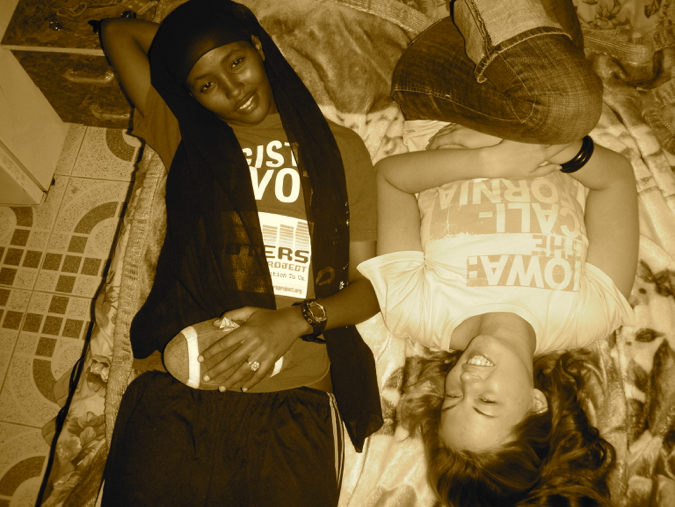
ESPN
You warned her not to go to Libya because of the detention centers. Some might question whether that was your role. What made you do it?
It was hard. When she made the decision to go to Libya … as a journalist, I was taught all these things about crossing lines and being objective. … I tried. And then other times, you see someone in need, you see how you can help them … to be just a bystander seems kind of cruel.
Why did you travel to the Mediterranean and talk to migrants after she died?
I had always wanted to revisit some of the places — or visit, I guess, for the first time some of the places that she had traveled through. It was something that was feasible and also a way that I thought that we could talk about what was happening today. Meeting with people who, in 2026, were telling very similar stories to what Samia had gone through — the torture that many people in Samia’s position experienced or these life-and-death decisions — that this is still happening today. So that was really important for me. Also, there was some closure that I realized that I kind of wanted, going to the place where she passed through.
What do you hope this podcast achieves?
I hope that it’s a story, it’s a podcast that people return to and that they share with other people. I hope that it’s a conversation starter. These are difficult topics. I hope that it’ll make people go down rabbit holes, you know? I hope that they will listen and something will grab them. And obviously, I hope they fall in love with Samia.