
Prince and his piano: 10 years later
A decade after his death, Prince’s final tour is still a reminder of what could have been.
Listen to this story
It was early spring 2016 and Justin Elliott was on the receiving end of a rather surprising request. Chris Gero, vice president and founder of Yamaha Entertainment Group, wanted to know if Elliott was interested in building a custom piano for a brilliant, new, obsessively punctilious client: music superstar Prince Rogers Nelson.
Since 2001, J. Elliott & Co. — owned by the Florida native and his wife, Jina — has overseen the technical production of pianos for such headliners as Alicia Keys, Paul McCartney, Elton John and Bruno Mars. But this request eclipsed them all.
At the time, Prince, 57, was headlining his buzzy Piano & a Microphone Tour. This was not the usual frenzied, song-and-dance, blistering guitar trek for the multihyphenated force of nature. The Piano & a Microphone gigs were intimate, vulnerable even — no Revolution or New Power Generation backing bands, just an artist and his instrument.
“I’m doing it to challenge myself, like tying one hand behind my back …” Prince said as he previewed his spontaneous, barebones concept to the Guardian in a November 2015 sit-down. “I won’t know what songs I’m going to do when I go on stage, I really won’t.”
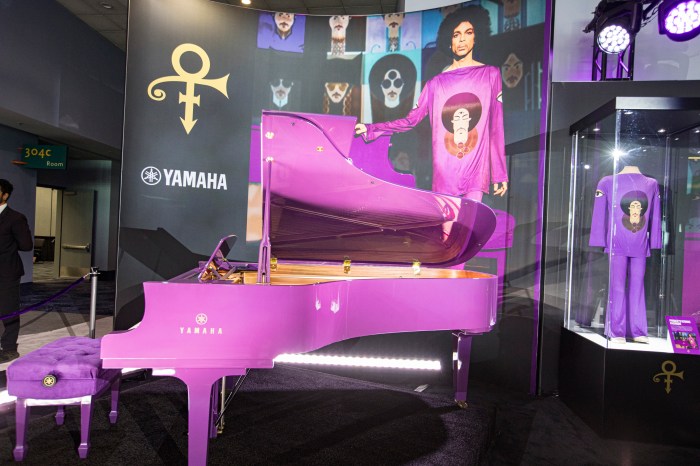
But first, Prince needed a piano with an extremely light touch, painted in his signature royal hue.
“We got into the Prince timeline, as I like to call it,” laughed Elliott, recalling the speed with which he was expected to build the sprawling, deep purple, 7-foot-6-inch-long Yamaha C7X-SH. Working on the instrument was treated like some clandestine spy mission.
“When it came to feel and tone, Prince envisioned a piano with plenty of quick, loose action,” Elliott said. “He would text his thoughts in all caps, and he didn’t have a cellphone. He would text from other people’s phone. You knew it was Prince when you saw the all-caps coming at you.”
The tour included a reimagined setlist of hits, deep album cuts and covers stripped down to their rawest essence. “I Wanna Be Your Lover,” “Dirty Mind,” “Controversy,” “Purple Rain,” “Kiss,” “The Ballad of Dorothy Parker;” Bob Marley and the Wailers’ “Waiting In Vain,” and A Charlie Brown Christmas’ “Linus and Lucy” were among the songs Prince performed.
The stage was a kaleidoscope dreamscape awash in pink and purple, and at times Prince’s voice was distorted as if he were engaging in some deep inner monologue.
Daniel Knighton/Getty Images
How meticulous was Prince? Before the tour began, he pointed out one of the couches at Paisley Park — the artist’s massive, legendary recording compound just outside his hometown of Minneapolis — and had his engineer cut off a piece of purple suede.
“This is the color I want,” Prince said about the piano.
Prince, however, never got the chance to play his new toy on the road. On April 21, 2016, the beloved musical visionary died from an accidental fentanyl overdose. Ten years after his tragic death, the Piano & a Microphone Tour remains an intriguing what-could-have-been that captured the man’s rich, complex legacy.
Prince only played 20 dates on the Piano & a Microphone Tour, but those hour-and-a-half performances unveiled a notoriously guarded musician at his most personal.
“I can’t play piano like my dad. How does Dad do that?” Prince said aloud during a warmup gig at Paisley Park in January 2016 of his complicated relationship with his late father, John L. Nelson, a professional jazz musician.
He spoke of the traumatic effect his parents’ divorce had on him as a 7-year-old child and how it drove him to obsessively immerse himself in music. Prince played the first song he ever learned on piano — the kitschy theme to the 1960s Batman TV series.
The Piano & a Microphone shows were one-part testimonial, one-part autobiographical one-man show. During a performance of the 1985 hit “Raspberry Beret,” he gave a warm shoutout to former Revolution keyboardist Lisa Coleman for writing its infectious, earworm groove (“This part right here, it’s too funky,” he said).
The day after the death of Denise “Vanity” Matthews-Smith, front woman of his risqué girl group Vanity 6, an emotional Prince turned the tour’s official Feb. 16 opener in Melbourne, Australia, into a full-blown tribute to his former muse.
“I just found out a little while ago that someone dear to us has passed away, so I’m gonna dedicate this song to her,” Prince shared, before gently easing into a slowed-down, heartfelt version of “Little Red Corvette,” later adding, “She loved me for the artist I was. I loved her for the artist she was trying to be.”
In early March 2016, Prince attended an NBA showdown between the Oklahoma City Thunder and Golden State Warriors the day before performing at Oracle Arena in Oakland, Calif. And in what would be Prince’s final concert on April 14, 2016, at Atlanta’s Fox Theatre, he transformed the beloved 1982 B-side “How Come You Don’t Call Me Anymore” into a joyous sing-along.
For Prince, who was known more as a blistering guitar god than as an elite pianist, reclaiming the foundational instrument on which he wrote his very first song on as a kid was paramount. Here was a serious player who, during the early ‘90s Diamonds and Pearls Tour, insisted his penthouse hotel included a grand piano.
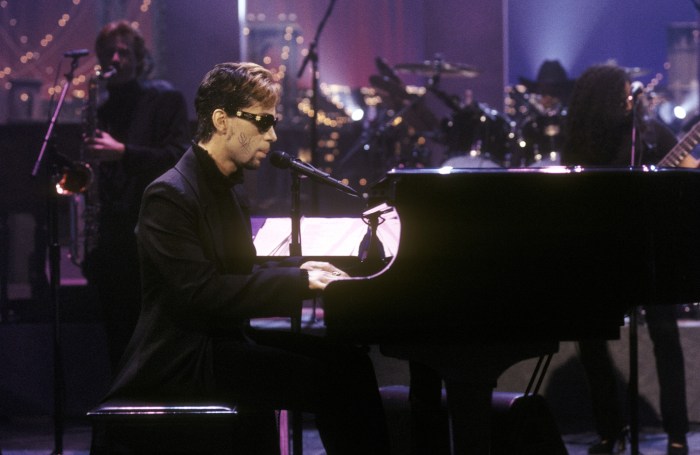
“I think the Piano & a Microphone shows were Prince’s way of letting people know that the piano wasn’t just a prop he dabbled on,” recalled Morris Hayes, keyboardist, producer and former member of the New Power Generation. He holds the longest tenure of any member of Prince’s band, serving from 1993 to 2012.
Hayes gets choked up when the interview turns to the two men’s last meeting in 2014.
“I’ve watched Prince sit there and do concerts like he was Liberace,” Hayes said, referring to the world-renowned 20th-century pianist.
Alan Singer/CBS via Getty Images
Hayes said his old boss was always in show-and-prove mode, especially after legendary producer Quincy Jones dismissed Prince as an “OK piano player” in the 1991 documentary The Prince of Paisley Park.
“Quincy’s comments kind of miffed Prince as someone who had written great songs and major hits on the piano like ‘Purple Rain,’ ‘Venus de Milo,’ ‘Sometimes It Snows in April,’ and ‘Nothing Compares 2 U,'” Hayes said. “He and Q would go back and forth for years. Quincy played with Miles [Davis] and all the jazz greats. He was a true great who was entitled to his opinion, but Prince deserved more respect.”
While Prince had a reputation as someone who was not particularly known for looking back, the Piano & a Microphone Tour was indicative of a time he openly embraced sentimentality. Before he died, he was writing his memoir, The Beautiful Ones, posthumously released in 2019.
Prince called his Purple Rain co-star Apollonia Kotero out of the blue in 2014 to tell her how happy he was that he got the rights to his music back.
He flew estranged Revolution bassist BrownMark to Minneapolis, where the two talked about forming a new band.
Prince reunited with old friend and collaborator Morris Day at a Paisley Park concert in January 2016. He told Day, the leader of his old protégé funk band the Time, of his plans to take the group overseas with him on tour.
After his death, Prince was credited for quietly donating millions to a plethora of charities over the decades, and he anonymously paid the hospital bills of old cohorts. It was as if the artist who was staring down his mortality was telling the world that time was too short to hold on to petty grievances.
A decade later, Prince is still making his presence felt.
The majestic purple piano, the last instrument Prince reportedly played, sits on display at Paisley Park, where the annual Prince Celebration event is set from June 3 through the Purple One’s birthday on June 7. Chaka Khan, Bootsy Collins, Morris Day, Miguel, Jimmy Jam & Terry Lewis, Tevin Campbell and members of the Revolution and New Power Generation are some of the notables scheduled to appear.
Amid passionate debate over the Prince estate’s handling of his legendary vault of unreleased material, perhaps executives could quiet the noise by releasing the Piano & a Microphone shows in all their heart-grabbing, stripped-down glory. It doesn’t get any more Prince than that.
“I can recall watching him write this song ‘I Hate U’ on piano in the Studio C rehearsal room at Paisley Park” Hayes said. “I’m at the doorway witnessing him pick the notes out and finding the melody. After he finishes, I said, ‘Wow Prince, that was dope. … I just watched you make another million dollars.’ [Laughs.]
“I asked him, ‘How do you do that?’ And he said, ‘Well, Morris, I don’t understand how everyone else can’t do it.’”
Somewhere, Prince and Quincy are having a laugh.