
Morehouse and Spelman’s sibling exchange forges lasting bonds between freshmen men and women
The decades-old tradition has been one of the defining experiences of ‘SpelHouse’ life

ATLANTA — For students at Morehouse and Spelman, family doesn’t always share a last name. With SpelHouse, a trademarked nickname for the connection between both single-gender historically Black colleges, strangers can become siblings.
For more than 40 years, Morehouse and Spelman’s annual “sibling exchange” has paired incoming students across both schools, creating bonds that last long after the students leave the Atlanta University Center (AUC). While the official year of its inception is unknown, the tradition — now organized by the schools’ student government associations (SGA) and orientation leaders — has become one of the defining experiences of life in the SpelHouse community.
“It’s important that freshmen coming into the Morehouse community and the AUC community have one of their first memories with Spelman, because it provides that first layer of support that you eventually need to lean on, whether it be physically, spiritually, or emotionally,” Morehouse SGA president Christopher Lambry Jr. said. “That is what the sibling exchange has provided people for decades.”
Joshua Bass / Andscape
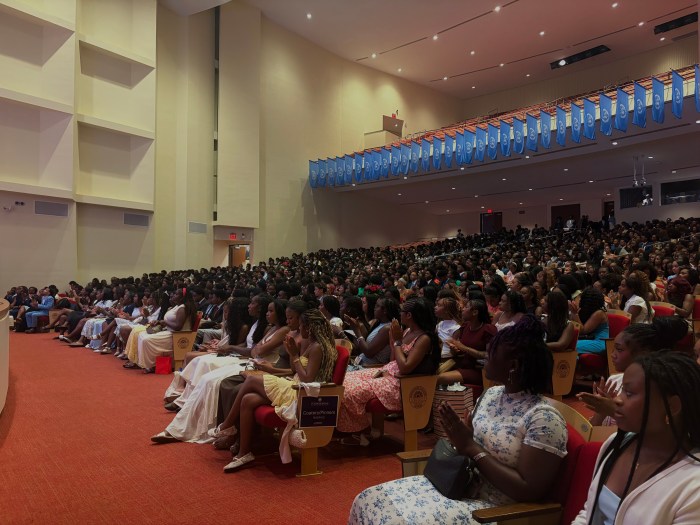
The exchange takes place during the early months of the fall semester each year. When the day arrives, students wearing their Sunday best form lines on the campuses of Spelman and Morehouse and head toward Morehouse’s King Chapel. Inside the sanctuary, the seating arrangement is deliberate: Morehouse freshmen fill the first row, Spelman freshmen the second, and so on, alternating row after row.
After everyone is seated, upperclassmen walk freshmen through what it means to have a Morehouse or Spelman “sibling.” Previously established pairs of siblings share stories about when they met, how their relationships have evolved and why the tradition has remained a fixture of SpelHouse life.
Then, the fun begins.
Spelman students form a line along one side of the sanctuary, while Morehouse students line up on the opposite side. Then the students walk out into the chapel’s lobby, one by one, and then walk toward each other. When they cross paths in the middle of the lobby, the person standing across from them becomes their sibling.
Derrick Brooms, executive director of Morehouse’s Black Men’s Research Institute, studies the experiences of Black men and boys in education. He said the beginning of college presents critical opportunities for students to build relationships with their peers.
“We know that one of the things that impacts Black students, college experiences, and Black men, in particular, is feelings of isolation and loneliness, and it looks different across institutions,” Brooms said. “And so if I’ve got a Spelman sister, it becomes, ‘Hey, let’s go to this event at MLK Chapel together,’ and part of that is, ‘I’m going with somebody, so I’m not by myself.’”
Those ideas come to life in the stories of the SpelHouse siblings who have experienced the tradition.
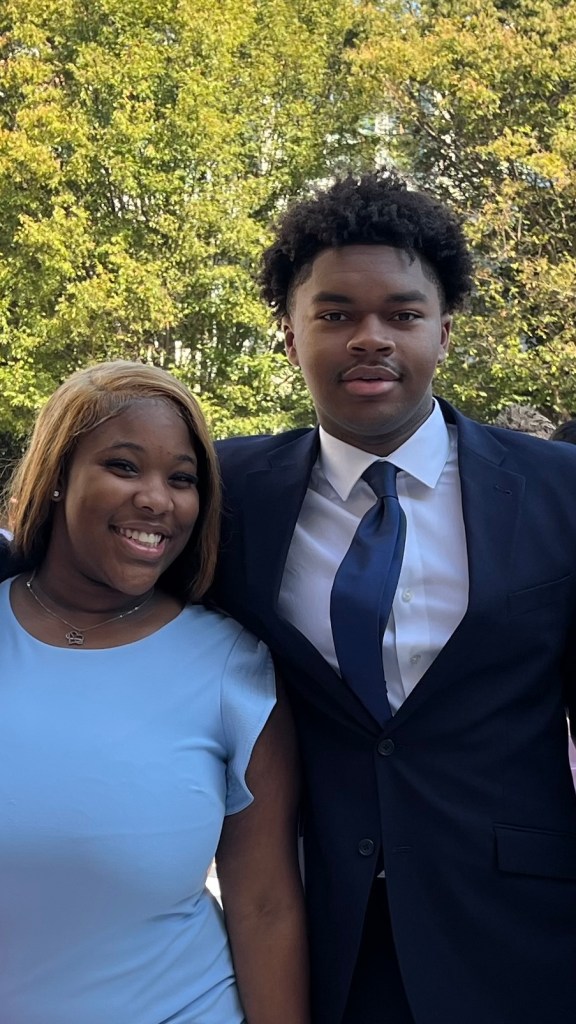
Amya Talley and Andrew Branch
Courtesy of Andrew Branch
When Amya Talley and Andrew Branch first met during the sibling exchange in 2023, they had one thing in common: Neither knew what to expect.
“I remember being very nervous, because I’m a nervous person,” Talley, now a senior at Spelman, said with a chuckle.
Branch, a senior at Morehouse, said he initially shared the same nerves. However, as an only child, he also looked forward to the sibling exchange as a chance to develop a true friendship and hoped he wouldn’t be matched with a person he “didn’t click with.”
“But I feel like me and my Spelman sister could be actual siblings,” Branch said. “It started off with game nights and just hanging out, and that’s when we got a lot closer.”
For some, the exchange can feel like just another piece of the new student orientation week, but Branch and Talley both said they felt more like family heading into their sophomore year.
Since meeting, the duo has supported each other at every turn.
“I had my regional step show performance and Drew came out, and he didn’t have to come and support me, but he did,” Talley said. “And it’s every event from that, he’s been there to support me.”
Talley, who has a younger sister, said she and Branch share a different sibling dynamic.
“With my younger sister, there’s things that I can talk to her about. But then with Drew, because we’re closer in age, we can relate to each other on a mental level, and we can have deeper conversations.” Talley said.
Branch said he learned how the sibling exchange experience allows students to have a village.
“I see how it turns into actual siblinghood. You actually learn, trust, and depend on this person.” Branch said. “So for me, it was like I gained another family member outside of my family.”
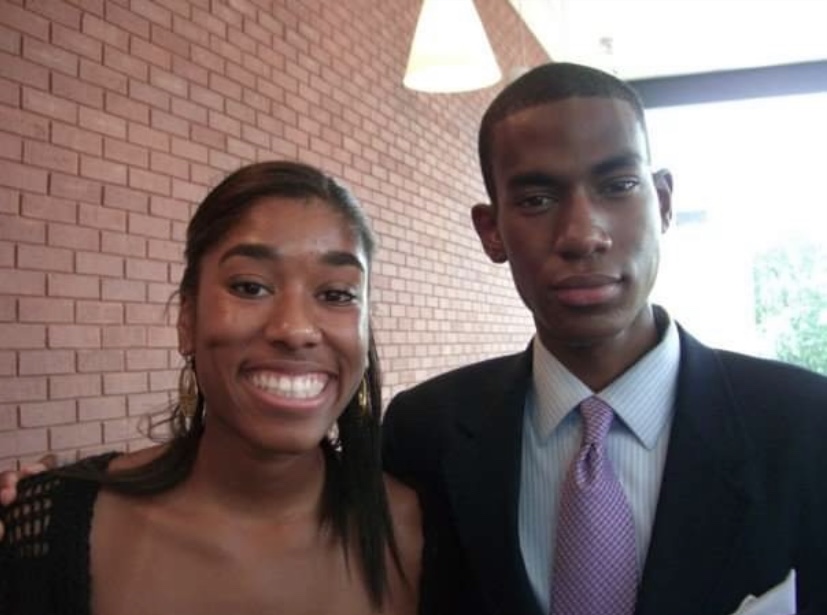
Lauren Sills and Dominic Jones
Courtesy of Dominic Jones
When Spelman alumna Lauren Sills first saw her Morehouse sibling, Dominic Jones, in 2006, he made an immediate impression.
“I see this young man [Jones] with a navy blazer, and I switched with one of my dear friends so I could line up ultimately with Dominic,” she said. “We immediately clicked because we both had these East Coast roots. He’s originally from New Jersey and I’m from Delaware, but we really grew up in the South.”
Because of their similarities, the conversation flowed easily as they discussed their respective upbringings and sports they enjoyed.
Jones said when they met, he felt fortunate to have Sills by his side. A fourth-generation Spelman student, Sills understood the HBCU sibling experience on a deeper level than he did, he said.
“I’m someone who really likes tradition, and so I came into it with an open mind,” Jones said.
Having seen how HBCU sibling culture led to close, long-term friendships for generations before her, Sills had an understanding of what SpelHouse could offer.
“I have really dear folks and family friends in my life that are from our institutions, so I knew that relationship is just really key to success there,” Sills said.
Two decades after they met, the Class of 2010 alums are still best friends.
“When we say Day 1, like, this is Day 1,” Sills said. “I truly think of him as my blood brother. I am very close to him, his wife, his family. And my sisters call him ‘brother.’”
Jones, who once cheered for Sills during her volleyball games at Spelman, said she has become one of his biggest cheerleaders.
“I feel like Lauren is always sort of yelling from the metaphorical bleachers,” Jones said.
He said Sills also was present for one of the most significant moments of his adult life.
“When I proposed to my wife, I made sure that Lauren was there as well,” Jones said. “All of the major milestones throughout our lives, I want Lauren to be there.”
Both Jones and Sills said HBCUs in general value relationships and understand the significance of fostering a community.
“The exchange really is a reflection of that connection and wanting to ensure that, yes, you were leaving with a valuable education but you also are leaving with an incredibly close network that cares for you,” Sills said. “We are really embodying the [concept of] ‘lift as we climb.’”
For Jones, continuing to build on these established relationships can provide support and needed opportunities.
“I think the world can be hard on people of color, and I think the communities that you build and develop in the AUC can really be a lifeline, support system, a professional network and a sea of individuals who have that shared experience,” Jones said.
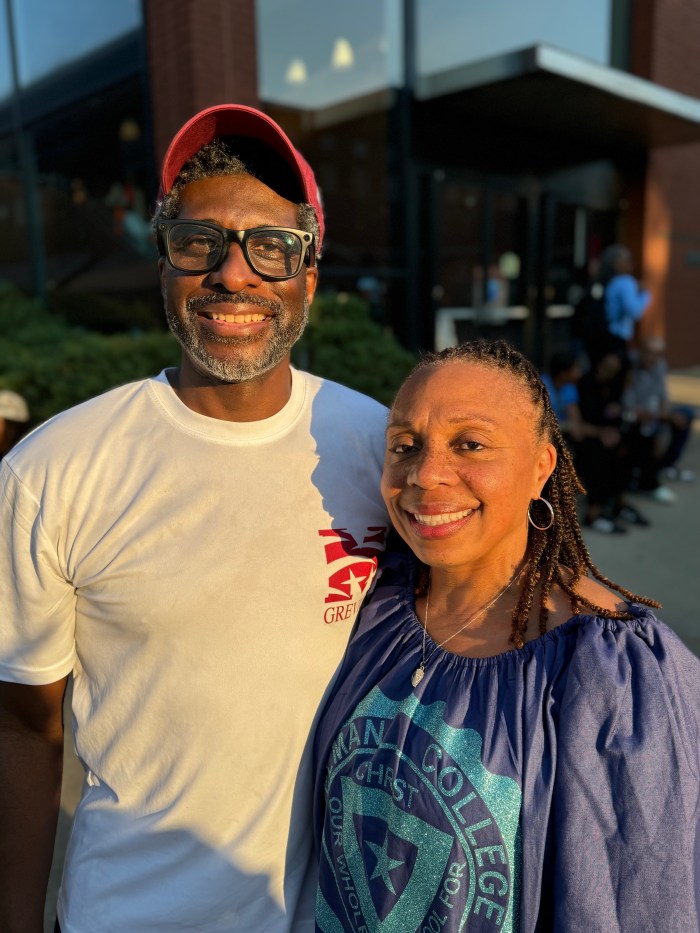
Dr. Mark Grevious and Crystal Hicks
Courtesy of Dr. Mark Grevious
When Dr. Mark Grevious and Crystal Hicks met during their sibling exchange in 1985, neither of them realized the introduction would lead to a friendship that has endured long after graduation.
“I honestly do feel like she’s my sister. … I certainly don’t have that relationship with any other Spelmanite,” Grevious said.
Grevious remembers the women and men lining up during orientation and pairing off. Rather than trying to position himself to pair with a particular woman, he stayed in line and trusted he would meet the person he was supposed to in the process.
That person was Hicks, a Spelman student from Dalton, Georgia, whose soft voice and Southern accent caught Grevious’ attention. They exchanged contact information and began a friendship that has lasted for four decades.
“Whenever we’re with each other, it’s just peaceful,” he said.
After graduating in 1989, they stayed in touch, exchanging birthday and holiday greetings and reconnecting at homecoming.
“The bond in many ways has gotten stronger since we graduated, and I’m very appreciative of having Mark as my Morehouse brother,” Hicks said.
Their friendship also has found a place in their professional lives. Hicks is a teacher, and Grevious has spoken to Hicks’ students about the medical industry. He also has helped Hicks set up and break down her classrooms. Hicks, in turn, has donated to and supported fundraisers Grevious has participated in both inside and outside of his work as a physician.
“There’s some relationships that you wish you never had, and then there’s some relationships that you covet,” Grevious said. “I covet this relationship.”
Now, their connection may extend to another generation of SpelHouse students. Grevious’ son is now a freshman at Morehouse, and Hicks’ niece is a freshman at Spelman. Grevious and Hicks want to introduce the two and hope that the same connection they had as students can develop within the new class of freshmen — and within their own families in particular.
“I’m so excited to serve as a SpelHouse auntie to Mark’s son this year,” Hicks said.
For Hicks, the value of the tradition lies in what students can learn from someone whose experiences may differ from their own.
“To understand that there are people around you, yet they are looking at the world differently, can be impactful,” Hicks said. “Having a brother to be able to have those conversations with really can make a big difference if you invest in it upfront.”