
Why Lane Kiffin’s ‘Ole Miss’ virtue signaling falls flat
LSU head football coach’s comments insulted everyone

A line from the May 11 profile of Lane Kiffin in Vanity Fair reads as such: “After four hours of talking with Kiffin, I’m stumped: Is he endearingly sincere or so full of s‑‑‑ that it’s an art form?” It’s important to note that characterization as you understand what came next.
The college football coach, who suddenly and quite disgracefully left the University of Mississippi to become head coach of Louisiana State University in November 2025, said in the article that the racist iconography of Mississippi’s flagship university made it difficult to recruit Black students to the school.
According to Kiffin, potential recruits would say, “Hey, Coach, we really like you. But my grandparents aren’t letting me move to Oxford, Mississippi.”
Kiffin’s comments place at least some of the blame for his move on the lack of diversity at “Ole Miss” (this is the last time I’ll use that name, by the way, as its origins are related to slavery as well), but his claims ring hollow.
His actions before and since taking the University of Mississippi job haven’t shown any care about diversity, or that the lack thereof in Oxford bothered him. Instead, this just looks like virtue signaling to justify his controversial move to Baton Rouge, which is insulting to people actually affected by what the University of Mississippi represents.
I grew up in Jackson, Miss., three hours south of Oxford. I understand something that not enough people know, but would if they bothered to visit a state with some of the richest history and cultural contributions of any in the country: There’s Mississippi, and then there’s the University of Mississippi.
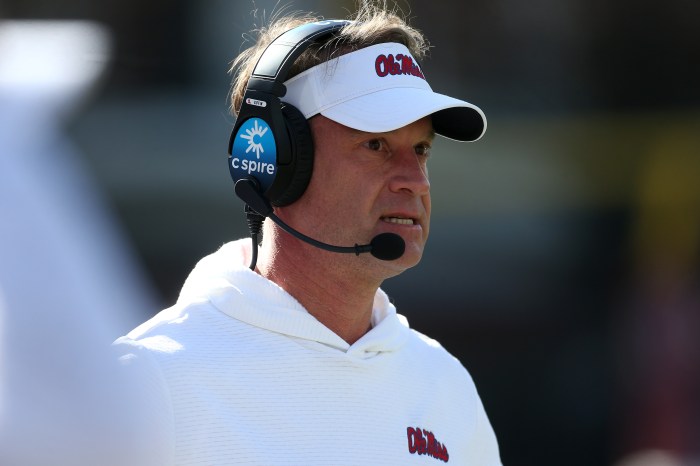
Petre Thomas-Imagn Images
I drove all around Mississippi at all times of day and night. I only ever feared being around the University of Mississippi. The fervor for the Confederacy, the flags and history disgusted me as much as the idea of the Confederacy itself.
A couple of years ago, I was invited to the University of Mississippi along with my dad to do a book talk. The way to get to Oxford from Atlanta is to fly to Memphis and take the short drive down. My dad, who has also, of course, been all around the Deep South, was also shaken up by the nighttime ride to one of the most terrifying areas of Mississippi during the Civil Rights Movement.
To be raised in Mississippi is to know that the culture at Oxford has historically been deeply anti-Black. How else can one describe a school that waved Confederate flags around during games until the late 1990s? Or a school whose mascot was a Confederate soldier and plantation owner — Colonel Reb — until 2003?
So to that end, I have no reason to believe Kiffin is manufacturing any stories about Black recruits and their relationship to the University of Mississippi. After all, their grandparents remember the violence, the National Guard and terror inflicted on James Meredith in 1962 for daring to be the first Black student on campus.
The problem with Kiffin’s comments, though, comes from the timing.
The University of Mississippi’s history has always been there. It was there when he took the job. It was there when he coached at Tennessee and Alabama and went to Oxford to play against the school for years.
Kiffin’s relative silence about the school while he was its head football coach is even louder, given his recent statements about how much it impacted his recruiting. It would also have been beneficial to understand if this history bothered him on a personal level, as it should bother anyone as a human being.
The silence during his tenure as coach and his use of the University of Mississippi’s history to justify his move to LSU after the fact are shameful. But now that Kiffin has planted his flag in a discussion about racial reconciliation and Southern history, he simply has no choice but to follow up with tangible action.
He should start at his own school.
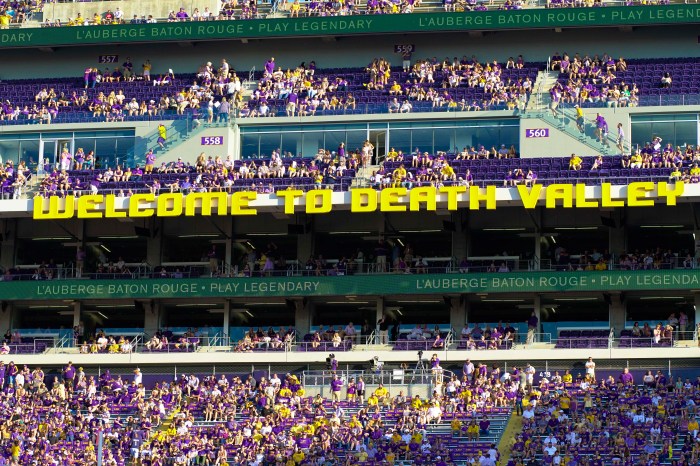
Andy Altenburger/Icon Sportswire via Getty Images
If Kiffin is going to argue that the racial climate of a state directly impacts his ability to recruit Black athletes, then that standard doesn’t stop at the Mississippi state line.
As he probably knows, Louisiana is ground zero for last month’s Supreme Court ruling that essentially gutted the Voting Rights Act of 1965. The state is currently working to eradicate Black representation from its congressional delegation. At the same time, there’s a groundswell movement calling for Black athletes to avoid SEC schools because of the potential demolition of the Voting Rights Act.
If Kiffin is so concerned with recruits being turned off by the anti-Black nature of a state’s politics, he might want to hurry up and use his power to effect change. He may want to say something about preserving everyone’s right to equal representation.
Since the Vanity Fair article was published, Kiffin has apologized.
“I really apologize if anybody at Ole Miss or in Mississippi was offended by that,” Kiffin said. “In a four-hour interview, I was asked a lot of questions on a lot of things, and Ole Miss has been wonderful to me and to my family. I was asked questions about the differences in recruiting, and I said a narrative that we battled there from some out-of-state Black parents and grandparents was not wanting their kid to move to Mississippi. That’s a narrative that coaches have been fighting forever. It wasn’t calculated by bringing it up.”
Either way, there’s no real going back for Kiffin. Either he cares or he doesn’t, and his time in Baton Rouge will put that to the test. He doesn’t get to discover his conscience on the way out the door.
That is, unless he’s not actually concerned with the way history and politics impact his recruits and only uses it as a way to smooth over how he has been perceived since leaving Mississippi.
That would be as slimy as his departure was to begin with.