
At Yankee Stadium, JAŸ-Z leaves no reasonable doubt
Three nights, 45,000 fans at a time, and a finale that stretched into Monday morning turned Yankee Stadium into a celebration of JAŸ-Z’s place in New York history

Listen to this story
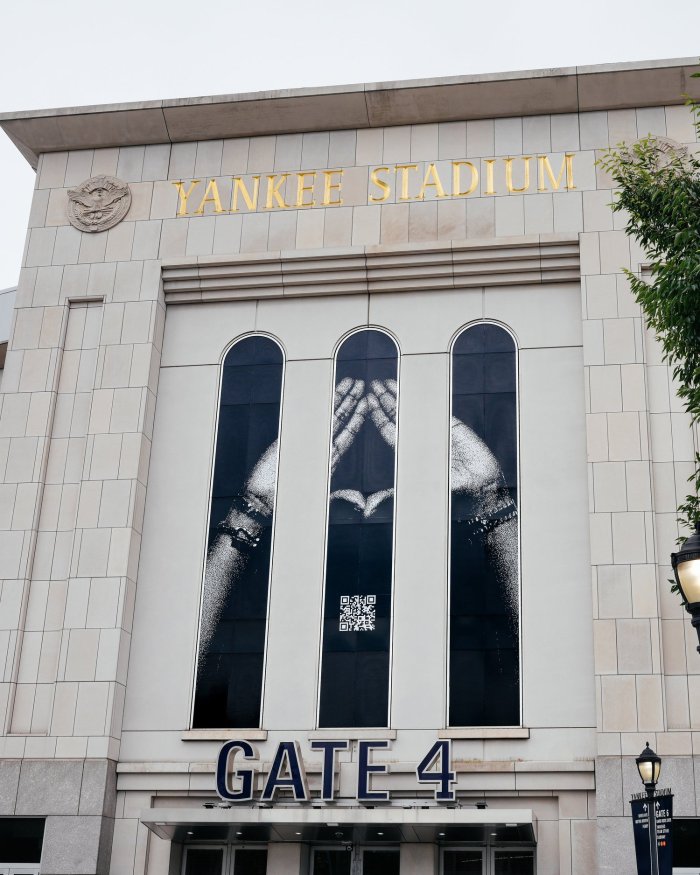
Gate 4 at Yankee Stadium, for at least one July weekend, was the entrance to the world’s largest living, breathing time machine. The credit landed with the man who once claimed he made the Yankee hat “more famous than a Yankee can.”
JAŸ-Z’s trifecta of shows — honoring his cultural-defining albums Reasonable Doubt and The Blueprint while essentially acting as a “Hov & Friends” night — tapped into the very pulse of the city that has been central to his story for more than 30 years.
The last of those nights came with chaos and uncertainty. More than 10,000 fans reportedly waited outside for hours. Some rushed the door. The Sunday show didn’t begin until Monday morning.
Perhaps it was fitting in a sense. Yankee Stadium hosts legends. Crowning them is a different story — and you’re going to have to survive moments of self-doubt to find the immortality Yankee Stadium can offer. Boxer Muhammad Ali came to understand this lesson in harsher settings 50 years ago.
By the time the sun arose over New York City on Monday morning, JAŸ-Z had learned it, too.
Roc Nation
“JAŸ-Z concert, huh?” the Uber driver, Kim — a 50-something Asian man who’s called New York City home since the turn of the century — asks rhetorically late Saturday afternoon.
“’[H to the] Izzo’ is the first rap song I remember hearing after moving here. I didn’t know he was still working!” Kim says with a laugh.
The last thing you hear before closing the door is Kim telling you, “Enjoy yourself!” When you turn around, the energy outside Gate 4 hits you in the chest like a summer heat wave (which, thankfully, isn’t literally the case). With the actual Bronx Bombers out for a weekend road trip to D.C. to play the Washington Nationals, another New York titan played the field in their stead. The intensity is reminiscent of October baseball. But it looks and feels like 2001.
JAŸ-Z-themed shirts — official and bootleg JAŸ-Z jerseys. Timberland boots as far as the eye can see. Jean shorts and Daisy Dukes cutoffs. North Carolina blue jersey dresses. Water bottles that absolutely don’t have water in them.
It’s high school reunions. College reunions. Those who moved away from New York came back for this moment. Outside the stadium, JAŸ’s voice lives in tandem with the weed smoke enveloping East 161st Street. There lives a mini-universe dedicated to him. Before the second night of his three shows, the strip is vibrant. A healthy line waits to visit the JAŸ-Z30 pop-up. Most politick at bars, buying rounds and rapping to whichever song is within earshot.
This is New York. The classics don’t always live on the radio. They reverberate from the concrete.
I’m a monster, I sleep whole winters/ Wake up and spit summers, hundreds rap JAŸ’s opening lines from DMX’s 1998 classic “Blackout.” Ghetto n‑‑‑‑, puttin’ up Will Smith numbers.
One could confuse it for a church revival. Replace the communion wine with D’usse, Maker’s Mark, or tequila. Replace the sage with sativa — and it’s still spiritual. But in this city? To a certain generation and crowd, Sinatra is the ultimate composer of New York life, hustle, glamour, heartbreak and success. To others, particularly those seen here, it’s JAŸ-Z.
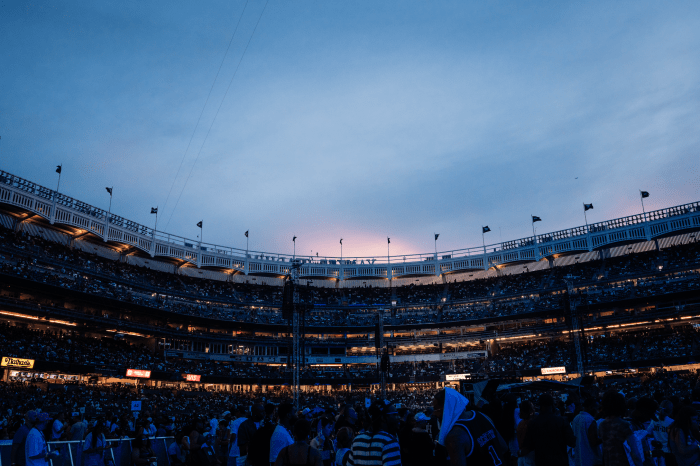
Amid the beautiful chaos that is NYC before a JAŸ-Z show, the magnitude of the moment becomes clear. Performing in Yankee Stadium as a non-Yankee is rare. Affectionately called “The Cathedral,” this couldn’t have been the prevailing thought of anyone in attendance.
Not even JAŸ-Z.
Nearly 50 years ago, another Black icon walked into Yankee Stadium. Muhammad Ali retained his heavyweight title in a brutal 15-round battle against Ken Norton.
What he couldn’t manage was to leave Yankee Stadium free of doubt.
Roc Nation
It’s not as if JAŸ-Z has never played Yankee Stadium before. He and Alicia Keys performed “Empire State of Mind” before Game 2 of the 2009 World Series — the last Fall Classic the Bronx took home. He returned the following year for two shows alongside Eminem, and in 2013, he and Justin Timberlake played there as part of their “Legends of the Summer” tour.
This past weekend was different. The stakes were different. Three nights at Yankee Stadium as the headliner carry a far different historical weight. This was deeper than nostalgia. This was cultural inheritance.
The weekend’s significance was understood the moment Night 1 kicked off. Beyonce cutting JAŸ’s hair. Beyonce replacing Mary J. Blige on the hook to “Can’t Knock the Hustle.” Blue Ivy playing the piano on “Feelin’ It.” Yet another freestyle that sent the internet into a tizzy for mentioning former quarterback Colin Kaepernick’s alleged agreement with the NFL and his vinyl partnership with the retail behemoth Target. The moment with Nas on stage where the two New York wordsmiths, once the most bitter of enemies, played to a sold-out crowd (and even more streaming online) in awe.
Telling the story of New York City without the impact of Reasonable Doubt and Roc-A-Fella Records is culturally disingenuous. JAŸ handled Night 1 like a man who understood the weight of such an album, but more importantly, catered to a crowd that hung on every word of a work that took time to grow into the cult status it currently holds.
Night 2, celebrating the quarter-century anniversary of his 2001 heater, The Blueprint, brought on its share of critiques.
It wasn’t as long as Night 1. The energy wasn’t the same. All true in some regard.
But in the grand scheme, it was for the better, given the calamity that lay on the other side of the storm’s eye. Strings of shows such as these never maintain the same emotional DNA over the course of their run. Setlists change. Moods change. Crowds change. But Saturday was far more intimate.
With the show starting at exactly 9:11 p.m., JAŸ never shied away from the obvious. The album that cemented him as the superstar he already was and the icon he’d grow into is forever wed to its release date of Sept. 11, 2001, what he called, perhaps, the darkest day in New York history.
This was the beginning of his love letter to New York. It was a man, a microphone and 45,000 people, all of whom presumably held some sort of core memory of The Blueprint, including NBA star LeBron James, who appeared in the crowd moments before JAŸ took the stage.
JAŸ’s Bronx trifecta showed history comes in many forms beyond music. The aforementioned freestyle referenced Kaepernick, and almost immediately revived discussions that never truly disappeared. JAŸ’s partnership with the NFL, how it came to be, and the former San Francisco 49ers quarterback stand as a definitive chapter in his life and times.
Whether an actual settlement between Kaepernick and the NFL exists or not, the larger point matters more. As Ali showed a half-century ago, Black excellence and the politics that come with it don’t stop when a beat drops or a bell rings. But the show must, and did, go on.
Couples treated the concert as a date night they’d carry forever. Parents brought their kids. It was a family reunion that allowed loved ones to connect without much talking. JAŸ-Z would handle that part.
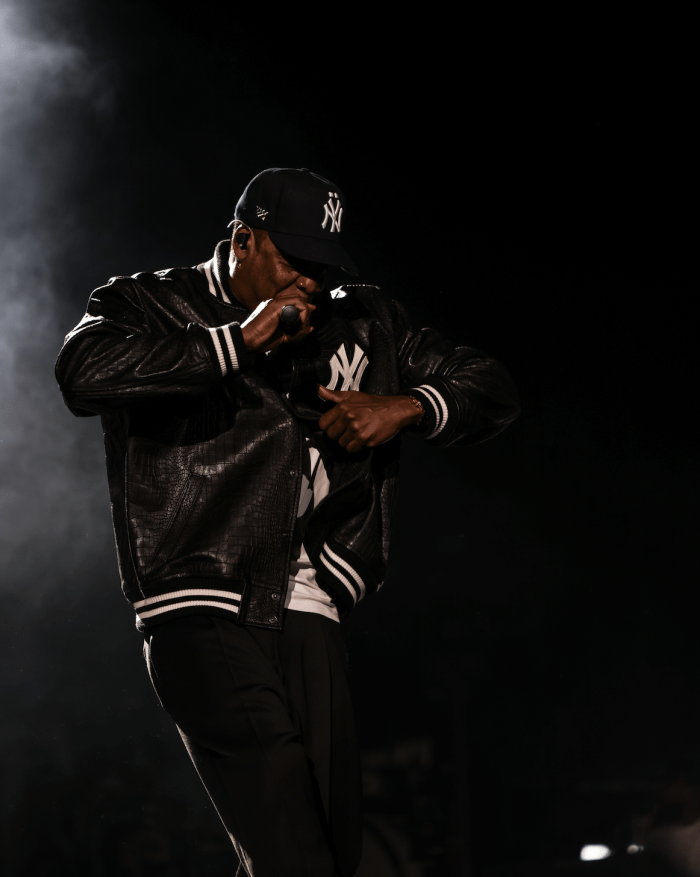
“See all these Yankees hats in here?” JAŸ playfully asked at one point.
Hearing records like “Heart of the City,” bringing Slick Rick out for “Ruler’s Back” and “Hola’ Hovito” inside Yankee Stadium was a flash point. Fans didn’t sing the records — they internalized them and sprayed them right back at JAŸ. Hip-hop photosynthesis, if you will.
A masterful blend of “Girls Girls Girls” and “03 Bonnie & Clyde,” capped off with Destiny’s Child’s “Girl” instrumental, was prolific and poetic.
Eminem’s appearance for “Renegade” and his solo performance of “Lose Yourself” literally shifted my seat. A woman with her infant daughter or niece in a carrier on her chest repeatedly steps into the aisle to dance, rap, and point to the sky. Hearing JAŸ rap Chains is cool to cop, but more important is lawyer fees is as biblical as a scripture.
“That’s the only line I wanted to hear this n‑‑‑‑ rap tonight,” a Brooklyn old head behind me says.
When I ask why?
“Because I wish I had known that when I was younger,” he said. “It would’ve saved me a lot of heartbreak. My family would look a lot different.”
Roc Nation
Revisit Ali-Norton III, held at the original Yankee Stadium on Sept. 28, 1976. The signs were always there.
The charisma still oozed out of 34-year-old Ali. As did the pop in the jab and the ability to work the crowd. But the speed was no longer 0-60 in the blink of an eye. Neither was his reaction time.
No one could predict how drastically his life would change in such a short time, but that night remains frozen in history. One of Ali’s last prideful professional moments took place at the same home field a young Brooklyn kid named Shawn Carter would attempt to conquer decades later.
Seventeen of 21 sportswriters covering the fight sided with Norton. Weeks after the fight, Ali admitted he concurred with them.
“[Norton’s] style is too difficult for me. I can’t beat him, and I sure don’t want to fight him again,” Ali, the textbook definition of “confidence,” said. “I honestly thought he beat me in Yankee Stadium, but the judges gave it to me, and I’m grateful to them.”
Ali fought 15 rounds to convince the judges.
It didn’t look good as the hours passed Sunday night. This was supposed to be JAŸ’s crowning moment, a house party with 45,000 fans who grew up with his music. Instead, it had all the makings of a sputtering end to what had otherwise been an incredible weekend.
Security breaches. Videos on social media showing non-ticketholders barging in. For hours, those in the stadium, outside the stadium, and JAŸ waited for the inevitable.
Only the inevitable proved to be JAŸ himself. No MC in history has understood the value of a moment quite like him. Place aside the financial strains. Place aside the thought of a noise ordinance in the Bronx, which many wondered loudly about as midnight crept closer. Then, shortly after the clock passed 12 a.m., JAŸ walked on stage, apologizing for the delay.
“It was like 10,000 people outside, and they closed all the doors. Somebody rushed the door, and they closed the door for your guys’ safety and everybody’s safety outside,” he explained. “It’s 10,000 people outside. I don’t want to start music and people get trampled. I’m really sorry for the inconvenience, but I had to make sure everybody’s OK.”
The moment. The tension. The recovery. It ultimately ended in another masterclass in mythmaking.
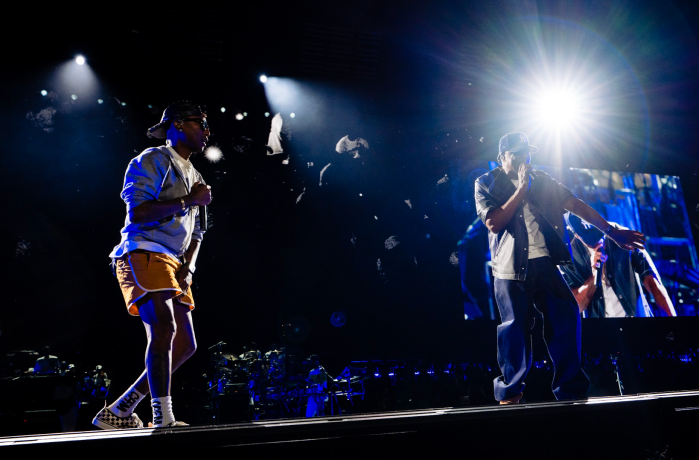
Until nearly 3 in the morning, JAŸ ran through an unrelenting barrage of hits. He brought out an embarrassment of riches of guests, including Clipse, The-Dream, Teyana Taylor, Usher, Young Jeezy, and the biggest flexes of them all, Rihanna and Beyonce.
Roc Nation
According to Pharrell, this battle wouldn’t nearly be JAŸ’s last.
“They poked the bear, then the bear cut his hair. And now he got on his helmet [Yankee fitted],” Skateboard P explained to the crowd. “He getting ready to go to work. I hope you kill all them n‑‑‑‑s.”
Between that statement and Beyoncé cutting JAŸ’s hair to start the festivities on Friday night, if JAŸ hoped to quell talk of a new album — that’s the only thing he failed miserably at this weekend.
Night 3, for all its tomfoolery, was the exact opposite of how Ali left Yankee Stadium.
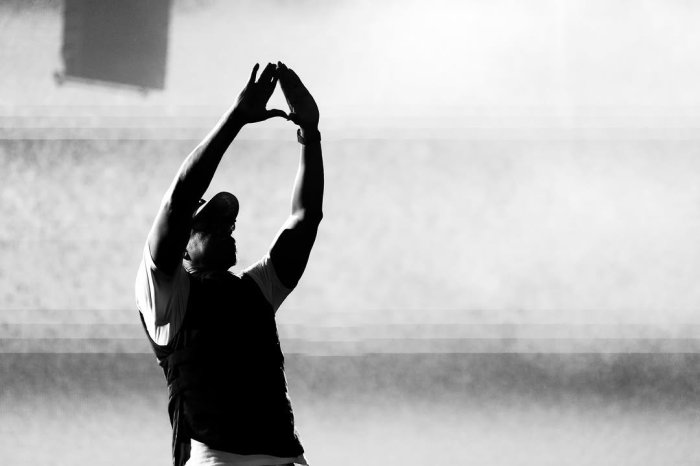
JAŸ-Z left without a reasonable doubt. Of his dominance. Of his place in New York’s sweeping and complex history. Of, as he said in “Public Service Announcement” — a Super Bowl-friendly record of the highest regard, if that’s the pathway we’ll see play out in the coming months — the vibe still very much in his veins.
Roc Nation
JAŸ-Z spent two nights and a very early morning at Yankee Stadium providing a different answer.
It wasn’t a farewell tour, though moments like this grow increasingly rare. Where else could one expect to hear “Song Cry” in a stadium full of people who understand the complexity and empathy that song commands without having to explain it’s stayed with them for a quarter century? The memories brought people from all over the country to Yankee Stadium — and damn near threatened to shut it down. JAŸ still being capable of authoring new ones, however, is a testament to who he is and how his ability to articulate thoughts has embedded itself in the story of America.
Thirty years after Reasonable Doubt, JAŸ-Z left none in Yankee Stadium. Babe Ruth hit home runs there that theoretically haven’t landed yet. Pope Benedict XVI preached there. Muhammad Ali endured there.
In a summer that has already celebrated a New York Knicks parade and the World Cup, one weekend in July reminded the city that its heartbeat was still very much loud. Still very much complicated. Still very much uniting.
And thanks to JAŸ-Z, still very, very much alive.