
Frances Tiafoe, Ben Shelton — win or lose — are heroes at US Open
Nearly 60 years after Arthur Ashe’s Grand Slam triumph, Black men’s tennis stars are beloved for more than just major championships

Listen to this story
Everyone is someone’s hero in tennis. That may be the most beautiful and attractive part of the sport.
I thought about this last week while listening to the overwhelming outpouring of appreciation for Gael Monfils after he played his final Grand Slam match at the US Open. Fans enthusiastically celebrated the end of a spectacular career.
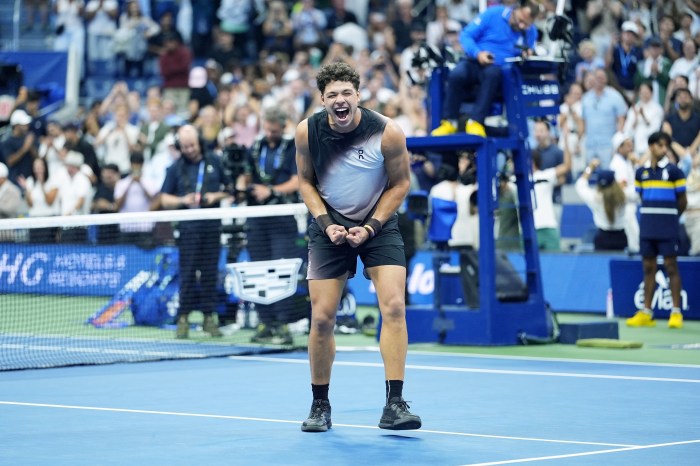
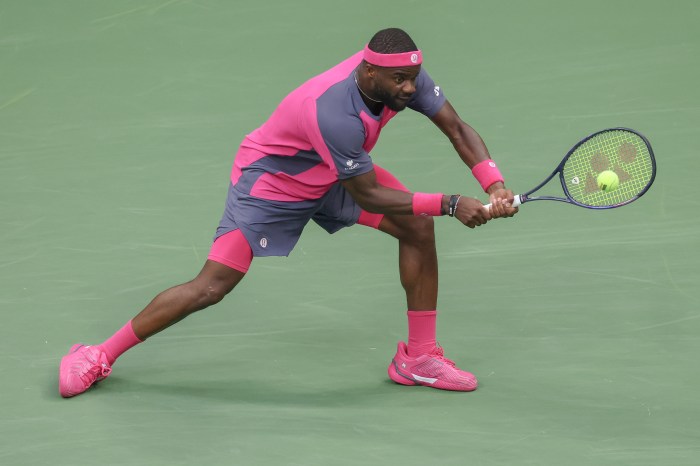
I also thought about this Tuesday evening after Frances Tiafoe defeated Alex Michelsen in an epic five-set match, and after Ben Shelton upset Carlos Alcaraz in another classic five-setter that ran past 3 a.m.
Shelton called his match against Alcaraz “the most enjoyable match that I’ve had in my career.” When he met the media in his post-match news conference, Shelton gushed, “This is the greatest moment on the tennis court of my life.”
That could be updated by Sunday evening.
On Friday, Shelton and Tiafoe will square off in an unprecedented all-African American men’s semifinal. Their match guarantees that an African American will play for the US Open championship. If Shelton or Tiafoe raise the trophy Sunday, he will become the first Black American man to win the US Open singles title since Arthur Ashe captured the inaugural Open-era tournament in 1968.
That’s more than a feel-good moment. That’s history.
Darren Carroll/USTA via Getty Images
I was fortunate to know Arthur, who died at 49 in 1993, and call him a mentor. I’m still astounded each time I walk into the stadium in Queens, New York, that bears his name.
That was not his goal or his mission. His goal was to bring diversity, equity and inclusion to tennis, and he would be immensely proud of Tiafoe, Shelton and all the African Americans competing at the US Open. He would be disappointed that it’s taken nearly 60 years for another Black man to win a US Open championship.
This is a lot to put on the shoulders of Tiafoe and Shelton, but they should know and appreciate Ashe, because they are part of the history he represents.
And they are now in a position to create their own.
There are significant differences, of course, between Ashe, Tiafoe and Shelton. Tiafoe is 28 years old, Shelton is 23. Ashe was 25 when he won the US Open in 1968. He was a UCLA graduate and an officer in the U.S. Army.
Ashe would become a singular figure — an athlete, intellectual, activist and global humanitarian — whose impact extended far beyond tennis.
While Arthur was cool and contained on the court, Tiafoe and Shelton play with emotion, charisma and draw energy from the crowd. Ashe’s expression rarely changed; Tiafoe and Shelton are expressive and combustible. They celebrate every winner with a roar and suffer through every missed opportunity.
Their relationship with fans has produced exhilarating moments and heartbreak.
“That’s tennis,” Tiafoe told reporters after his quarterfinal victory Tuesday. “You’re going to win some, you’re going to lose some.”
Tiafoe reached the US Open semifinals in 2022 and lost to Alcaraz in five sets. He reached the semifinals again in 2024 and led Taylor Fritz two sets to one before losing in five sets. This is also Shelton’s third Grand Slam semifinal; he didn’t win a set in either of his first two, losing in straights to Novak Djokovic at the 2023 US Open and Jannik Sinner at last year’s Australian Open.
After Tuesday’s match, I asked Tiafoe how he’s changed since his first semifinal appearance in 2022.
“I’m a different person in general,” he said. “Those two runs were great, something I’ll carry forever, but I’m not that person who I was when I made the run in 2022 and made one in 2024.”
The difference?
“I’m still pumped about it, excited about it, but I have higher hopes for myself,” he said. “The tournament is still going. There’s a lot more tennis to be played, more sets to be played, a lot more physical things to be done, so we’re going to enjoy this, but we got to keep going.”
EPA/BRIAN HIRSCHFELD
The beauty of tennis is that you don’t have to win championships to be popular. This is especially true in men’s tennis and especially at the US Open, where popularity is not always tied to championships.
You can become a star before you become a champion. Neither Tiafoe nor Shelton has won a Grand Slam title, yet they are among the most recognizable and embraced American players.
The brilliant back-to-back performances Tuesday by Tiafoe and Shelton helped cement their popularity, regardless of who wins Friday and regardless of the final result Sunday. They are already heroes to their respective fanbases.
Fans love the Tiafoe backstory — his parents were immigrants from Sierra Leone, having fled the country’s 11-year civil war after it erupted in 1991. And fans connect with the exuberance of Shelton, a relative latecomer to the sport who played two years of college tennis at Florida under his father, a former professional himself.
A championship by either of them will establish greatness, but their popularity is a testament to fans caring enough to watch and follow the players’ journey. Popularity is built on personality, style, charisma, and an emotional connection with fans. The connection was on full display for Tiafoe and Shelton on Tuesday, when both relied on the fans in Arthur Ashe Stadium to drag them across the finish line.
With Black tennis players, there is an added weight of history. While Venus and Serena Williams, Coco Gauff and Naomi Osaka — not to mention Sloane Stephens, Madison Keys and Taylor Townsend — have established a championship legacy of Black women, no such legacy has been created for Black men after Ashe.
The closest anyone came was MaliVai Washington, an American who reached the Wimbledon finals in 1996.
On Friday, either Tiafoe or Shelton will match that feat, with the opportunity to take the final step Sunday. As exhilarating as their quarterfinal performances were, the historic implication of their semifinal adds another layer of pressure, depending on how much both players value the opportunity to make history.
Do we even need to put the championship weight on Tiafoe and Shelton? Arthur’s US Open title in September 1968 came five months after the assassination of the Rev. Martin Luther King Jr. and three months after the assassination of Sen. Robert Kennedy. The country was torn apart by the Vietnam War, the draft and persistent ongoing racial turmoil.
In tennis, Ashe was a symbol of calm and, to an extent, restraint — though not accommodation. He touched many lives and moved in many circles.
Fast-forward to 2026, and a tense political atmosphere has launched an attack on many of Ashe’s core ideals — namely diversity, equity and inclusion. Ashe valued African American history, which is also under attack. Indeed, he was part of that history. There will be a historic element at play Friday with Tiafoe and Shelton playing for the right to compete on championship Sunday and break a 58-year drought — as well as the unprecedented 23-year span without any American men’s Grand Slam winner.
Yet, Tiafoe and Shelton are two of the brightest young lights in tennis, and that will not change, win or lose. They are beloved and the perfect icons for their sport — because in tennis, every player is someone’s hero.