
Trajan Langdon’s knack for overcoming challenges sparks Detroit Pistons’ revival
President of basketball operations’ hire, decisions coincide with franchise’s rise from worst in NBA to 60 wins

DETROIT — On a May morning in 2024 at his home in Beverly Hills, Calif., Detroit Pistons owner Tom Gores finished his final interview of Trajan Langdon with a tough question at 2 a.m.
“Do you have a stomach for this [job]? Because it’s not going to be easy,” Gores told Andscape he asked Langdon.
Gores wasn’t underselling the challenges of the Pistons’ president of basketball operations role. Detroit had posted the NBA’s worst record in each of the previous two seasons, including a franchise-low 14 wins and a league-record 28-game losing streak in the prior campaign. The Pistons had last won a playoff game in 2008, a disastrous stretch for a storied franchise with three titles to its name.
But from rising out of basketball obscurity in Alaska to overcoming knee surgery at Duke to responding to a failed NBA playing career by flourishing professionally in Europe, nothing has ever come easy for Langdon. So, “The Alaskan Assassin” quickly decided he could stomach yet another challenge and said yes to the Pistons.
“He didn’t blink. He was all in,” Gores said. “Then I asked him to text me his top 20 action items and get started first thing in the morning.
“Now, I didn’t expect things to turn around as fast as they did, but I’m not surprised.”
Two years later, Langdon, 49, has led the Pistons from the NBA basement to the best record in the Eastern Conference.
Last season, Year 1 under Langdon, the Pistons and new head coach J.B. Bickerstaff won 44 games, celebrated Cade Cunningham as a first-time All-Star, and pushed the New York Knicks to six games in the first round, making their first playoff appearance since 2019.
The Pistons finished this season with an East-best 60 wins, led by two All-Stars in Cunningham and Jalen Duren and an NBA Coach of the Year candidate in Bickerstaff. The East’s top-seed Pistons will host the winner of a play-in game between the Orlando Magic and Charlotte Hornets tonight in a first-round playoff matchup starting Sunday.
“Some people were like, ‘What are you doing?’ ” Langdon said to Andscape regarding taking the Pistons’ job. “’You’re going to a team that just won 14 games and didn’t win a game for two months.’ In the back of [your] mind, you always know when you take over a team, it’s not going to be good. There’s a reason why leadership is changing. There is a reason why the job is open all the time.
“The high-water mark was 23 wins the previous four years. So, I’m doing all my due diligence. Obviously, in the process of getting a job, I’m seeing how difficult it’s going to be, how difficult it’s been. But I knew it was for me.”
Overcoming challenges is part of Langdon’s bloodline.
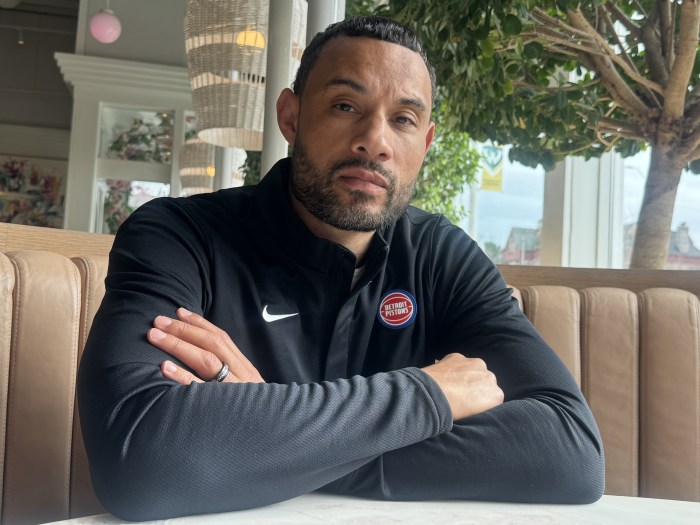
Trajan Langdon
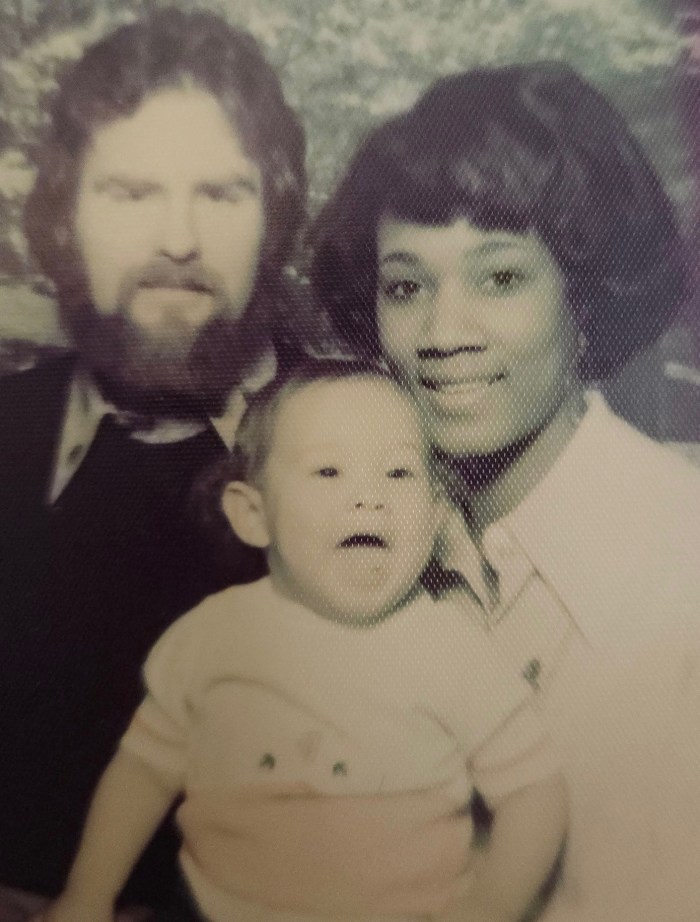
Langdon was born at Stanford Hospital in Palo Alto, Calif., on May 13, 1976, to a white father, Steve, and an African American mother, Gladys. The couple met in 1968 when a mutual friend introduced them during a drive to Oakland, Calif., where they attended the Black Panther Party’s Free Huey rally highlighted with a speech from Black Panther Party co-founder Bobby Seale at the Oakland Auditorium (now the Henry J. Kaiser Center for the Arts).
“A friend used to pick me up in his car and just call and say, ‘Hey, Gladys, we’re going this way. We’re going to this place.’ And he picked me up, and … he didn’t say Steve was going to be in the car, not that I would have said yes or no. But anyway, that’s how I met Steve,” Gladys said.
Said Steve: “We got to see … the Black Panthers there. Me and this other guy who was with me, well, we were the only white guys in the vicinity of where we were. I don’t know if we were the only ones in the venue, but that was the way in which [Gladys and I] were introduced to each other.”
Steve was a student at Stanford University while Gladys was attending College of Notre Dame de Namur University in nearby Belmont, Calif. It was 1968, the year Martin Luther King Jr. and Robert F. Kennedy were murdered. While race and racism were weighing heavily on the country at that time, love fought through that as the Langdons dated for five years before getting married in Redwood City, Calif., in 1973.
The former Gladys Patterson grew up poor in Brewton, Ala., a small town of about 5,000 people less than 10 miles from the state’s southern border. Brewton’s history includes its role in the antebellum South’s economy, which relied heavily on slavery for agricultural and industrial labor, according to Eagle Eye TV, Auburn University’s student-run TV station. Gladys said her childhood home didn’t have running water, and the bathroom was an outhouse. Gladys also picked cotton during some summers growing up.
Within six months of graduating from high school, she left Brewton and moved to the San Francisco Bay Area at the urging of a hometown friend living in East Palo Alto. She initially attended San Mateo College and worked assembling transistors for Fairchild Industries before graduating from Notre Dame de Namur with a bachelor’s degree in social work.
“I picked cotton when I was in junior high school,” Gladys, 80, said to Andscape. “The truck would pick us up about 5 o’clock in the morning and we would ride for about an hour and we’d pick cotton from about 6 [a.m.] until 5 [p.m.]. This is during the summers in Alabama.
“Well, in high school, my jobs changed. I started doing domestic work. I started babysitting, doing house cleaning and cooking for the people that I worked for.”
Gladys said she brought her children back to Brewton several times during their youth (Trajan also has a young sister, Trista, who was born in Alaska and is the Washington Commanders’ senior vice president of operations and guest experience). While Gladys thought it was important for her children to be around her family and to know their African American heritage, she was also “very conscious” of raising them to be good human beings, not just Black.
“They both identify as Black. Their identities are Black. Trajan, certainly, there’s no question in terms of what his identity is,” Gladys said.
When Gladys celebrated her 80th birthday last year, she finally revealed to her children and grandchildren that she had picked cotton in Alabama.
“We were all in this room and I was talking about knowing your roots,” Gladys said. “I don’t think they quite understood what I was saying about an outhouse or not having running water, having all of your plumbing outside of the house. So, it was difficult for them to understand.”
Steve Langdon’s father was Irish and his mother was Slovenian. His aunt taught him during his youth about Ireland’s century-long resistance to English and British rule, which ultimately led to the 1919-21 Irish War of Independence and the country’s subsequent partition. Steve’s mother provided an education on Slovenia’s invasion by Axis powers in April 1941 and the struggle against Nazi Germany, Fascist Italy and Hungary.
So, while Steve Langdon — who would become a prominent American anthropologist and professor emeritus at the University of Alaska Anchorage, widely recognized for his extensive research on Alaska Native cultures, particularly the Tlingit people of Southeast Alaska — isn’t Black, he certainly could relate to “power and oppression” affecting one’s life.
“Well, there’s a deep side of my ancestry, too. My ancestry is one of resistance,” Steve Langdon, 77, said. “I know all about Irish resistance. In my Slovenian side, they resisted the Nazis in World War II, and it’s the Slovenians who created independence and broke away from Yugoslavia. So, there’s a little bit of this resistance in my understanding.”
Trajan Langdon
Steve Langdon was 8 when his family moved to Alaska during the territorial days in 1958. The motivation came from his father, who established the region’s first mental health facilities, according to the University of Alaska Anchorage. After finishing a Ph.D. at Stanford in the late 1970s, Steve Langdon moved his wife and infant son, Trajan, back to Alaska.
Trajan became fascinated with sports at a young age while growing up in Alaska with lots of family on his father’s side nearby. He grew up playing baseball, basketball and soccer and rode his bicycle everywhere. Focused on excellence in academics and sports, Trajan’s passion was basketball, and he was often in the snow shooting jumpers on an outdoor hoop.
What helped Trajan first fall in love with basketball was watching the now-defunct Great Alaska Shootout hosted by the University of Alaska Anchorage. The annual college basketball tournament was a Thanksgiving-week staple, famously showcasing elite programs and future NBA stars such as Patrick Ewing, Dwyane Wade and Klay Thompson. Langdon was actually in the stands with his father when Ewing made his college debut for Georgetown at the 1981 edition of the tournament.
Langdon loved spending those tournament days intently watching as many games as possible. It also gave him a barometer on the talent needed to play high-level college basketball.
“Well, he got to see some of the earliest games of the Shootout,” Steve Langdon said. “I remember him sitting in my lap when he was 3 years old maybe, and he was just fixated.
“And when he got older, he would sit there all day. Game after game after game. One thing about him: He takes it all in. It’s that ability to focus and take things in and then work with that. That’s a very important piece of his capacities.”
Langdon became known as the “Alaskan Assassin” as a superstar shooting guard at East Anchorage High. He won three consecutive Alaska large-school state championships. A three-time Alaska Player of the Year honoree, the first-ever player to win the award three times, Langdon set the state scoring record with 2,200 points. He was also a 1994 McDonald’s All-American who won the game’s 3-point competition.
Finding teenagers capable of challenging Langdon on the court was tough in Alaska. So instead, he developed his game, competitive spirit and voice by playing in pickup games against grown men at Fairview Recreation Center and Elmendorf Air Force Base in Anchorage. One of the men he played against was current Cavaliers guard Jaylon Tyson’s father, John, a fact Langdon didn’t know until earlier this season when the elder Tyson introduced himself after a Cavaliers-Pistons game.
“I’d be like 15, 16 going against his Air Force dudes. ‘Who’s got next?’ I have to talk to the dude. ‘Hey, can I get with you?’ ‘I got my five.’ ‘Who’s got next after him?’ So, you got to go navigate that,” Langdon said. “That was such a huge brokerage for me. I’m completely out of my realm at the Air Force base. They were trying to stay on the court. I had to get uncomfortable if I wanted to get on the court.”
The pickup games helped turn Langdon into a strong enough player that he had his pick of high-level colleges to play for, with Stanford and Duke as the finalists.

Trajan Langdon
Stanford was quite familiar with him from his time attending summer high school basketball camps at his father’s alma mater. But Langdon was very impressed with then-Duke assistant coach Tommy Amaker, who diligently recruited him.
Langdon ultimately chose to play for Naismith Basketball Hall of Fame coach Mike Krzyzewski and Duke University because he wanted “to be challenged” by a renowned basketball program regularly on national TV. This was on the heels of the Blue Devils losing to Arkansas in the 1994 national championship game.
“If I can compete and earn a spot and then succeed, then I’m going to have the best chance to be the best player I can be, which is what I always wanted to do,” Langdon said. “So that was a lot of the basis of that choice. Obviously, the coach was Coach K. I knew he was going to help me be the best I could be.”
Before he suited up for the Blue Devils, however, Langdon had another sport to pursue.
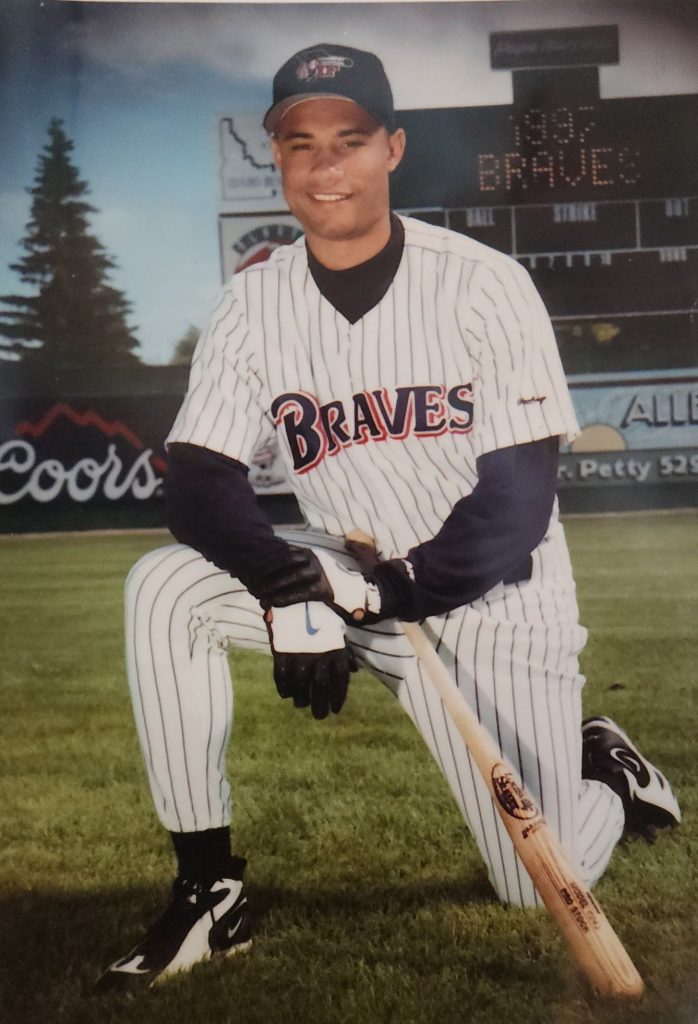
While he was setting records on the hardwood in Alaska, he had also been a baseball standout. A two-way star, he batted .333 as a senior, once struck out 11 batters in a game, and he would later be named the Cook Inlet Conference Baseball Player of the Decade for the 1990s.
Langdon was doing a baseball workout with his father outside a hotel during a recruiting trip to Duke when he was noticed by another hotel guest, then-San Diego Padres scouting director Kevin Towers. The Padres drafted Langdon in the sixth round of the 1994 Major League Baseball draft, before future MLB All-Stars Carl Pavano and Placido Polanco.
Langdon received a $230,000 signing bonus by the Padres and committed to playing for at least three summers. The Padres also paid for Langdon to attend Duke, since a pro athlete could not be on a college basketball scholarship. He was also offered an opportunity to play basketball and baseball at Stanford.
Langdon played 17 games for the Padres’ Single-A affiliate in 1994 before going to Duke. He also played for the Padres’ Rookie League team in 1995 and 1997. Langdon batted .176 with three home runs in 165 at-bats in 50 games over three seasons before retiring from the diamond.
“He played third base. He was solid,” said ex-University of Washington basketball and baseball player Jason Tyrus, who was in Single-A with Langdon.
Said Langdon: “Liked baseball. Enjoyed baseball. Was good at baseball. Never had the passion. I connected probably with my dad more over baseball.”
Tyrus definitely could tell that Langdon preferred basketball and joined him to get shots up during the downtimes of the baseball season. Tyrus says then-Duke assistant coach Johnny Dawkins also attended some of their games and called to check in on Langdon.
“[Langdon] would always get his shots up,” Tyrus said. “All the time. And when we were traveling, the guy would find a gym to go get shots. He’s serious. …
“He would want me to rebound, man. I still wanted to shoot, man. I was only one year out. But he was good. He was big. He was young, because he was 18. I was 22. But it was like, you can just tell the difference in guys that get a full basketball ride to Duke. The preparation. The dedication to the craft that when you go in, what is expected of you.”
But Langdon’s first two years with Duke didn’t go as planned.
Trajan Langdon
Langdon started as a freshman on a struggling Blue Devils basketball team that finished 13-18 and posted two Atlantic Coast Conference wins during the 1994-95 season, failing to make the NCAA tournament for the first time in 12 years.
The following summer, he sprained his ankle while playing for the United States men’s basketball junior national team. That sprain led to a stress reaction in his left knee, potentially career-ending surgery, a medical redshirt for the 1995-96 season, and a 14-month layoff.
“If I don’t have those two years, I don’t know that I become the pro that I became, or the basketball player that I became, because I had to fight through so much,” Langdon said. “I had to be resilient. I had to fight through all the negativity. You redshirted a year and you don’t play, you get forgotten about it. Nobody’s paying you no attention.”
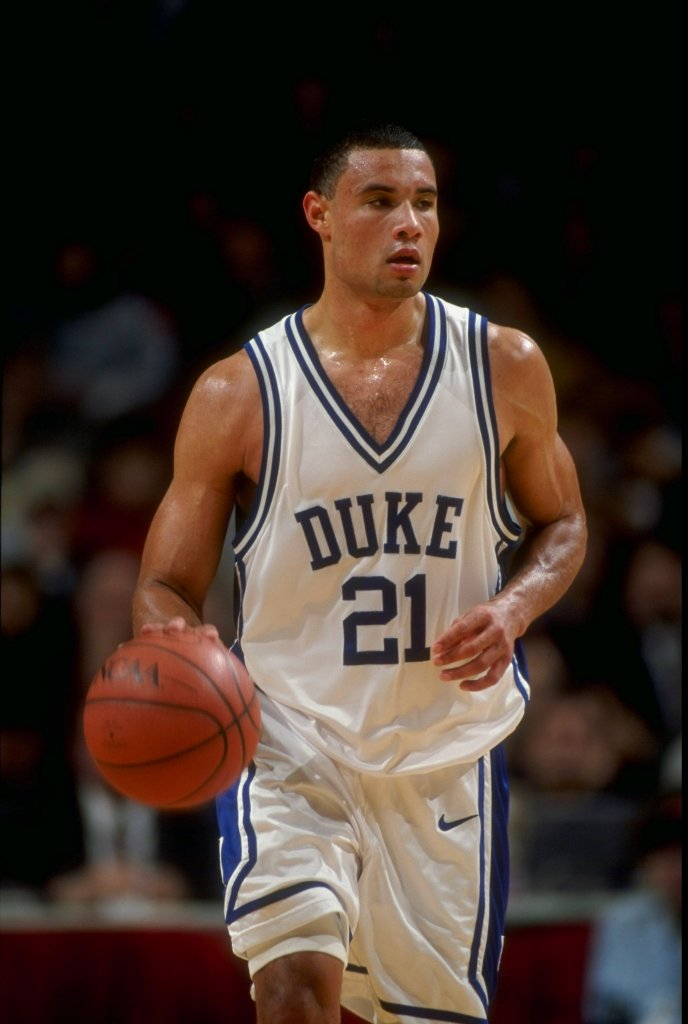
Langdon proved his resilience, returning to become one of Duke’s most prolific 3-point shooters during his four playing seasons. The three-time All-ACC first-team selection finished his career with 1,974 points and held the school record for 3-point field goals (342) until J.J. Redick surpassed it in 2006. The 1999 consensus All-American led Duke to the national title game that same year, but his traveling violation with 5.4 seconds left and down by one point prevented the Blue Devils from beating Connecticut.
In addition to Langdon’s on-court contributions, Krzyzewski called upon him to be a leader and help ensure other Duke greats such as Elton Brand reach their potential. Brand arrived in Durham in 1997 as a prized recruit, but Krzyzewski made him switch roommates on the road, pairing him with Langdon in hopes that Brand would learn maturity on and off the court from the upperclassman.
Brand, who won consensus National Player of the Year honors as a sophomore before embarking on a 17-year NBA career that included two All-Star appearances, said Langdon had an “instrumental” impact on his development.
“He was a serious upperclassman that cared about what he put into his body, proper sleep, proper nutrition, how to attack the weight room, how to get your shots up, how to look at a game, how to attack it,” Brand said. “And he just changed my perspective on basketball, life and just taking care of focusing on what you need to focus on.
“I wasn’t as mature and developed, and he helped me definitely transition into that as a collegiate player. Seeing his work ethic and the way he handled his business made me step up my game on and off the court.”
Langdon was selected with the 11th overall pick in the 1999 NBA draft by the Cleveland Cavaliers. He became the first Alaskan ever to play in an NBA game, but saw the court sparingly in three seasons with the Cavaliers, averaging 5.4 points on 39.6% shooting from 3-point range and 1.4 assists per game in 119 regular-season games.
“I enjoyed all three of my years, including really good people,” Langdon said. “I thought the organization did a fine job. I don’t need much, so they treated me well. Played for two different coaches, Randy Wittman and John Lucas. … I thought I had a solid second year with Randy Wittman. And then we had a change in coach. He just changed some things with the style of play and with the roster that we had.
“There was a difference between my second year and my third year. I wanted to stay, but then realized I need to play. I can’t just be sitting on a bench.”
Brand said Langdon “was ahead of his time just because of the way he could shoot. I see elite shooters today with a role. Back then, they kind of passed the ball. It ebbed and flowed. It was like you’re an elite shooter, you had a role, and then the shooting portion wasn’t fashionable.”
Jonathan Daniel / Stringer
Langdon said he had no offer to re-sign with the Cavs in 2002, and the only NBA opportunity he had was a training camp invite with the Miami Heat. Instead, seeking security, playing time and happiness, he opted to go overseas with Benetton Treviso in Italy.
That decision led to a legendary career in Europe in Italy, Turkey and Russia from 2002-2011. Langdon won two EuroLeague championships with CSKA Moscow (2006, 2008) and was a three-time runner-up. The two-time All-EuroLeague first-team selection was the EuroLeague 2008 Final Four MVP. He finished his EuroLeague career ranked fifth all-time in 3-pointers made (339) and sixth in both scoring (2,178 points) and steals (216). He retired in 2011 after earning a ninth consecutive Russian championship with CSKA.
Langdon also got revenge on the NBA during his European career, scoring a game-high 17 points for CSKA Moscow during a 94-75 exhibition win over Brand and the Los Angeles Clippers on Oct. 7, 2006. While former NBA players don’t remember many exhibition games, Brand remembers that one.
“[CSKA] had some talent and they had some talented players, and ownership really wanted to win that game and they were pushing,” Brand said. “No excuses because they kicked our a–. But they deserved that win because they were ready. Trajan showed, NBA player or not, this is the level I’m on.”
Langdon returned to the NBA in retirement as an Eastern regional pro personnel scout for the San Antonio Spurs from 2012-15. He returned to the Cavs in 2015 as the director of player administration. Langdon next became the Brooklyn Nets’ assistant general manager and the G League affiliate Long Island Nets’ GM on March 6, 2016.
Brand, now the Philadelphia 76ers’ general manager, said Langdon is “meticulous in his approach” on how he scouts and puts a team together, and he has learned a lot from him.
“From what I’ve seen, especially in his lead position, is him putting a team together and seeing how a team can function, adding vets that you need, adding shooting that you need, adding toughness or whatever he needs, just seeing how a team can operate and how a team can win together,” Brand said. “That’s what his strong suit is. And playing in Europe and playing at Duke and just playing all over the world … that helps shape his view of basketball and what winning is and what team success looks like.”
“There’s a presence where he doesn’t concern himself with what other people think. His job is to do what he believes is right, whether it’s in that moment or the grand scheme.”
– Detroit Pistons head coach J.B. Bickerstaff on Trajan Langdon
Langdon joined the New Orleans Pelicans as general manager on May 19, 2019, working under executive vice president David Griffin. He built a reputation of drafting well during his time with the Nets and Pelicans, selecting the likes of Zion Williamson, Jarrett Allen, Caris LeVert, Zion Williamson, Trey Murphy III and Herbert Jones.
Following four seasons of struggle, the Pistons fired Troy Weaver as their president of basketball operations and hired Langdon on May 31, 2024. Behind the scenes, Gores and the Pistons were already looking for a replacement from a wide net of highly experienced candidates. The Pistons’ thorough search, led by former NBA general manager and Duke guard Billy King, ultimately led to Langdon being offered the job.
Langdon took over a young Pistons roster that finished the 2023-24 season with 11 players 25 or younger. The key players inherited were Cunningham, Duren and forward Ausar Thompson. Langdon also inherited the No. 5 pick in the 2024 NBA draft and used it to select G League Ignite forward Ron Holland.
Pistons vice chairman Arn Tellem was previously an agent who represented Langdon during his pro basketball career, putting another voice familiar with Langdon in the building. Despite the naysayers, Brand told Langdon he should take the job.
Gores had his Pistons savior.
“When I hired Trajan, I approached the search process the same way I have other parts of my career,” Gores said. “I’ve been in the turnaround business for 30 years, and I was looking to recruit a real executive just like I would for CEO of a multibillion[-dollar] corporation in any other industry. Obviously, knowing basketball is critical, but there are so many other elements to running a front office.
“I wanted someone who could lead and inspire and also execute. I wanted someone who could thread a lot of needles.”
The first needle Langdon threaded was the tough decision to fire a respected head coach in Monty Williams. Langdon fired Williams on June 19, 2024, after just one season of a six-year, $78.5 million contract, following the Pistons’ 14-win season. Detroit still owed Williams about $65 million for the remaining five years of his deal after the firing. He had been hired by Weaver in 2023 after coaching the Phoenix Suns to the 2022 NBA Finals and also coaching the Pelicans.
Langdon followed by making Bickerstaff his first notable hire, not long after the latter was fired by the Cavs. Langdon didn’t have much of a prior relationship with Bickerstaff, but Indiana Pacers lead assistant coach Lloyd Pierce made a recommendation.
Bickerstaff had a 165-153 (.519) record in five seasons in Cleveland, leading the franchise through a rebuild. But after coaching the Cavaliers during the 2022-23 season, he was fired after losing in the second round to the eventual NBA champion Boston Celtics. The son of former NBA head coach and executive Bernie Bickerstaff had also previously been a head coach with the Houston Rockets and Memphis Grizzlies.
The hiring of Bickerstaff has ultimately resulted in one of the fastest turnarounds in NBA history and a possible 2026 NBA Coach of the Year award. Bickerstaff said based on what he has learned about Langdon, he isn’t surprised he gave him a chance.
“What I quickly found about him is if you’re in a room with him for five minutes, there’s a presence where he doesn’t concern himself with what other people think,” Bickerstaff said. “His job is to do what he believes is right, whether it’s in that moment or the grand scheme. That’s how he carries himself every single day, and that’s why I think we work well together is because I’m emotional and he’s, like, even-keeled.
“So, he pulls me back to where I need to be and he makes decisions [that are] non-emotional. But he has a great way about him to show people that he cares about them emotionally as well. So, he walks a fine line, but he’s very skilled at it.”
Longtime Pistons forward Isaiah Stewart said he loved Weaver, who drafted him, but the losing and the rotating door of teammates under the prior regime was also a challenge. With Langdon, Stewart said he loves his accessibility, and the biggest influence he has had on the players is adding structure and resources.
“[Langdon] came in more structured, organized with certain stuff,” Stewart told Andscape. “And this is me being respectful for Troy. But obviously, [Langdon] had a great mind of what he wanted to see as far as structure. He’s been doing a great job of that structure with us off the court, making sure guys stay healthy. The new staff brought in resources that they gave us young players that are always available for us.
“Trajan is a guy that when I leave [the practice facility], that I’m able to call his phone and he’ll answer. Our voice is being heard. They know our situations, what we have to deal with on the daily, but [there is] structure. Even going down to who he hired as the head coach, he hired a head coach that was going to come in with structure. Structure is very important to have on a young team in the NBA. Give us a kind of system. They came and they put the system in place, and I feel like it’s the system everybody can relate to. Everybody genuinely likes the system.”
From start to finish, the Pistons have been the most dominant team in the East this season. Only the Oklahoma City Thunder (64 wins) and San Antonio Spurs (62) won more regular-season games than the Pistons, who won 60 despite Cunningham missing 11 games with a collapsed left lung.
About the only knock on the Pistons was that Langdon didn’t make a move at the trade deadline to add another scorer next to Cunningham and Duren. Instead, Langdon traded guard Jaden Ivey to the Chicago Bulls in a three-team deal, acquiring swingman Kevin Huerter and forward Dario Saric.
The trade, aimed at improving spacing and adding veteran experience, also provided the Pistons with a 2026 first-round pick swap with the Minnesota Timberwolves that will be the 21st pick in this deep draft.

Trajan Langdon
Bickerstaff supported Langdon’s decision not to make a big trade.
“He’s going to do what he believes is right, and he made the decision that I believe is best for this team,” Bickerstaff said. “You got guys in a position that have busted their a– to get here. Why panic and push a button when you don’t know what the extreme or the extent of what this team can be? And these guys earned it. They put themselves in a position to be first in the East at that time.
“So why rock the boat and mess it up when you don’t know what the final endgame is? He’s a big believer in chemistry. He’s a big believer in those guys in the locker room. And jumping out on a limb just to make a deal for — maybe it’s a short term, maybe who knows — just wasn’t the right thing to do.”
Said Langdon: “I want to see our guys continue to grow, give them room to grow. I didn’t want to do anything that could impact that.”
It’s been 22 years since the Pistons won an NBA title. It’s been 21 years since Detroit has played in the NBA Finals.
While championship dreams are back in Detroit, Langdon is more worried about the franchise giving itself the best chance to win, knowing luck and health also play a role along that journey.
“I try not to use the word ‘championship’ just because I saw one won in San Antonio, saw one won in Cleveland, won several in Europe. I know how hard it is,” Langdon said. “I want our entire organization to understand championship habits and championship process, championship environment. So much goes into winning one that, sometimes the best team doesn’t win, right? Sometimes you need some luck to win, too. So, it’s let’s continue to work, be the best possible team that we can be every year. That should be our goal.
“Whatever team we have, we’re reaching that ceiling for that team. And if the ceiling means we have a chance, that’s what gets us to it, then that’s what it is. But if it means we play the best basketball in the series and we play insane, but the other team is better and they beat us in seven games … things happen that sometimes just happen, and you win because of those things or you lose because of those things.
“If you go about winning, being together and competing every day and go about the process in the right way, you give yourself the best chance to win. Ultimately in the places that I’ve been, doing that has led to a high level of winning. That’s what we’re going to do here.”
Looking back, it’s safe to say Gores is ecstatic he hired Langdon.
“Trajan is a great judge of talent, both on the court and in the front office,” Gores said. “He’s brought in tremendous people and assembled an impressive team. He’s a great listener and communicator. He’s integrated so well with [Pistons president of business operations Melanie Harris’] team on the business side, which has been important for the success of our whole organization. He has all the qualities that I look for, not just in basketball, but as a leader.
“If he weren’t in basketball, I think Trajan could run a steel company or any other kind of business. He’s also a great family man and father. I’ve gotten to know him on a personal level and he has great character and high integrity. He’s a real asset to me and to the Detroit community.”
It’s also safe to say Langdon’s parents are proud and not surprised by their son’s success.
“He’s had to work hard all the way through, starting in Anchorage when he was dribbling the ball in the snow during the winter months when it was dark outside and very cold,” Gladys Langdon said. “So yeah, he’s been serious about what he wants to do for a long time.”