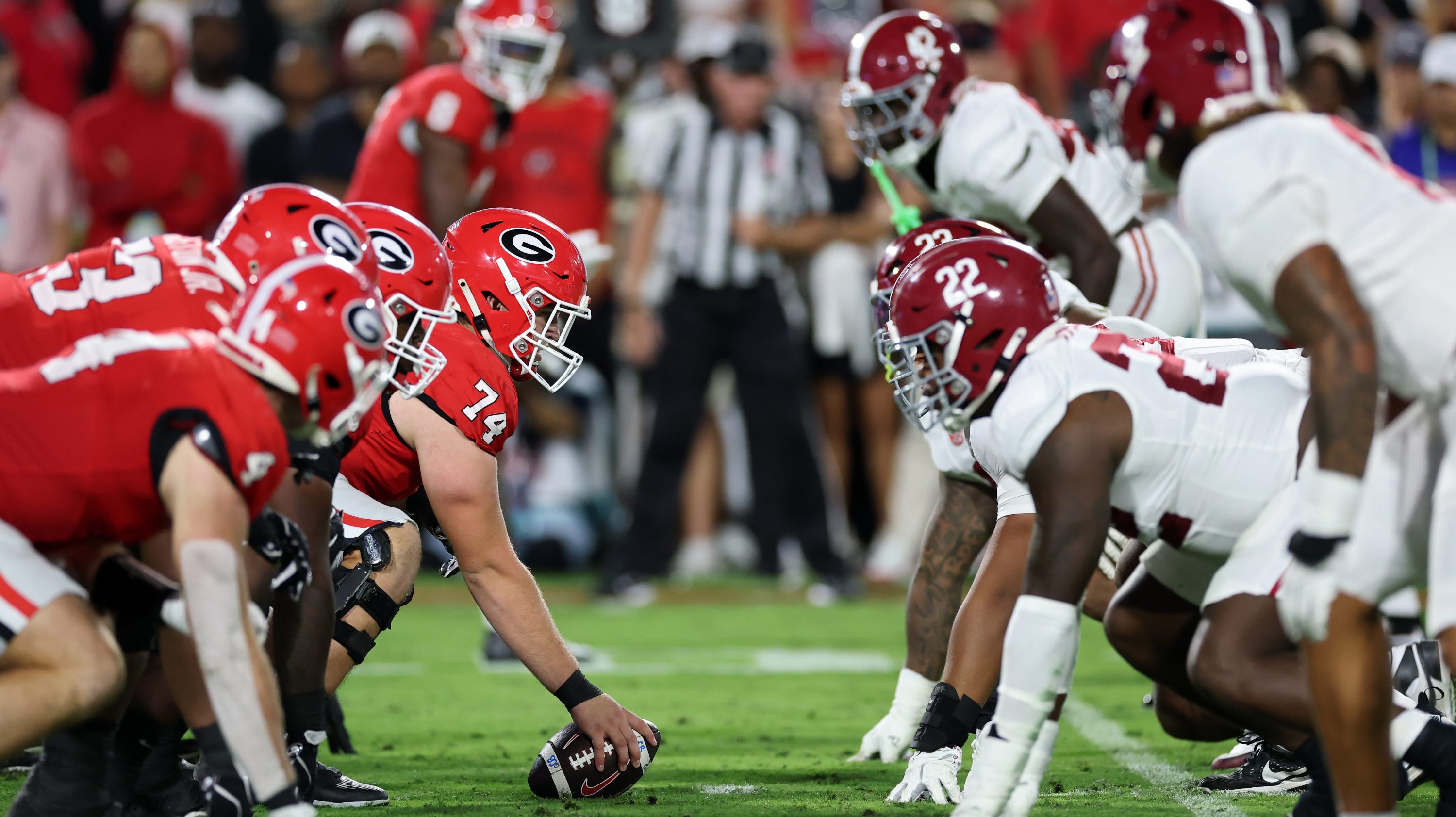
Georgia vs. Alabama defines college football’s midterm moment
Politics and sports are intertwined for the biggest game of the year

Two-minute offenses are often the thin line between ecstasy and anguish. In football and politics.
The most important of both will run through Tuscaloosa, Alabama, on Saturday. Yet neither No. 2 Georgia nor No. 6 Alabama (7:30 p.m. ET, ABC) will call the plays that matter beyond the field.
(As long as the weather plays fair, of course.)
Alabama and Georgia are no strangers. They’re enemies who live in the same orbit, battle in the same conference, and pursue the same euphoria. They’ve won 11 of the past 12 SEC championships, including each of the past six. But Georgia-Alabama wasn’t always the political powder keg it will be this weekend.
Think about the excitement permeating on Alabama’s campus all week. Think about the tailgate, already its own world, intensified with no college comparison this weekend. Think of Alabama icon Nick Saban, an unabashed Protect College Sports Act proponent, returning home to watch the most anticipated game of the season on a field named after him.
Think about President Donald Trump’s planned attendance just a few weeks before the midterm elections that will shape the second half of his second term. Think of him doing so in a state forged in part through Black athletic dominance and Black liberation at the voting booth — and a state that remains critical to his political takeover, now more than a decade old. Picture endless beer pong tables, libations upon libations, baby back ribs and chicken wings. Hear the endless sea of battle cries from both sides.
Nothing smothers urgency’s aroma, though. American power converges on primetime television once again through football.
Throughout his presidential odyssey, Trump’s relationship with athletes has been full contact.
He’s criticized LeBron James, Colin Kaepernick and a host of Olympic athletes. Drew deep ire over a perceived erasure of Jackie Robinson’s military service. Canoodled with Saquon Barkley, Jerry Jones, Dana White, Tiger Woods, Jaxson Dart, and, most recently, Marlon Humphrey and several Baltimore Ravens teammates.
He expressed a desire for the Washington Commanders to return to their original team name. And he made Linda McMahon, the WWE president and CEO, his secretary of education. This year alone he’s attended the College Football Playoff title game, Game 3 of the NBA Finals, the World Cup final, a UFC card on the South Lawn — and the Texas-Tennessee football game, which featured an Air Force One flyover two weeks ago.
Saturday marks Trump’s third trek to Bryant-Denny Stadium. Power goes to where the people are.
On Saturday night, the people will be in Tuscaloosa.
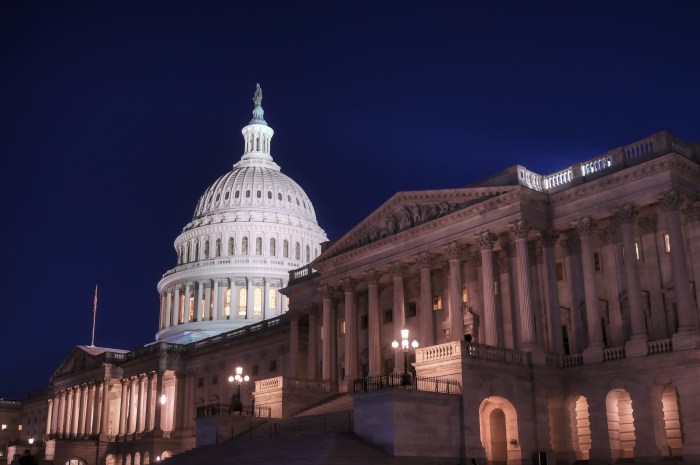
Two weeks earlier and 700 miles to the northeast, the U.S. Senate voted 77-22 to pass the Protect College Sports Act.
The legislation, should it be approved by the House of Representatives and signed by Trump, would “establish nationwide standards” governing medical coverage, revenue sharing and transfer mobility (alongside antitrust shelter for the NCAA).
The dissent has never been that the system couldn’t use reform. The biggest black eye of the bill has always been allowing all parties, athletes included, to exercise skin in the game in doing so. The same politicians buying airtime during the biggest games each Saturday are the ones policing athletes’ future freedoms.
The PCSA’s supporters have failed to get the legislation through the House before next month’s midterms. A polarizing bill in polarizing times hangs in limbo until after Americans vote in November.
The irony is simple. With the PCSA, Congress is attempting to legislate every aspect of college athletes’ lives except for who they are — though there are other bills aiming to have a say in that, too.
The Protect College Sports Act is admittedly neutral on employment status, a decades-long diversion. College sports are big business. Lobbying for it is, too. Saban and Colorado coach Deion Sanders have publicly advocated for the bill. Everyone has a voice — from athletic directors and coaches to politicians — except for the athletes people pay to see.
Under the lights in Tuscaloosa on Saturday night, young men on Georgia and Alabama — many of them Black — will take the field while potential rules are being written about them but not with them.
Georgia and Alabama are only two of the opponents that will be facing off Saturday. Televised football is the last true appointment viewing where it’s possible to reach millions of citizens at a one time. Hence, political campaigns have run out-of-state ads nationally for weeks.
During a single weekend last month, Republicans ran 5,546 ads during football games, compared to 471 for Democrats, according to reports. Republican Texas Sen. Ted Cruz spent $171,000 for a single 30-second ad during the Week 2 NFL matchup between the Washington Commanders and Dallas Cowboys.
The messaging matters. The time and the audience matter more. Forget “stick to sports.” Now, politics and sports are so intertwined that the same dystopian machine telling players to understand their place is largely the same one securing ad time during their games.
Americans are rebelling. President Trump has vowed to no longer fund ads promoting his policies with taxpayer dollars. Yet, politics still finds its way into the stadium. By night’s end, everyone’s hurry-up offense will be on full display — the least important of which may be the actual football game everyone is tuning in for.
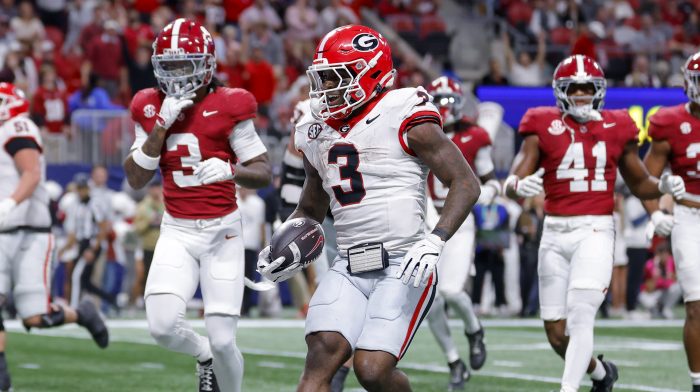
Alabama vs. Georgia — the actual football of it all — matters, though.
This is playoff leverage. These are bragging rights. This is one juggernaut attempting to gleefully sacrifice another. In fact, the last time Georgia beat ‘Bama in Alabama — 2007, for the record — life looked a lot different. Matthew Stafford, now the reigning NFL MVP and 18-year veteran of the league, was Georgia’s starting quarterback. Saban, now three years into retirement, was in his first year as the Tide’s coach.
The longest economic recession since World War II was preparing to start.
James was preparing to begin his fifth NBA season.
And Trump was a reality TV star, fresh off filming Season 6 of The Apprentice in Los Angeles.
Football may not be the vessel, but it is the most precious art form. Sports. An art form sustained by unpaid athletic labor, Black talent who for so long had only a pipe dream’s worth of leverage over how the rules are written.
So set Saturday night in Tuscaloosa as the appropriate scene. Two top-six teams. College football’s greatest current rivalry. The President of the United States. Nearly 100,000 people in attendance, many who are voters. Everyone gathers to watch a sport Congress has made itself a player in. A game America loves so much it wrote a bill without input from a key voice. A bill that may never become a law.
An irresistible force and immovable object meeting like this will have direct implications on the College Football Playoff. But Georgia vs. Alabama is about a reality far larger than football. It’s about Congress. About who generates the revenue. And about the people who determine value. Saturday night is an entry point into voting, power, money and politics — everything America’s been at odds with since its inception.
From kickoff to close, the labor and theater will be worth marveling at — the violence we reconcile in conjunction with the memories the game has always fostered. It’s a family heirloom, and since when has family ever been perfect?
Whichever team wins isn’t as important as the gladiators who determine the outcome still not having the bandwidth to determine their futures. That’s the actual two-minute offense. The clock is running. America moves the proverbial rock downfield, inching to an inflection point the entire world has stock in.
Georgia vs. Alabama is many things to many people. The one thing it isn’t? A game where the ones determining the final score have a say-so in the plays that matter long after the clock hits zero.