
Clippers-Kawhi saga a win for player empowerment, a rare rebuke of NBA ownership
There’s now hope that billionaire team owners will be held accountable
Listen to this story
The NBA’s announcement Wednesday of severe penalties against the Los Angeles Clippers and owner Steve Ballmer for circumventing the salary cap reminded me of a defining league discussion of the past 15 years: player empowerment.
Aside from LeBron James, former Clippers star Kawhi Leonard — a central figure the salary cap circumvention controversy — may be the face of this movement. But judging from the $700,000 fine that Leonard faced, in comparison to the harsher penalties Ballmer and other Clippers executives received, we should have widened our gaze a long time ago.
Instead of defining NBA labor and power through the players, we should have defined it through ownership.
The disparity in punishment for Leonard compared to what the Clippers and Ballmer face is a win for the supposedly waning player empowerment era, and it is a rare rebuke of the NBA’s ownership class.
What happened to Ballmer’s Clippers and former Clippers owner Donald Sterling are truly an apples and oranges comparison, and yet we have to go back to the NBA’s wresting away of the franchise from Sterling to see a punishment so severe — and so justified.
“The NBA’s collectively bargained system for determining player compensation is a fundamental component of the basketball competition that the league oversees for the benefit of the teams and players and ultimately the fans,” commissioner Adam Silver said. “I am deeply disappointed by the flagrant violations of our rules and by the Clippers’ institutional and leadership failures that led to this misconduct. The severity of the penalties reflects the seriousness of the violations.”
Ballmer was fined $30 million and suspended from all team and league activities for a year. The Clippers will forfeit their first-round draft picks from 2029-33. Further, Gillian Zucker, Clippers president of business operations, is suspended without pay for one year, and Lawrence Frank, president of basketball operations, is suspended without pay for six months.
It’s important to assess how we got here. Critics of the league often complained about James’ various moves to South Florida, Los Angeles and other locales, and they have cried foul about power moves such as the rumored one that linked Leonard and Paul George to their crosstown rival Lakers. The narrative, of course, is that these moves affected the league’s “competitive balance.”
Discussions about competitive balance should have always been centered on ownership and the willingness to spend on a winner. The second apron on the luxury tax, designed to punish owners who want to spend on a winning team, makes little sense to the players who want to make more money, or the fans who want to see their team contend for a title every year.
The NBA had to punish Ballmer “for knowingly seeking to help Mr. Leonard obtain off-court income opportunities” because circumventing the salary cap is a betrayal of trust against the owners. Silver was left with no other choice.
It was a tough move for Silver and the NBA, make no mistake about it.
“Is Steve Ballmer the perfect owner?” former TV host Charlie Rose asked Silver in a 2015 interview. “Yes, he’s the perfect owner,” Silver responded.
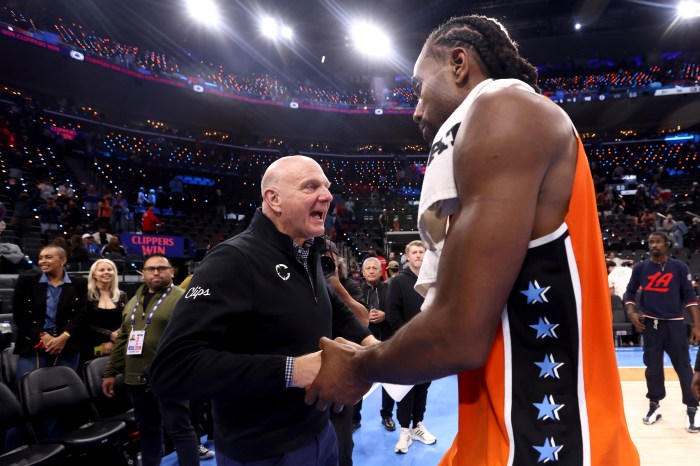
Katelyn Mulcahy/Getty Images
Ballmer’s acquisition of the Clippers represented a changing of the guard — a shift from the “mom and pop” ownership groups to a billionaire tech class with loads of money and a desire to spend. Golden State’s rise to NBA prominence — and its current digs in San Francisco — are reflective of ambitious ownership.
In 2010, the same year James made “The Decision” to join the Miami Heat, Joe Lacob bought the Warriors, who since have won four NBA titles. Moving the Warriors from Oakland to San Francisco is also representative of the influence of “tech bros,” and the name of the arena Golden State used to play in, Oracle, ties back to the Ellison family, who have an eye on controlling significant pieces of media infrastructure.
Some of the (rhetorical) questions weren’t as clear then as they are now. What will the ethics of capitalistic billionaires mean for their million-dollar workforce and the fans who root for them? What will happen when cities tell owners to finance their own stadiums? How will the rising tide of private equity reshape how the NBA does business?
As it turns out, equity was Ballmer and the Clippers’ undoing. A year ago, the NBA opened an investigation into a $28 million equity and endorsement contract between Leonard and Aspiration Fund Adviser LLC, a green banking company that later filed for bankruptcy. Aspiration co-founder Joseph Sanberg was sentenced to 14 years in prison after pleading guilty to fraud to the tune of $248 million.
The NBA’s ownership class has been shaken altogether in recent months, whether it was Mark Walter’s seemingly hurried sale of his majority stake in the Los Angeles Lakers to Bob Iger, former chief executive of the Walt Disney Company, and Josh Kushner — who has ties to the current presidential administration — to the dramatic cost-cutting practices of Portland Trail Blazers owner Tom Dundon.
Dundon’s refusal to contribute to arena upgrades is reflective of the chasm that can exist between ownership and taxpaying fans.
These stories reflect the need for sound decision-making and transparency, which make the role of journalists exceedingly important. It was former ESPN host and personality Pablo Torre who broke the news on the Clippers’ cap circumvention, and as of yesterday, promised to dive into Walter’s dealings. Walter, who is under federal investigation for tax fraud, is also the owner of the Los Angeles Dodgers.
But as someone who has been an advocate of the player empowerment era, and having seen some of the owners’ efforts in the boardroom and throughout media to discredit players, it is good to see the pendulum shift back into the players’ hands, even if for a moment.
I understand that working-class folks and taxpaying citizens have far more in common with athletes than they do owners, even if we put billionaires on pedestals. Billionaires, many of whom have received their wealth through controversial and even unethical means, deserve to face some pushback on what have largely been unmitigated moves.
If Silver’s reluctance turned into retribution against perhaps the NBA’s “perfect owner,” then maybe there’s hope for ownership to be held accountable in other areas, too.