
Dear Black men, we’re killing Black women
Do you understand, my brother?

Listen to this story
I want the perfect words. I want the words that heal. That galvanize. That undo. That reform. I want the words to end it and begin something new. But I don’t have those words. I just have a truth that burns my fingertips.
We’re killing them.
We. Us. Black men.
We’re murdering Black women. And I don’t know how to stop it. Mostly because I don’t know how many of us want it to stop.
On April 19 in Shreveport, Louisiana — not too far from my paternal family’s home, where roughly 60 years ago my grandmother’s husband almost choked the life out of her — Shamar Elkins murdered his fiancée, Shaniqua Pugh, along with eight children aged 3 to 11.
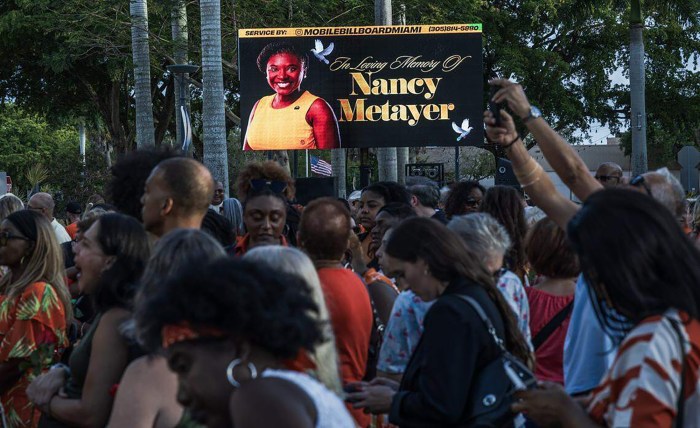
Nancy Metayer Bowen, the vice mayor of Coral Springs, Florida, was killed by her husband Stephen Bowen, according to authorities. Her body was discovered April 1.
A few days later, Eddie McCollum was arrested and charged with shooting and killing his wife, pastor Tammy McCollum. She was killed a day after she gave her Easter sermon, the echoes of her words still reverberating through the church as her life ended.
A wave of headlines telling the same story: Black women and children killed by Black men they shared a roof with.
But it was the murder of Dr. Cerina Fairfax that revealed the worst of us.
Her husband, former Virginia Lt. Gov. Justin Fairfax, murdered her, then killed himself April 16. The murder-suicide occurred months after she filed for divorce and weeks before he was scheduled to move out of the family home. Their two teenage children, who were home at the time of the shootings, are now orphans.
The news of Cerina Fairfax’s murder was shocking, especially for people who didn’t know the full details of their lives. Her husband, the second Black person to be elected to statewide office in Virginia history, had befriended many influential Black folks and was a member of Alpha Phi Alpha Fraternity, Inc. Far too many of those men reacted to the tragedy by eulogizing their “dear brother Justin Fairfax.”
Shortly after news of his death spread, social media was inundated with tributes, commenting on how good a man he was in life. “Justin Fairfax REST IN HIM,” one post read; “My Thoughts And Prayers Are On Former Lt. Governor Justin Fairfax & His Wife. So Tragic,” read another. All of these posts were accompanied by photos of men hugging and shaking hands with Justin Fairfax, with big smiles and brotherhood as if the man didn’t murder his wife.
One such person who posted about Justin Fairfax was journalist Roland Martin, who shared a now-deleted social media post about his friendship with the disgraced politician and his wife. The post was accompanied by a picture of Martin smiling alongside Justin and Cerina. Of the two paragraphs that included thoughts about the former lieutenant governor’s mental health struggles and their shared fraternity brotherhood, Martin included only one sentence that shed any light on who Cerina Fairfax was:
“Cerina, a dentist by profession, was an accomplished woman in her own right.”
And herein lies the rub: How can any Black woman trust us to hold abusers accountable in life if we can’t even distance ourselves from them in death?
The first episode of Martin’s YouTube talk show after his eulogy for Justin Fairfax focused on Black male mental health. And while mental health is a necessary conversation to have, it’s inadequate and insulting for that to be the focus for these acts of violence.
It’s the same thing that often happens with mass shootings and acts of racial violence. The discussion pivots to scapegoating mental health instead of addressing the issues at hand: gun violence, racism and anti-Blackness. We’re doing the same with these horrific killings. The heart of these murders is the scourge of misogyny, hatred of Black women, and the way we take out our frustrations on the women who love and fight for us.
Imagine knowing we are the perpetrators of this destruction, and all we have to offer in return is a Malcolm X quote. You know the quote, right, brother?
X’s “The most disrespected person in America is the Black woman” has become our “thoughts and prayers” — an ineffective salve that only serves to be a warm blanket to comfort us in our complicity. The quote is also constantly posted without any interrogation of the fact that the most famous statement about the injustices Black women face comes from a man.
Imagine for a moment that more than half a dozen high-profile instances of Black men being killed by police had taken place in the span of a month. Imagine the streets. Imagine the protests. And imagine who would be on the front lines of those protests — the same women who have to come home to men who might kill them; the same men who would rather post pictures smiling with those killers than reckon with the true reason those killings have taken place.
It’s not up to Black people to end white supremacy. It’s not up to queer folks to end homophobia. And it’s not up to Black women to end the epidemic of Black men killing them.
So what are you, my brother, going to do? How can you live with this shame? Does the shame even exist?
Pedro Portal/El Nuevo Herald/Tribune News Service via Getty Images
I know this is frustrating to hear. I know you’re full of love, grace, kindness, joy, laughter and care for Black women. I know. And I know how hard it is to live in a world that continues to make you prove that humanity while it tries to deprive that very same humanity from your story. I know.
But we have to see the reality that we can be all those things and still be a weapon in the machine that is harming the women we hold the most dear. No matter how massive or minuscule our role, we are still part of that machine. A cog or a cannon is still a tool.
Brothers, I’m not coming here from a place of perfection. No one is asking that of you. I’ve sat silent in barbershops where sermons on misogynistic ideologies were shared. And it saddens me to be the one to tell you, but no matter your intentions or your actions, there is a woman somewhere who remembers your face because it caused them so much fear. I know you’ve acquired a lot of unearned terror, but hear me out.
A few weeks ago, I was staying at a hotel. One night, I walked to the elevators where a Black woman was also waiting. It was just the two of us. I stayed on my phone checking the scores from the night’s NBA games. The elevator arrived, and she walked in first. She pushed her floor. It was the same as mine. So I didn’t push anything. When we got to the floor, she waited for me to get out first. I made sure to rush out of the elevator so she could feel safe.
Are you confused? Do you understand, my brother?
For however long we were on that elevator, she was at best cautious and at worst scared that I merely got on that elevator to follow her and make her another victim.
And I know you’re tired of being followed in stores, hearing car doors lock when you walk by, or being pulled over for fitting descriptions. And I know you pull out chairs, open doors, pay the tab and are a hashtag girldad. But you need to understand that the Black woman’s carefulness is justified. Their concern is warranted. And it may feel like an insult, but it’s not.
Unlike the store clerk or the cop, these women have seen enough. They’ve seen supposed well-meaning brothers turn into the faces that reside in their nightmares. They’ve had their safe spaces turned into panic rooms. By us. By you and me, my brother. We can’t judge their precautions, because we don’t know what it’s like. We’ll never know the betrayal of intimate partner violence as they do. Remember this. Please, brother. Please remember it.
So what do we do?
I’d be lying if I said I knew how to stop this. We’ve had generations of teaching, grooming and training to bring war to the women who love us. I don’t know how far back we have to go to heal. I do know that the residue is around us. Chris Brown is going on another sold-out tour with Usher, who has done yoga with Russell Simmons and defended Sean “Diddy” Combs. #FreeTory hashtags still fly freely across the timeline. Abusers are celebrated. Violence is justified.
And our boys are watching.
Our first step is in how we teach them to be intentional in our love. We aren’t to teach them to perform love. But to be love, even when the women aren’t around to reassure us that we’ve done enough.
Our boys need to know that their support doesn’t end with their lack of violence. Simply not abusing and merely not murdering isn’t enough. When I talk to fathers about the harm, they often turn to how they are going to raise their daughters.
And it breaks my heart to bear the bad news, but you can’t raise a woman not to be abused — just like you can’t raise any child not to be killed by gunfire in America.
Your parenting can’t stop a bullet. But it can stop the shooter.
But before we teach our boys, we have to teach ourselves. And our brothers. We have to stand up to them. We have to show the radical love of checking them and being willing to be checked without ego. We’re in this together. We have to be aligned for this to work. We have to want a world where Black women are free from even the notion of our harm. We have to be willing — no, enthusiastic — about a shared world where they are our equal.
Are you ready for that world, my brother? Do you want that world?
You have to. Because we’re killing them. Whether with the speed and fury of a devastating act of violence or slowly through psychological and physiological distress.
We’re killing them.
And all we have to do is stop. It feels so easy.
It should be so easy.
Are you ready?