
This Army specialist tried wrestling for the first time just eight years ago. Now she is a world champion.
Adaugo Nwachukwu helped Team USA claim its first women’s wrestling world team title since 1999 by winning gold in her weight class at the Senior World Championships

Adaugo Nwachukwu had never wrestled before leaving her birth country of Nigeria in 2018.
She tried the sport on a whim after moving to the United States. Despite it being very different from the pro wrestling she loved watching on TV back home, Nwachukwu quickly made the jump from novice to breakout star while adjusting to a new culture. She won state championships in high school and national championships in college, even while unsure she wanted to keep competing.
Nwachukwu eventually decided to fully commit, and now, less than two years after leaving college, she’s a world champion. The Army specialist helped Team USA claim its first women’s wrestling world team title since 1999 by winning gold in the 62-kilogram weight class on Oct. 29 at the Senior World Championships in Astana, Kazakhstan.
She wants more — Nwachukwu is fixated on qualifying for the 2028 Summer Olympics in Los Angeles. The 23-year-old finished third at the 2024 Olympic trials and believes she’s ready to take the next step.
“I’ve been saying this for the past two years, that I don’t think anybody is standing in my way,” Nwachukwu said. “And even though there might be people standing in my way, no one is going to stop me from making that 2028 Olympics team.”
Her track record justifies her confidence, but as recently as a few years ago, Nwachukwu was ready to give up the sport. She also considered quitting after her very first tournament and had to be persuaded to compete on the college and national teams.
Success helped her stay interested.
“I think probably after I won my first national title, I was like, ‘OK, this is actually cool,’” Nwachukwu said. “Like, I’m having fun. And I’m actually good at it. … I was winning, and I was loving it. And I was like, ‘OK, I’ll keep doing this, then.'”
The only reason any of it happened is because the sports she played in Nigeria — soccer and track-and-field — were out of season during the winter, and she wanted to stay busy. After she arrived in San Jose, California, a new friend encouraged her to try wrestling.
Nwachukwu’s high school wrestling coach, Frank Ortiz, saw her talent immediately.
“We gave her one move, a move called the blast double,” Ortiz said. “On that very first day [of practice], she walked in and she started, like, nailing people against the wall and shooting through them.”
Tony Rotundo / USA Wrestling
Turns out, Nwachukwu wasn’t just a gifted athlete, owning power, speed and exceptional balance. She was a quick study, too, placing fourth in her weight class at the California Interscholastic Federation state championships while competing for San Jose’s Silver Creek High School as a sophomore in 2019.
Nwachukwu kept improving, and she won a state title at Silver Creek as a junior in 2020. Her senior high school season in 2021 was lost to the COVID-19 pandemic, but she remained active in club wrestling.
She joined the Army later that year and didn’t want to wrestle in college, but Ortiz urged her to do so.
Again, he was right. Nwachukwu won National Association of Intercollegiate Athletics national championships during all three of her college seasons — two at Iowa Wesleyan University and one at William Penn University, where she transferred after Iowa Wesleyan closed. USA Wrestling named her Women’s College Wrestler of the Year in 2024.
Nwachukwu credits Ortiz for pushing her.
“Anybody could be in that situation where your coach or a role model or like, someone — one of your support system — is telling you, ‘Do this,’ or ‘Go see this person, go to this camp, go to this clinic,'” she said. “You don’t know what opportunity or person you’re going to meet that is going to change your life.”
Bruce Robinson is a coach with the Army World Class Athlete Program, which allows athletes to compete at the international level while also serving in the military. Seeing Nwachukwu’s highlights on Instagram and realizing she was enlisted, Robinson tracked her down. After persuading her to continue wrestling and join his program, she finally went all in, putting off her fourth year of college eligibility.
Nwachukwu’s new focus unlocked an increased level of intensity.
“She is mean, and that’s the mentality it takes to win at that level,” Robinson said. “When she gets on that mat, she is mean. When she trains, she is mean. Like, if anything is for a purpose, she knows what she wants to do and she goes out there and does it.”
She entered the world championships on a mission, disappointed with her second-place finish at the Under-23 world championships two weeks prior.
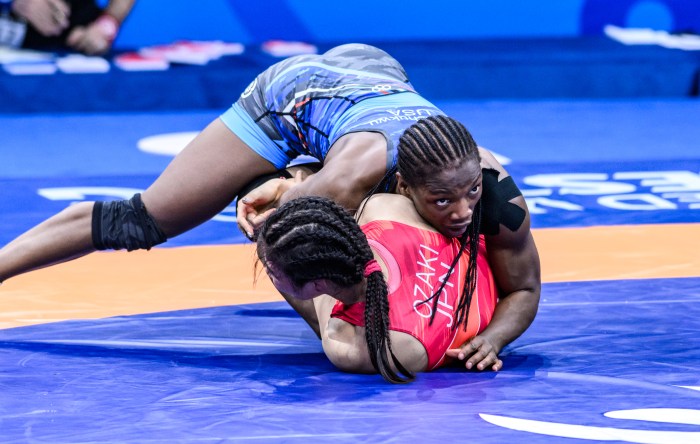
Trailing by two points in the final seconds of the championship match against Japan’s Nonoka Ozaki, it seemed Nwachukwu might come up short again.
Instead, she notched a takedown with one second remaining to tie the score and put her in position to win thanks to tiebreaker criteria. Ultimately, Japan filed an unsuccessful challenge of the takedown, giving Nwachukwu another point and cementing her victory.
“I kind of wanted redemption,” she said. “And just, the last 13 seconds, I was like, ‘OK, this is the time to go get it if you really want it,’ and I did. And it was a great feeling.”
U.S. teammate Dymond Guilford said Nwachukwu was calm heading into the final match.
“She was cool as a cucumber,” Guilford said. “I’m not talking about a fake type of, ‘Oh, I’m trying to stay calm, cool, collected.’ No. She was there. She was present. She was happy. She was laughing. She was joking. Like, she was in her element type deal. And that was already my indication, like, ‘Oh, she’s about to go out there and whip homegirl.'”
Nwachukwu led a diverse roster that helped the United States win its first women’s team gold since freestyle wrestling became an Olympic sport for women in 2004. She was one of five Black wrestlers on the U.S. roster, along with Guilford, who claimed bronze at 76 kilograms; Kennedy Blades, the bronze medalist at 68 kilograms; Precious Wieser, who finished fifth at 72 kilograms; and Morgan Turner, who wrestled at 50 kilograms.
“I’ve never seen this much representation on one team at one time,” Guilford said. “And we all understood the hardships that it took to be at this level, to get here. And we all had a mutual respect and admiration for each other because of that. And we kept kind of hinting to each other like, ‘Bro, what a beautiful time it is for us all to be on this team together.’”
The Americans won the team race 137-135 over Japan, the country the U.S. has been chasing for years — Japan had won the women’s wrestling team title every year since 2013. Nwachukwu’s gold earned 25 team points.
Nwachukwu has taken steps to keep improving. She will wrestle for defending NCAA champions McKendree University this season, her final year of eligibility.
So far, American Tamyra Mensah-Stock is the only Black woman to win Olympic wrestling gold, reaching the top of the podium at the Tokyo Games held in 2021.
Robinson expects Nwachukwu to join her.
“The funny part is, she’s a world champ right now, ranked No. 1 in the world,” Robinson said. “And fundamentally, technical-wise, we’re still a little bit behind some of the other girls, because she started so late. So, I mean, when she gets there, I mean, it’s just going to be a different level. … I see her being almost unbeatable in a couple years.”