
For Dallas Cowboys, Christian Parker is an easy target
First-year defensive coordinator continues to shoulder blame for failures of owner Jerry Jones, organization

The Dallas Cowboys on Wednesday stripped first-time defensive coordinator Christian Parker of playcalling duties, effectively making him take the fall for the unit’s ineptitude in yet another lost season.
He was the easy target.
After Parker’s highly questionable playcalling in an embarrassing 46-40 Week 10 loss to the visiting San Francisco 49ers — when Dallas gave up its most yards at home in its 67-year history — the Cowboys arguably should have boxed up his office and wished him well. There’s just no justification for having 37-year-old edge rusher Von Miller isolated in coverage against 49ers superstar running back Christian McCaffrey.
Predictably, Parker’s poor decision, one of many in his brief time orchestrating the Cowboys’ defense, ended in disaster. McCaffrey dusted the future Hall of Famer before catching a 66-yard touchdown pass from 49ers quarterback Brock Purdy late in the fourth quarter, helping to seal the victory.
But typically for the Cowboys over the past three decades, even when they make a textbook football move, they still find a way to fumble the ball: Parker, the Cowboys claim, remains in the franchise’s long-term plans.
“Christian Parker is still our defensive coordinator,” Cowboys head coach Brian Schottenheimer told reporters in Dallas on Wednesday, apparently with a straight face. “He’s a critical piece of what we’re trying to do as we search for answers and solutions. He has an incredibly bright future. Not just this year but beyond with us.”
Say what?
Whether the Cowboys genuinely believe this or are simply trying to shift the narrative until they can make a coaching change in the offseason, one thing is clear: When it comes to running a football operation, the Cowboys are as misguided as Parker’s defensive strategy.
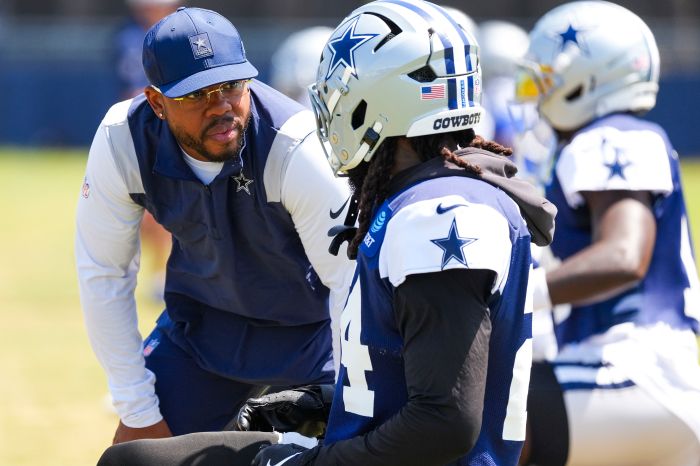
Smiley N. Pool/The Dallas Morning News via Getty Images
With the Cowboys’ defense floundering — leading the league in yards allowed per game at the time — they brought in veteran assistant Mike Pettine on Oct. 12 to help Parker. Barely five weeks later, Pettine was handed the reins of the defense on game day, a coordinator’s primary role.
Twice, the Cowboys have undermined Parker’s authority. Yet they say Parker remains a big part of their future while trotting him out as the public face of the defense.
Make it make sense. It doesn’t, longtime NFL coach Terry Robiskie said.
“What they’re saying … that’s not how it works in the NFL,” Robiskie, who coached 39 years in the league with eight teams, said in a phone interview Tuesday night. “For [Schottenheimer] to say that, that he’s our future, who are you [kidding]? If they turn it around now and play good defense, they’ll never let him get his job back. And if they keep losing — the head coach — he may not be there anymore, too.”
Supposedly, Schottenheimer made the decision to shake up the Cowboys’ coaching staff and demote Parker, 34, the youngest defensive coordinator in franchise history. After the debacle against the 49ers, the Cowboys dropped to last in the 32-team league in yards allowed per game and 30th in points per game.
To be sure, Schottenheimer played some role in the staff changes. Jerry Jones runs the Cowboys as the club’s owner, president and general manager. Make no mistake: Parker is out because Jones approved the move.
And it’s one from which Parker’s career may never recover.
“I’m telling you, they’ve killed his career in the NFL,” said Robiskie, who was an offensive coordinator with the then-Los Angeles Raiders, the Cleveland Browns and the Tennessee Titans. “They’ve literally destroyed him in the NFL. He’ll probably never get a coordinator’s job again, and he’ll probably have to go to college to try to rebuild.
“When [head coaches] look to [fill their staffs], they look at what happened when guys were given opportunities. And when you put him out there like this so quickly, in front of the world like this after only [10] games, he looks like a failure. And that’s not even the worst part.”
In the NFL, there are fates worse than getting fired during a season.
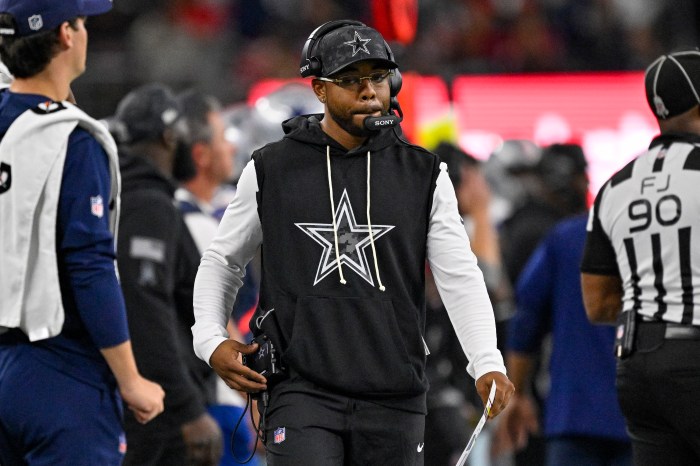
Jerome Miron-Imagn Images
The Cowboys have seven games remaining. Parker is expected to report to work each day to help the Cowboys win, entering a team headquarters in which “no one will respect him because that’s just the way it is” in situations like this in the league, said Robiskie, who helped the Los Angeles Raiders win Super Bowl XVIII in 1984.
“The way they’ve handled it, it’s like you’re saying the whole season is his fault,” Robiskie said. “By making him go in there, it’s like you’re lining him up against a wall each day to just throw darts at him. I’ve seen it before. It’s bad. It’s like [management] is saying, ‘You’re the one who messed it up. You’re the reason we’re in this situation.’ That’s the way they’re making it look.”
The Cowboys’ defensive woes predate Parker’s arrival.
Last season, Dallas ranked last in points and 30th in yards. With Jones making the final call on the organization’s biggest decisions, the Cowboys haven’t advanced to the Super Bowl in more than 30 seasons – squandering some of franchise quarterback Dak Prescott’s best years.
That’s not on Parker, Robiskie said.
“You know, if they were going to do this to him so quickly, they never should have hired him in the first place,” Robiskie said. “They want to blame him, but this isn’t all his fault.”
As legendary head coach Bill Parcells famously said, “You are what your record says you are.” During his brief tenure in Dallas, Parker’s was awful. There’s no denying it.
Over a much longer period, however, Jones’ record has been awful, too. And he must own that as well.