
Jalen Hurts’ health shouldn’t be up for debate
Football has a long tradition of treating Black QB’s injuries as character referendums first and medical events second

Listen to this story
The NFL may have decided not to punish the Philadelphia Eagles, but the team still fumbled Jalen Hurts’ health.
When the Philadelphia starting quarterback called his calf injury a “very unique experience” last week, the first red flag appeared. However, it’s not about what comes next for the former Super Bowl MVP, who is now out for the year. The more troubling question is what the Eagles risked to preserve what little hope they had left in the season.
The league and the Eagles would much rather fast-forward to the Week 7 slate Sunday — or Monday night, in the Eagles’ case — than dwell on the Hurts saga.
Right or wrong, actual football is an elixir to the game’s inevitable controversies. The NFL attempted to close the door, informing the NFLPA it wouldn’t be punishing the Eagles or reviewing protocol as a result of how Hurts’ care was handled. On Tuesday night, the NFLPA kicked that same door in, demanding a “full investigation into what occurred.”
Yet, before that…
The eeriness of a hospital room in the dead of night lives with a person. People live there. Family trees alter there. People die there — in many cases due to circumstances beyond their control. Complete darkness is only disrupted by hallway light seeping in through the bottom of the door. Or a curtain, depending on the setup. Only the sounds of machines monitoring vital signs break the silence.
Maybe a light was on here. Maybe doctors interrupted the machines’ beeps while keeping tabs on a high-profile patient. Regardless, such was Hurts’ reality in London earlier this month.
The Eagles’ franchise quarterback sat in a hospital, per NFL Network’s Ian Rapoport, until 3 a.m. after being told not to sleep because of the risk of a blood clot. How did the team respond to Hurts’ safety already being in jeopardy? He then played the entire game against the Jacksonville Jaguars. Rapoport called the scenario “crazy.”
In reality, it’s far darker.
It’s asinine. It’s inhumane. It’s life-or-death. And it’s a decision that should carry serious consequences.
Kirby Lee-Imagn Images
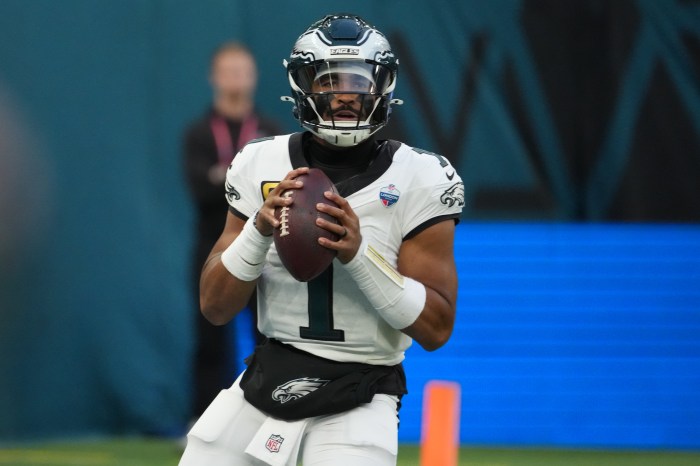
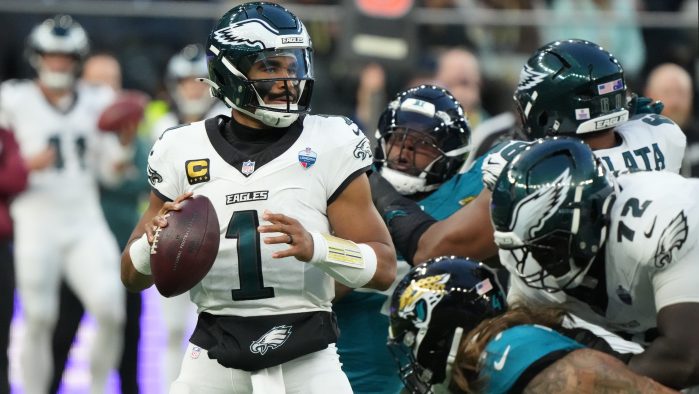
The timeline is the indictment, and the Eagles’ medical staff is directly in the crosshairs. Hurts took a cleat to the calf during the Eagles’ Oct. 4 loss to the Rams. Six days later, he was diagnosed with a superficial clot, and eventually went 21-of-40 passing against the Jaguars in London.
Sources told Rapoport that Hurts was able to sleep approximately seven hours at the team hotel and napped until taking the field for pregame warmups.
Barely a full day in London, but evidently enough time to diagnose a clot and clear him to play.
Over the next several days, Hurts’ clot moved — though the Eagles never specified how much. That turned out to be the worst answer. Hurts was shut down, moved to injured reserve and ultimately ruled out for the season. The official diagnosis was deep vein thrombosis (DVT) along with bilateral pulmonary emboli — requiring at minimum three months on blood thinners.
In less than a week, Hurts’ condition went from “superficial” to clots in both lungs and questions about what the rest of his career — one of the most dissected and debated in recent sports history — will be. But it also begs questions that have become increasingly impossible to ignore.
What did “medically cleared” look like during those dark, early morning hours in London? And what’s the protocol for a superficial clot?
When it comes to pulmonary embolisms, aka “blood clots,” sudden death is the “first symptom” and occurs in about 25 percent of cases. Roughly two-thirds of deaths happen within two hours — making Hurts’ initial “superficial” diagnosis all the more harrowing.
Pulmonary embolisms, per the Centers for Disease Control and Prevention, mark a leading cause of preventable hospital deaths. Clots often disguise themselves as rib injuries, fatigue or calf strains — all common costs of doing business playing professional football. It’s a blitz no one sees coming, not even those whose job it is to decipher them.
Black Americans, in particular, experience far more frequent battles with this reality. Compared to white Americans, Black Americans have 30- to 60-percent higher fatality rates and are three times more likely to die from a blood clot outside a hospital — and have higher odds to die within 30 days of diagnosis. Roughly a third of people with recent DVT’s say they experienced barriers to treatment, citing awareness, cost, racial bias and more.
There are the numbers. Then the words. The Eagles’ 2-4 start has laid blame at the feet of a litany of individuals and parties within the organization — Hurts, fairly and unfairly, being the most obvious of them all. All while his blood was literally clotting.
Last Thursday on NFL Network, Michael Robinson, a former Pro Bowl fullback, insinuated Hurts’ blood clot meant he quit on his teammates. First came the organizational blame.
“It looked like they were trying to pin the outcome of this season on Jalen Hurts,” Robinson noted, “just so that they can have an excuse later on to move on from Jalen Hurts.”
Then came the devil’s advocacy.
“‘If everybody’s hurt, I’m hurt too,’” he said, speaking hypothetically from Hurts’ perspective. “[Maybe he’s] getting himself out of the fray so that this lost season. … He’s pulling himself off so that this doesn’t look like ‘It’s on me.'”
Robinson issued a social media apology Monday, saying his comments were “unfounded” and he “never should have speculated” on Hurts’ health or “commitment to his team.”
Jalen Hurts has long been one of the most polarizing names in sports. When his team wins, the credit goes to the offensive line, skill position players and stout defense. When he loses, it’s because of his perceived inability to maximize such amenities. The truth has always existed in the gray area in between.
Robinson’s comments, however, reflect the grace football inevitably erodes. It’s a game where failure is far more prevalent than success, but a player who fails to meet the expected ratio of success becomes the enemy. That’s Jalen Hurts’ football experience in a nutshell.
That’s why the analysis of Hurts’ situation — without sleep for nearly two days, according to The Ringer’s Tom Pelissero, and ailing in a hospital only to be released to play an NFL game — became so unnerving.
He was said to be ducking accountability. As a Black man playing the most scrutinized position in American sports, he somehow lacked the fortitude it required to play — as if footage of him being benched in the 2018 college football national championship game, a nightmare scenario he handled with grace and bounced back from to become a Super Bowl champion, hadn’t been released days before.
Kirby Lee-Imagn Images
There’s a long tradition in football of treating a Black quarterback’s injury as a character referendum first and a medical event second. Robinson couched it as devil’s advocacy. But speculation doesn’t need malice to do damage — it just needs a platform.
Jalen Hurts, a Black man, is a 28-year-old NFL starting quarterback with every presumed medical option available … and it still almost went left. Now imagine that same clot in a different body that wasn’t as consistently analyzed as the franchise quarterback’s. Imagine if he was your bartender, your hair stylist, or the one delivering your Amazon packages.
Blood clots are no strangers to sports. Mike Williams, a former offensive lineman for the Washington Commanders, experienced one in the summer of 2010. He never played again.
The stark precedent, though, is Basketball Hall of Famer and two-time NBA champion Chris Bosh. About a decade ago, I begged him to retire from basketball for many of the same reasons Hurts faces now. His initial February 2015 clot was, surprise surprise, mistaken for a rib injury. He returned months later and played until February 2016, when a second clot appeared in his leg.
His career, which included 11 All-Star Games and the most important block, rebound and assist in Miami Heat history, was over at 31 … for the same issues that the Eagles allowed Hurts to play through.
Nuance is added when you consider the society in which all of this is unfolding. Hurts is an American citizen; a country constantly at war with itself over healthcare just witnessed an uncomfortable case study.
The joint statement from the Eagles and Hurts’ agent Nicole Lynn is commendable. Though it embodied transparency, it still begs the question: Why did the Eagles feel comfortable putting a player on the field who hadn’t had adequate rest following an international flight, even with approval from doctors in London?
Grace is afforded when empathy lives in the proverbial courtroom. Football’s track record is spotty at best. Asking questions and pressing for accountability is often seen as an overreaction until tragedy strikes. Thankfully, it hasn’t in this case. But what can we expect the next time the sport is forced to confront events that should serve as a reminder that some things are bigger than football?
On Saturday, Air Force Tech. Sgt. Ian Patterson inadvertently plunged nearly 150 feet from the Alamodome rafters onto the field during a pregame ceremony for the University of Texas at San Antonio’s matchup with Navy. He died. The game wasn’t canceled. Instead, it was delayed by roughly 10 minutes, then went on.
The Eagles’ medical staff is under the microscope. How did they determine “qualified,” and how much say did the man who had to play with minimal rest and a blood clot have in the decision? The difference between medically cleared and what’s actually safe is where the most critical juncture lives.
“Oftentimes, we want to catch these things kind of early,” Dr. Jordan Schaefer, a hematologist at the University of Michigan Health System and associate professor of internal medicine at the University of Michigan Medical School, told USA Today.
“It can get, potentially, worse.”
It did. Thankfully, not fatally worse. Nevertheless, in some London hospital, the face of a $10 billion organization sat in a room wondering how his football future and life would be affected.
You can’t just say a franchise quarterback had a blood clot, played an NFL game on a few hours of rest, then developed multiple clots in his lungs — and no one is to blame. As details continue to emerge, it becomes increasingly difficult to shake the notion that Hurts’ safety was treated more like a luxury than a priority.
Given the stakes, Hurts’ well-being shouldn’t have been something to gamble with, just another factor weighed against the cost of playing a backup. The Philadelphia Eagles have to answer for why that was ever up for debate.