
Tampa Bay Rays outfielder Chandler Simpson is a modern baseball outlier
Speed. Putting the ball in play. Simpson, 25, has remained true to his strengths in a power-driven game.
CLEVELAND — Call Tampa Bay Rays outfielder Chandler Simpson a throwback.
In a game obsessed with launch angles, exit velocity and home runs, Simpson is making his mark by putting the ball in play, hitting for average and using elite speed to create havoc on the basepaths.
That style carried Simpson to the major leagues and through a 2026 regular season in which he hit .306, led the American League with 46 stolen bases and became a Gold Glove finalist.
Now, on baseball’s postseason stage, the 25-year-old is showing why putting the ball in play can be just as disruptive as sending it over the fence.
“His bat-to-ball skills are elite,” Rays manager Kevin Cash said. “The speed puts pressure on every defender on the field. He’s an outlier.”
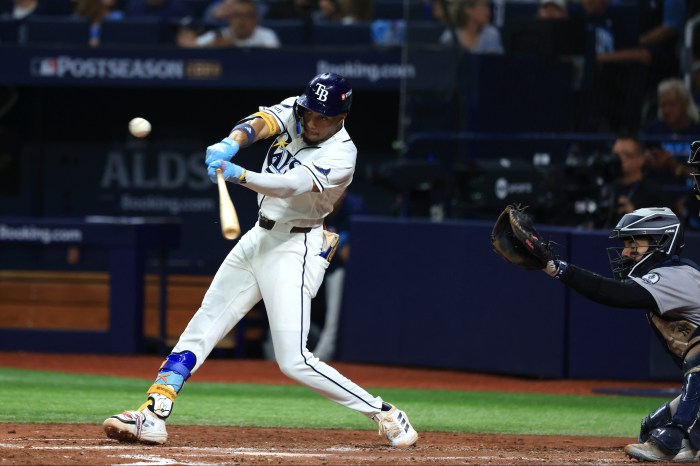
Simpson, who is 5-foot-11 and 170 pounds, has provided examples during the American League Championship Series against the Cleveland Guardians, turning seemingly ordinary plays into opportunities for the Rays, who trail 2-1 in the best-of-seven series entering Friday’s Game 4.
In Game 2, his two-out infield hit in the fourth inning put runners at first and third, extending an inning that eventually produced three unearned runs and helped Tampa Bay even the series 1-1.
On Thursday, with the Rays trailing 1-0 in the fourth inning, Simpson delivered a two-run triple to right field. The hit gave Tampa Bay momentum, but Cleveland rallied for the 3-2 victory.
For Simpson, the approach isn’t something he adopted to stand out in today’s power-driven game. It’s how he’s played baseball for as long as he can remember.
“It was always preached to me that power wasn’t going to be my game,” Simpson said. “So from an early age, coaches, my younger coaches, were just like, ‘You’re going to have to play the speed game.’”
Instead of swinging for homers, Simpson embraced the tools that made him different. Even as baseball increasingly rewarded power, he remained true to himself.
“I’m just leaning into my strengths, because if I’m 100 percent focused on that, then it gives me the best chance to be successful for the team,” Simpson said.
Kim Klement Neitzel-Imagn Images
Simpson’s path for success was developed at home in Georgia by his father, Dr. Ralph Simpson, a school administrator, and his mother, Dr. Edye Simpson, a school principal.
“I learned time management and responsibility from my parents,” Simpson said. “They taught me work ethic and drive when it comes to education. I use those same principles in baseball.”
This also meant a deep study of the game by watching hours of players Simpson tried to emulate, such as Dee Strange-Gordon and Billy Hamilton — former big-leaguers renowned for elite speed and baserunning.
“I embraced their skill set and incorporated that into my style of play,” Simpson said.
Simpson was raised in the hotbed of Black baseball in the Atlanta area, led by men such as former major leaguer Marquis Grissom, who founded the Marquis Grissom Baseball Association (MGBA).
The travel baseball teams Grissom has sponsored and mentorship he has provided has produced many professional players, including Simpson, Michael Harris II (Atlanta Braves) and Lawrence Butler (Athletics).
Grissom trains many of his players on land he owns that features a 180-yard incline. The players formed a group called “The Hill Boys.”
“That Hill Boys select group is guys who really come and grind and work their ass off during the offseason to get better, to try to get to that next level,” Grissom said. “And Chandler is an example of that.”
For Simpson, the grueling workouts are essential to maintaining the speed that has become his trademark.
“Just really strength-wise, legs, getting ready for a long 162-game season, spring training and postseason as well,” Simpson said. “So, making sure that we’re conditioned, making sure we’re strong in the lower half — because that’s the first thing that really starts to go throughout the course of a season.”
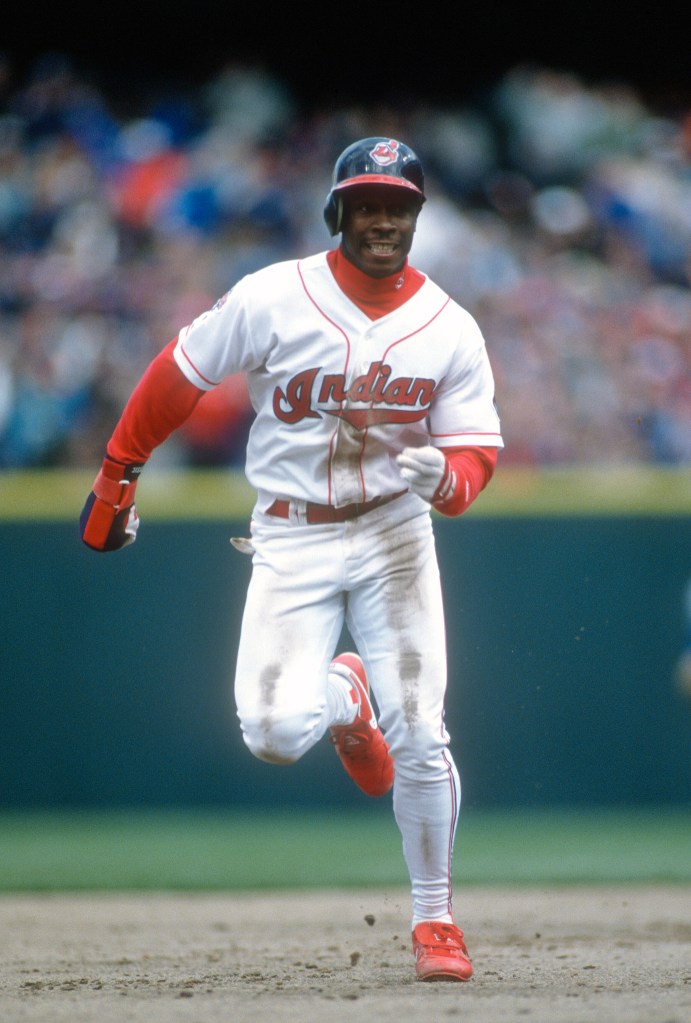
Former Cleveland All-Star Kenny Lofton, 59, appreciates that Simpson represents a style that has become increasingly rare in baseball, where home runs often overshadow speed, contact hitting and manufacturing runs.
“It’s great to see somebody like him showing what he can do and bringing speed back to the game,” said Lofton, who stole 622 bases during his 17-year MLB career, ranking 15th on the all-time leaderboard.
But there’s still the issue of baseball’s emphasis on power for Lofton, and it has come at the expense of players who rely on speed and putting the ball in play. He argues teams are less willing to invest in players whose strengths don’t include hitting home runs.
“When you put the ball in play, a lot of good things can happen,” Lofton said. “When you don’t put the ball in play, can’t nothing happen. You can’t even have a guy make an error.”
Lofton hopes Simpson’s style can help change that thinking, which could lead to general managers adding more of these types of players to their rosters.
“I would have a couple of Chandlers on my team,” Lofton said. “And I would put some guys on my team who know how to put the ball in play.”
Focus on Sport/Getty Images
Simpson doesn’t want to change baseball’s emphasis on home runs and power. He said there’s room for players who succeed differently.
“I know that power is the mantra of how the game is played today, but I feel like you can play the game with bunts, baserunning, defense, contact — how the game was originally invented to be played,” Simpson said.
For young players who don’t possess the power that today’s game often celebrates, Simpson hopes his journey provides encouragement.
“I’m just glad that I can be an influence and inspiration to other kids that have my style of play and feel like it won’t translate to the next level,” Simpson said. “That it can [translate], and they can go all the way as well.”
Twenty-seven years ago, a popular Nike commercial featuring then-Atlanta Braves pitchers Greg Maddux and Tom Glavine delivered a memorable line about baseball’s fascination with home runs: “Chicks dig the long ball.”
Simpson offered a different perspective when asked about the famous slogan nearly three decades later.
“I don’t care what they [dig],” Simpson said with a grin. “I know the short ball can win games, and that’s what I’m about.”