
Daejon Love’s 49ers scam merits more than just laughs
The focus has shifted away from victims and accountability for Love’s actions
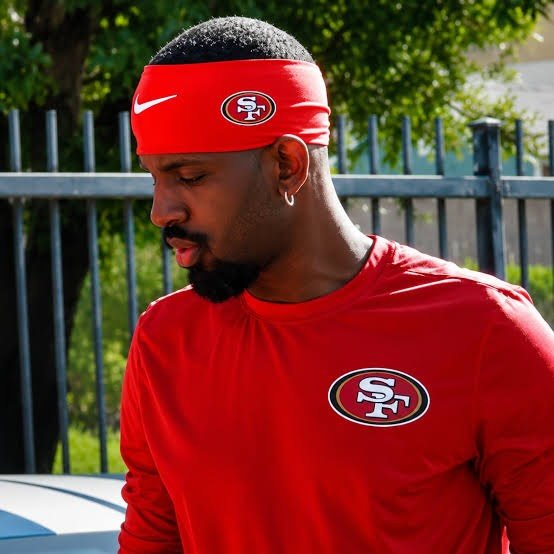
I wanted to laugh at Daejon Love — if that’s his real name — and his impersonation of a San Francisco 49ers wide receiver. I really did.
I did laugh at a meme that was posted after Aaron Donald announced his return to the Los Angeles Rams. The top caption read “all this,” showing Donald, Myles Garrett, Puka Nacua and Matthew Stafford, while the bottom caption read “to stop one man,” with Love pictured below.
Memes and spoofs, like the one Lou Young crafted at Love’s expense, are harmless. What’s not harmless is the reality of the situation. Prosecutors say Love stole over $1 million from more than 20 women. Some people find it funny, arguing the victims should have “known better,” or viewing it as a type of retribution for “gold diggers” who scam pro athletes.
I think it’s all absurd — and that’s not just celebrity culture, but America. Hell, people are scared of lettuce these days. Speaking of greenery, one of the top shows on TV follows an American expat who built a weed empire in London and now moves like a mob boss. Meanwhile, in real-life America, we still don’t know what really happened to Nolan Wells.
Collectively, we’ve responded to celebrity and calamity the same way we do most things in this country: with humor, cynicism and disregard. While the laughs are harmless, our inaction and compromised sense of justice are not.
I listened to Stephen Jackson and LeSean McCoy weigh in on the saga. Jackson, who famously mourned the murder of his longtime friend George Floyd, offered an odd defense of Love.
“I see y’all laughing at the dude. Y’all ain’t no better than him,” Jackson said. “A lot of y’all still got hoop dreams; y’all just ain’t walking around with a uniform on. … The only difference is he’s wearing a helmet and a jersey. Most of y’all are fake, and none of y’all know what you’re talking about.”
Floyd is an important reference point because the trauma that Jackson holds should inspire empathy, even if the stakes of Love’s alleged crimes are not life and death. Instead, the former NBA player shifts focus away from the victims and accountability for Love’s actions, and Jackson uses his platform to punch down at those less accomplished than he is.
McCoy leaned into his “Shady” nickname by offering a gender-based, retribution-forward narrative: “I love Daejon Love, and let me tell you why. … Every time a man does something, they want to crucify us for it. I watch women do this all the freaking time!”
This is, of course, an exercise in intellectual dishonesty. Love’s scam used fake investments to target and defraud women. What Shady did on his podcast was project his personal dealings of his dating life, and he tacitly admitted as much: “I’ve been finessed a lot,” he said.

Aaron J. Thornton/Getty Images for BET
Blurring the lines of decency — of mutual respect between men and women, celebrity, and accountability — is essential to scamming.
Some suggest Love’s behavior stems from an incantation by rapper Yung Miami, born Caresha Brownlee, whose “Spend Dat” is an ode to scheming and is arguably the song of the summer. “Where all my scamming ass n—-s at? / Spending that money fast,” the City Girls founder sings on the hook. “Boosting b—-es, where y’all at? / Stuffin’ that s— in y’all bag.”
The song is a case study in how we interpret entertainment and empowerment. Ultimately, the throughline for most people is not education. It’s exploitation. Before detractors of Yung Miami groan and declare, “Caresha, please,” understand that the game is bigger than her and has been for a while.
I revisited a 2018 profile on Yung Miami and her former City Girls bandmate, JT, with the headline: “City Girls Are More Like You Than You Think.” It painted the duo in a stunningly honest light and discussed their upbringing, along with the realities of jail time for JT, who had been locked up in federal prison for credit card fraud.
This quote from music producer Kevin “Coach K” Lee got my attention.
“I don’t think [City Girls] are political, but the situations that they’ve been put in are political. This world is male-dominated and crazy,” he told Naomi Zeichner of New York Magazine’s The Cut. “Miami and JT, they’re the voice for women who have voices, but don’t get to use them. They’re like, ‘Oh I got a voice?’ Then we gon’ really let them have it.”
Daejon Love is no innovator. Like Jackson, he disregards the meritocracy and self-esteem of former athletes who didn’t make the professional ranks. Like McCoy, he offers commentary that suggests a disdain for women. There are times when a scammer’s actions sound like a cry for help, or in the case of City Girls, is more of an F-U declaration. And then, there are folks like Love who scam for the love of the game.
Being fair, that “love of the game” is bigger than our dear friend Daejon. The game, of course, is greed. Capitalism. The love of money over everything else. The Federal Bank of Cleveland just released a report about the record number of wage thefts occurring in the United States:
In fiscal year 2025, the US Department of Labor recovered more than $259 million in back wages and damages owed to 176,957 workers (US Department of Labor, 2025). These recoveries were in response to various forms of what is termed “wage theft,” including unpaid overtime, unlawful wage deductions, and minimum-wage violations. However, this figure comprises only the amount recovered through government enforcement. Existing research estimates that from 2013 through 2015, workers in the 10 most populous states experienced minimum-wage-violation underpayments of $8 billion annually, affecting 2.4 million workers, with the average affected worker underpaid by about $3,300 per year.
By now, you’ve heard about the Los Angeles Clippers’ scamming ways, and how Mark Walters’ majority sale of the Los Angeles Lakers has drawn scrutiny as he faces federal investigation. Terrell Owens, a real former 49ers receiver, said the energy the feds are directing toward Love should be directed toward Pro Football Hall of Fame quarterback Brett Favre, who is linked to the largest welfare scandal in Mississippi history.
“[Niners] in the news again for all the wrong reasons. And I know this is probably not good to say, but you look at what he’s done, scamming women out of X amount of dollars. Brett Favre scammed a lot of people outta money too, and he’s still walking around. So if that’s the case, Brett Favre should be in jail, too,” Owens said.
I can hear detractors of this column now. “It ain’t that deep,” you’ll tell me.
I wish that were true.
But the response to Love’s shenanigans suggests something different: from rich and famous former athletes who see this as retribution against women, to people willing to say or spend anything to get close to fame.
There’s a picture of Love looking over a birthday cake shaped like 49ers No. 7 jersey. The irony is caked on thick, to put it mildly. For starters, that’s Colin Kaepernick’s jersey, not Love’s. A decade after he kneeled, Kaepernick’s status in cultural history is undisputed.
But there’s another reason “love” does not belong on that jersey: We’ve become far too cynical about things that truly matter.