
‘Lanterns’ explores what is gained — and lost — in the pursuit of being a Black superhero
Episode 3 grounds John Stewart’s origins against the backdrop of race relations

Listen to this story
Black boys know about the talk.
It’s as much a part of our lives as America itself. Whether it was about surviving chattel slavery, avoiding eye contact to escape the fate of Emmett Till or navigating a modern traffic stop — instilling survival into our boys through practiced drills and forced recitals has long been a devastating rite of passage for Black parents and their sons.
The third episode of HBO’s Lanterns, released Sunday, takes “the talk” to an intergalactic level, using John Stewart’s origin story to merge science fiction with very real anxieties about raising Black boys in America.
Here is some background — or lore, as your kids might say.
Stewart, played by Aaron Pierre, is the protégé of Hal Jordan (Kyle Chandler), the current Green Lantern tasked with protecting planet Earth by the Guardians, a mysterious alien force. The men’s relationship has been tense and combative.
Co-creator Damon Lindelof, who was also the mind behind 2019’s Watchmen, has brought some similar beats to Lanterns — a series that takes a comic book staple and grounds it in sociopolitical issues such as race, economics and politics. Most of those issues stayed in the background for the first two episodes, but it all came to the fore this week.
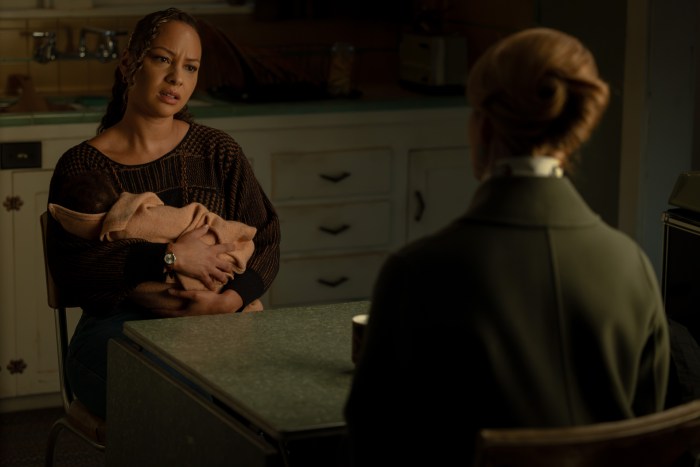
Episode 3 focuses on Stewart’s history: His father was passed over for the role of Green Lantern because he told the Guardians he was afraid. The rejection drove his father to depression, while his mother was determined to find a different path for their son. When a Guardian visits Bernadette Stewart (Jasmine Cephas Jones), she explains the toll the snub has taken on her family and why the decision itself is misguided.
“Do you understand how unfair it is to ask a Black man in America if he’s afraid?” she asks.
The scene reveals that the Guardians hadn’t considered race and how it factors into who is seen as worthy and who has the privilege of being fearless in the world. It’s an eye-opening moment about who gets chosen to be a superhero and why — and what is lost when race and its obstacles are ignored in deciding who is worthy to carry the mantle.
There is been plenty of misreading of this moment — some by bad-faith internet actors looking to denigrate another “woke” television series, but also some genuine confusion that needs clearing up. John’s mother, and by proxy the show itself, is not saying Hal was chosen to be the Lantern solely because he is white.
He simply benefits from a system that fails to understand privilege and race, rewarding a white man without considering the nuances of the decision. The exchange is an indictment of a system rather than a targeting of one man.
HBO
The Guardian sees the mother’s conviction and agrees to give John a chance to apply to be a Lantern later in life. That charge leads John’s parents to spend the next few decades raising a child who will live without fear so he can be ready to become a Lantern when the time is right.
“Parents of Black boys often have to negotiate the thin line between loving their kids and preparing them for the harsh world around them.”
That training explains who John becomes as an adult: His parents hardened him to make him fearless. This meant forcing him to stand still as his dad shot an apple off his head (as we saw in the first scene of the series premiere), leaving him to walk alone at night, and relentlessly training him to be the perfect soldier for the intergalactic police force.
And though John’s parents are training him to be superhuman, the metaphor is clear: This is what it often takes for many Black boys to survive and strive in America.
Parents of Black boys often have to negotiate the thin line between loving their kids and preparing them for a harsh world. That preparation can strip away our innocence and joy. How can it not, when the cops we once aspired to be can end our lives? When friends we want sleepovers with have parents who don’t want us around? When entering the wrong store gets us followed, or holding the wrong toy gets us killed? Preparation might keep us alive, but at what cost?
John Stewart’s origin story faces that trade-off head-on. He still loves his parents, sure, despite their distance and hardening. But he’s a soldier willing to follow orders, even if it means staying put in a chair overnight because the Guardian told him so, or camping out alone eating berries and leaves for nine months to complete a mission.
He does so with minimal emotion. He appears solely driven by his mission, and you’re left wondering where he’s made space for happiness, emotion or vulnerability.
The episode, though, isn’t just about the emotions that are pushed down.
When John’s military career ends, his mother enrolls him in art school. He’d been drawing since he was a child. At that school, his ability to illustrate from memory with great detail earns him an interview with the Guardians.
After John spent his entire life being fearless, it was his creativity, his love of art, that actually got him what he wanted. The message shines through: Even though Black boys are often required to hide emotions to survive, it’s that freedom to explore our art, our passions and the joyful escapes that will truly get us to the precipice of our dreams. It’s a glimmer of hope, hinting at something deeper in John’s upbringing than previously revealed.
Lanterns has so far given us a compelling and complex view of the Stewart family, grounding a superhero story in an authentic Black experience. However, I’m not convinced this is the last we will see of the Stewart parents.
We’ve seen the results of their refusal to let John experience fear and the benefits of letting him explore art. But there’s more to him — and his parents — than that. We may still get a complete look at how he was raised, and the people who raised him, before the eight-episode season ends.