
Russell Westbrook, retirement and unspoken superpowers
Future Hall of Famer leaves behind a one-of-a-kind legacy of intention and intensity
Listen to this story
Russell Westbrook, a force of nature and inevitable first-ballot Hall of Famer, retired from the NBA on Wednesday in a manner worthy of his career — with praise and prestige from a man named Michael Jordan.
I mean, why not? Jordan Brand has often been a defining part of the Westbrook mystique. A decade ago, as a precursor to his MVP campaign, a commercial for the Jordan Westbrook 0.2 sneaker dropped with some memorable theme music — Lil Uzi Vert’s “Do What I Want.”
It was a self-fulfilling prophecy for the man who would become this generation’s Oscar Robertson, a true master of the triple-double. With respect to the cerebral Jason Kidd and the indomitable Nikola Jokic, it is Westbrook who is most synonymous with the statistical achievement — and anomaly.
But in true Westbrook and inner-city Los Angeles fashion, having one Michael Jordan bless your career is not enough — word to Kendrick Lamar. And so, Westbrook’s retirement video was narrated by actor Michael B. Jordan, in a spot called “The Museum of Unspoken Answers.”
The carefully crafted and Hollywood-produced piece, 210 seconds in length, ended with this caption: “The greatest thing he left behind couldn’t fit inside a museum. It never had to be said.”
I never thought “playing with a chip on his shoulder” would be an inadequate description of Westbrook, until he retired and I realized something. What constitutes that chip? What defines it? Shouldn’t it be chips, like a bag of Lay’s or a can of Pringles? Is it enough to laud Westbrook’s intensity and athleticism? The curation on display in the retirement video offers a clue, with our hero’s vast accomplishments accentuating his gap-toothed smile and confident smirk.
Westbrook, 37, is far from a wild man. His superpower is his intentionality — not was, but is.
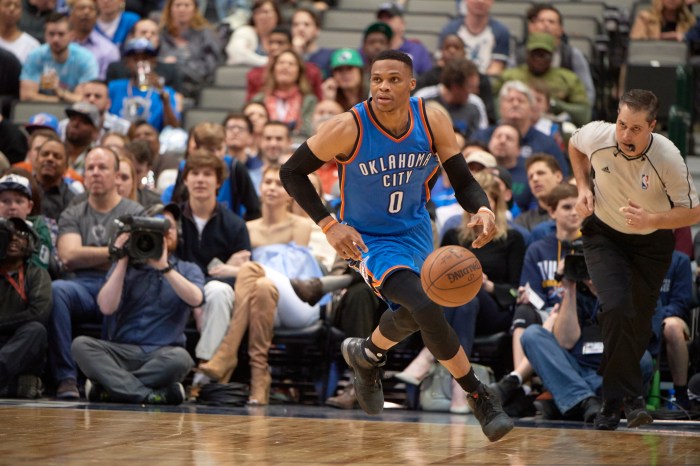
Greg Nelson /Sports Illustrated via Getty Images
It would be easy to suggest that being overlooked as a high school basketball player in L.A., then being underrated at UCLA — college hoops’ championship standard-bearer — would fuel his basketball passion. But doing so doesn’t grant Westbrook the title he deserves: savant.
Look how intentionality has informed his life. Basketball is only the beginning of his talent. He gives back to the inner city with vigor. He loves his wife and children with intensity. And the love reverberates. “Always bts. Always us. Always our hero,” Nina Westbrook posted on Instagram after her husband announced his retirement, captioning photos of him and their children behind the scenes at the video shoot.
In a world that often told him “no” or “not,” Russ’ response to his wife’s post revealed the driving force behind his success: “My WHY!!!!”
“Why Not?” is Westbrook’s mantra, an incantation. It’s hard to imagine anything being louder than Kevin Garnett winning a championship and yelling, “Anything is possible!” As proof, I would like to present to the court the NBA career of Russell Westbrook. What a love story it has been.
It is at times playful, like Russ sneaking snacks on the bench or vibing out to Lucy Pearl’s “You.” There are poignant moments, such as the 20-20-20 game to honor his friend, the late Nipsey Hussle. The common theme here is taste: musical preference and the bitter aftertaste of losing a homeboy in the familial and community sense.
Every measure of pain that comes from existential whys becomes the fuel for our why nots. It is the place where humanity meets divinity — a good place for a player whose every step is intentional.
Intentionality is irresistible, magnetic even. It has driven Russ to both basketball ecstasy and madness. His fierce rushes to the rim — the kind that break a lesser man’s hands — define this drive. Yet this magnetism is polarizing. Critics questioned his usage and utility, suggesting that anything less than a championship was failure.
Comparison is truly the thief of joy. Westbrook played during an era when point guards were as much traditional playmakers as they were explosive matchup nightmares. Point guards are supposed to distribute the ball and knock down a few long-range shots, not put you on a poster or shoot volume 3-pointers. Derrick Rose. Damian Lillard. Stephen Curry. Chris Paul. John Wall. Deron Williams.
The Big O knew. He told Westbrook it would be like this.
“I went out to see him in Oklahoma. I was happy for the guy, but man, I said, ‘They’re going to turn on you,’” Robertson said on the “All The Smoke” podcast. “Because they’re going to expect you to do this every night. And even if you do it and don’t win, they’re going to blame you. They’re not going to blame anybody else.”
The pressure made Westbrook louder. It felt like more manifestation, because he was drafted as a Seattle SuperSonic, and then when the team moved to Oklahoma City, the word “THUNDER” was fittingly emblazoned on Westbrook’s chest. Yet even as the 6-foot-4 triple-double machine remained a blur posting those shocking stat lines, he proved to be a top-flight teammate — whether publicly celebrating mentor Nick Collison or speaking up for Steven Adams against ravenous reporters.
And then there was his relationship with former OKC teammate Kevin Durant. Their brotherhood turned bitter when Durant left for Golden State following a stunning 2016 Western Conference finals collapse.
The Thunder’s once-promising young core of Westbrook, Durant, James Harden and Serge Ibaka had dwindled to Russ alone in Oklahoma City. But his electricity was enough to power a franchise, and Sam Presti — the same general manager who “fumbled” OKC’s first young core — regrouped and has since built a new powerhouse. It wouldn’t have been possible without Westbrook’s superpowered feats and steady hand as a teammate.
“Russell Westbrook is the ultimate competitor. His internal belief and unbridled fearlessness helped establish the foundation of our organization from day one in 2008, and he elevated the confidence and inspired our community in every year thereafter,” Presti wrote in a statement after Westbrook announced his retirement. “Russell will be as successful in his life after basketball as he was during his career because his qualities and gifts transfer.”
Transfer. Like electricity. Like thunder.
As it turned out, Durant, Westbrook and Presti fulfilled their destinies. Durant and Presti became champions. Westbrook became undeniable. KD reflected on Westbrook’s career in a beautiful and sentimental commentary on X. This excerpt in particular caught my attention:
“Some of us wish we could go back and do things with a little more intent and some can just wipe their hands and be satisfied with the time spent. Who u gonna be? We know what (Westbrook) was on,” Durant wrote.
When you’re on like that, you can’t turn it off, not even in retirement. And there’s really not much else that needs to be said.