
Doc Rivers still fighting for NBA coaches as he enters Basketball Hall of Fame
2026 inductee talks mentorship, the Hall call, his biggest coaching influences, and more

CHARLOTTE, N.C. — Doc Rivers felt nervous on the morning he expected a call from the Naismith Basketball Hall of Fame about whether he would be inducted as a coach in the Class of 2026. Rejection a year earlier during his first bid did nothing to ease his tension.
The 64-year-old felt his anxiety grow as his phone stayed silent.
“It’s so funny. They tell you a time period. Like, ‘Hey, the Hall is going to call between 9 and 11.’ That call doesn’t mean it’s a good call,” Rivers told Andscape from the Ritz-Carlton Charlotte on April 18. “And I had physical therapy that morning from 8 to 9. Right after, I told the therapist, ‘Hey, I got to be done about five minutes earlier today.’ I drove to the office, so right at 9 I walked in the office and there’s no phone ringing. I’m like, ‘OK. So there ain’t a cellphone call.’
“So about 9:15, I get a ping, text, and it was like, ‘Hey Doc, we’ve tried to call you twice, but you haven’t picked up the phone.’ I didn’t realize, because I’m old, that I have my phone blocked to unidentified numbers, and obviously I don’t have, like, ‘Hall of Fame’ saved on my phone. So I said, ‘Oh my God!’ So, I said, ‘Call back. Phone’s on.’
“They call, and the first thing [Naismith Basketball Hall of Fame executive director John Doleva] says is, ‘Hey, I want to be the first to tell you [that] you’re a member of the 2026 Hall of Fame.’ And that was awesome.”
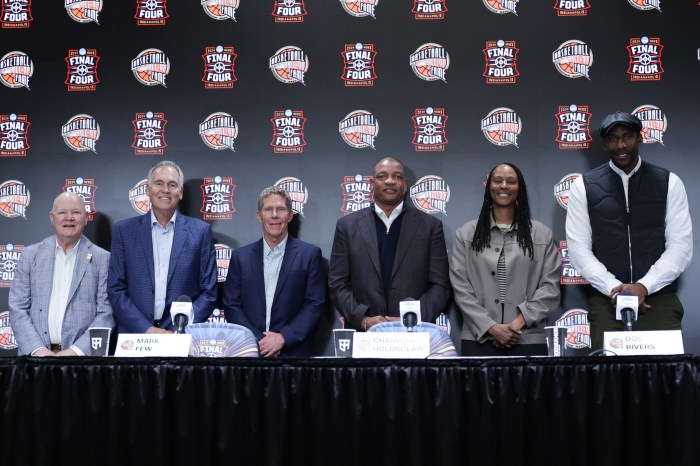
Rivers was named to the Naismith Basketball Hall of Fame as a member of the Class of 2026 on April 4. Rivers, former NBA star Amar’e Stoudemire, and former WNBA star Candace Parker, among others, will take part in the formal enshrinement ceremony Saturday in Springfield, Massachusetts.
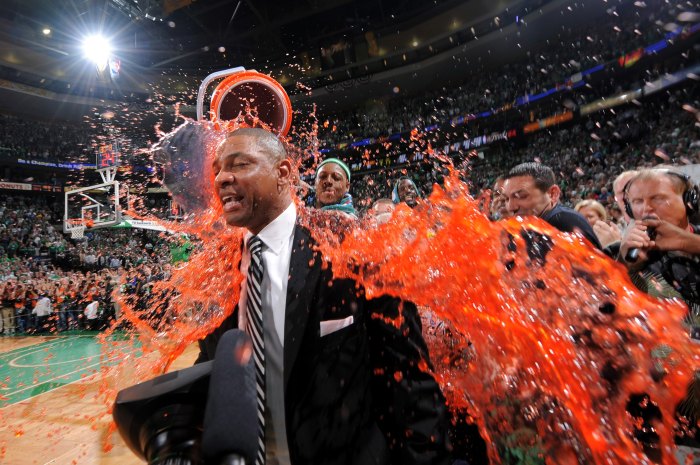
Escorting Rivers for his speech will be Hall of Famers Ray Allen, Kevin Garnett and Paul Pierce — the trio he coached to the 2008 NBA championship and the 2010 NBA Finals with the Boston Celtics.
Rivers has a 1,194-866 (.580) coaching record and ranks sixth among NBA head coaches in career wins. In 2022, the 2000 NBA Coach of the Year was named one of the 15 greatest coaches in NBA history by a panel of 43 current and former NBA head coaches in collaboration with the National Basketball Coaches Association.
He is also fourth in NBA history in playoff coaching wins (114). Of his 21 playoff appearances, 17 have come in the past 18 seasons, with the 2025 postseason marking his seventh consecutive playoff trip. Rivers also coached the Milwaukee Bucks to an NBA Cup title in 2024.
A 1988 NBA All-Star player, Rivers began his head coaching career with the Orlando Magic from 1999 to 2003 before serving as head coach of the Celtics (2004-13), Los Angeles Clippers (2013-20), Philadelphia 76ers (2020-23) and Milwaukee (2023-26). The Bucks announced Rivers’ departure from the organization in an April 13 statement, and he told Andscape it was “100 percent my decision” to leave.
After initially playing it cool, Rivers admitted he became emotional when speaking with his brother about the Hall of Fame news.
“My assistant, Annemarie [Loflin], was in the office. And she knows me more than about anybody,” Rivers said. “And she always calls me ‘Rivers.’ She said, ‘Rivers, you know you can be happy right now. You know you can embrace this.’ I was like, ‘I know, it’s just kind of uncomfortable.’ She lost her mind about it. So, I called my brother, and that’s when I got emotional because he answered the phone — he was golfing — and he started crying hard. My brother’s tough.
“And the first thing he said was, ‘Mom and Dad,’ because my parents are no longer with us. And he said, ‘I just can’t.’ I start thinking about how my mom would have looked at the ceremony, and then I got emotional. That was hard. It was awesome, but so emotional because, man, that would have been cool.”
In the following Q&A, Rivers reflects on his Hall of Fame induction, on endorsing active head coaches for the Hall of Fame, the highs and lows of coaching, the importance of being a mentor, what his mentors meant to him, and more.
Jeff Haynes/NBAE via Getty Images
Was it a relief to make it to the Hall of Fame?
I believed that I was going to get in at some point. But it was a relief that I was in. I wanted to get in while I was still coaching, and I achieved that. I championed that. I really fought early on for Pop [Gregg Popovich]. I’ve always got something I’m fighting for. I just felt like Steve Kerr, myself, Spo [Erik Spoelstra, should be Hall of Famers]. College coaches get to coach and be [named] “Hall of Fame coach.” But [active] NBA coaches rarely get that.
I really believe it would have saved some of these guys’ jobs, like George Karl. … His career should have been in the Hall. Then he gets in after he leaves [coaching]. But would he still have been coaching if he was “Hall of Fame coach George Karl?” So, it’s a big thing for me, and I’m still pushing to get Rick Carlisle in now. It’s so funny. I’m in, but now I’m still working for NBA coaches.
When I found out that you don’t need to retire to get in — because that was what we were told early, and that wasn’t true — I really started pushing it. So, yeah, it was a relief to get in. I knew my numbers. Everybody in the top 10 [in wins] is in the Hall of Fame. Half of those guys have never won a title. I’m in the top four in playoff wins. So, I knew I was going to get in at some point. But it’s still an amazing thing.
What are you most proud about in terms of getting in?
Winning a title almost makes you a Hall of Fame coach. Getting to the Finals twice, you’re definitely going to get in. For me, though, it’s the wins when you shouldn’t have won. You don’t get credit for the wins you’ve had when you lose. I go to being in Orlando and up 3-1 in the Detroit series [in 2003]. We were the eighth seed. There’s no way we should be up 3-1. I felt like that is as good as you can coach a team. But then we lose three. That [Pistons] team went on to win a title [in 2004]. We ended up breaking the whole team up because we weren’t good enough.
Look back on all the single wins, not the championship. I win where you have no business [winning]. Those are the things you look at. But I still keep going back to the relationships. I have amazing relationships with a lot of guys. I have some bad relationships with guys, too. And whenever I speak at coaching clinics, I always tell them this: “If you want to be a coach, you better be ready to get your heart broken. If you don’t have the heart for it, don’t do it.”
Because if you don’t tell them and they don’t become successful, that feels way worse. So, yeah, that happens a lot, but more on the positive side. The negative side gets the press. We don’t get along with the player; they don’t get along [with us]. But I did learn a valuable lesson, too, in life that just because you don’t get along with the player does not make the player a bad person. That’s the one thing I tell coaches, too.
My rookie year as a [head] coach, I got calls about Armen Gilliam and Chris Gatling from other coaches. “You don’t want them guys on your team. Bad guys.” Those guys were amazing for me, and that’s taught me a valuable lesson. Well, they might have been bad guys for them, or it didn’t work, but for me they were phenomenal. And that taught me a huge rookie lesson.
What do you think of your coaching tree that includes Tyronn Lue and Tom Thibodeau?
I love it. It’s growing. Ty [Lue], I just couldn’t be prouder of. The guy that is not a part of the tree yet, but I think Rajon Rondo is going to be one hell of a coach. He’s the smartest human being I’ve ever coached, and he works at it. He was with me all this [past season in Milwaukee]. Now he’s a savant — and that doesn’t go well at times, because he sees [the game differently].”
We talk about it all the time. “You were a hell of a point guard, too, coach.” “Yeah, I was a good point guard. I wasn’t a hell of a point guard. I was a solid point guard.” And he’s like, “Coach, you were plus-10. You see it, and they don’t. How do you handle that?” I said, “You breathe, because you learn patience.” And that’s what he’s going to have to work on. But he will get that.
You also were coaching as the social media era was born. And I don’t know if there’s any coach who dealt with more social media hate or comments about losing a 3-1 lead. What do you want to say to those people?
I don’t say anything to anybody. I don’t care. Social media is what it is — a lot of cowards. A lot of people make comments. I wish everybody would love me. And the ones that I don’t, I don’t care either. You know what I mean by that? I don’t care about all that stuff. It definitely changed players for sure, but it has had no effect on me.
As a coach, you have made a lot of speeches. How is this Hall of Fame speech different?
I’m not trying to motivate anybody at the Hall of Fame, whereas in the locker room, you know what you’re trying to do. I have written this speech 10 times over the last year, and it’s not good enough yet. I think the difference is, at least right now, it should be more about thankfulness than what you’ve done. Part of the [philosophy] of “Ubuntu” is that you don’t live in isolation, and that’s what I teach. If you’re successful, somebody helped you.
If you do anything in life, you didn’t do it alone. Boxers are in the ring, but they needed help. [Boxing trainer] Angelo Dundee helped Muhammad Ali. My speech should be more about the people who helped me get there and less about me. That’s where I’m headed today. Or maybe I will make it up to like Snoop [Dogg] and say I want to thank me.
Brian Babineau/NBAE via Getty Images
Was Pat Riley the first person who pushed you to coach?
Pat was definitely the first one. Mike Fratello, I didn’t get the job in Orlando without him. How I got the job in Orlando is almost nuts. Chuck Daly called me and told me to come down to training camp and sit with him and watch camp. I get there and we go to dinner. And he said, “I’m retiring after this [season] and you’ll be the next coach of the Magic.” And that’s Chuck Daly; he never coached me. And that was because of Mike Fratello telling him every day, “Man, one day this guy is going to be a coach.” Chuck saw me play and knew how I thought.
Pat Riley was the one. I never wanted to coach. And people don’t understand that. I never had any plans on coaching. And every coach who coached me always says, “That’s BS.” But no, I was going to do TV, and when I played for the [New York] Knicks, that’s the first time I saw something where I was like, “Man, this [coach] is cool.” And that was Pat Riley.
Can you talk about having Garnett, Pierce and Allen escorting you to your Hall of Fame speech?
Having them on stage means the world to me. I love to see these guys together. Winning a title should be like having a blood transfusion, as I’ve said many times, and these guys will always be tied together. It’s good to see them that way here. It’s interesting: I didn’t realize that when you made the Hall, the only people you can have introduce you are people in the Hall. This was an easy choice for me, though I must say if George Raveling was still alive I would’ve had George on the stage with me as well, along with Wayne Embry.
The Hall of Fame ceremony will also be in the New England area. Would you agree that the Celtics were the biggest part of your coaching career?
Without a doubt. Without the Boston Celtics in my life, I’m not having this discussion with you. And it’s really cool how we did it. We started from scratch. And we built that franchise back up. That’s the thing you think about when you think about being proud. Like Paul [Pierce] said, “We had not won in like 17 years.” We were at the bottom. We worked our way up. That’s pretty cool.
How do you feel when people now call you a Hall of Famer?
I’m uncomfortable. I love it, but it’s just too much attention. But it is cool. But come on. If you’re anything in sports, and they tell you you’re in the Hall of Fame, there is no other higher honor that you can get to. It’s the highest of the highest honors, and I embrace that. I fully understand the magnitude of it. But it makes you very humble more than anything. And as a coach, you just know how hard coaching is, and how hard it is to win. People don’t give winning enough credit. Winning is hard.