
World Cup, USMNT intervention a red card for the White House
Presidential call, FIFA reversal strikes at the cornerstone of athletic competition

Andscape columnist William C. Rhoden explores the intriguing teams, people and themes around the 2026 FIFA World Cup in North America.
Listen to this story
NEW YORK — In one simple act of intervention, the administration of President Donald Trump has transformed the United States men’s national team from World Cup underdogs to global villains.
On Sunday, in a stunning turn of events, FIFA, the governing body of international soccer, suspended the red card U.S. striker Folarin Balogun received in the team’s match against Bosnia-Herzegovina last week in the round of 32. FIFA’s move makes Balogun, one of the United States’ best players, eligible to face Belgium on Monday evening in the round of 16.
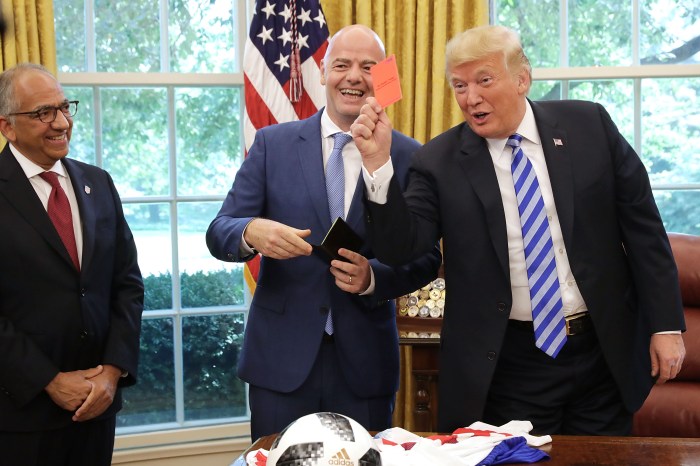
ABC confirmed reports that Trump made a call to FIFA after the U.S. win over Bosnia-Herzegovina last week and apparently asked FIFA president Gianni Infantino, an admirer of the president, to review the red card. In 2025, Infantino presented Trump with the FIFA Peace Prize during a ceremony for the 2026 World Cup draw in Washington, D.C.
We don’t know if Infantino pressured the committee that looks at all incidents during the World Cup. Yet, Balogun’s red card was surprisingly suspended.
One of the issues long faced by the United States is its pay-for-play youth soccer system that prioritizes profit over casting a wide net to attract the best potential athletes. What makes the presidential intervention and subsequent red card decision by FIFA so dangerous is that they strike at the cornerstone of athletic competition — which is supposed to be the one place where the ability to purchase results is negated by merit.
The administration has directly inserted itself into a major sporting competition in broad daylight and in a high-profile way that could determine a match’s outcome. Never one to resist a grandstanding opportunity, the president’s intervention not only impacts the integrity of soccer’s greatest tournament, but also marks a setback for a U.S. team that has desperately sought the respect of the worldwide soccer community.
Just when skeptics were beginning to embrace the United States as an underdog, the exercise of muscle by the president of the United States was a punch-in-the-gut reminder that Team USA is no underdog. In fact, it has become an extension of the administration.
On Sunday, Belgium manager Rudi Garcia was understandably upset, though he attempted to inject humor into his disbelief.
“I didn’t know that at the World Cup, the 5th of July is actually the first of April — it’s April Fools’ [Day],” Garcia said at a news conference. Garcia said more, but the most significant part of his remarks came at the end: “We’re not defending the national team or federation, we are defending football.”
There is also the matter of precedent for red cards being suspended. During Sunday’s match between England and Mexico, England’s Jarell Quansah received a red card. Can the English prime minister now call Infantino and lobby to have that red card suspended?
Predictably, social media has been radioactive and polarized. Supporters of the USMNT applauded FIFA’s about-face while the rest of the world largely hates it. For the U.S. men, this is the unfortunate aspect of presidential intervention and FIFA complicity.
Chip Somodevilla/Getty Images
Up to this point, the attention surrounding the men’s national team at the World Cup had generally been positive, and the narrative was that soccer in the United States — a distant fourth behind football, basketball, baseball and even hockey — was on the rise. Tonight’s game against Belgium had the potential to become a watershed moment.
Now it’s simply one more polarizing event in a polarized nation.
The USMNT is trying to advance to its first World Cup quarterfinal appearance since 2002. The men’s team lost in the round of 16 to Ghana in 2010, Belgium in 2014 and the Netherlands in 2022. The team never got out of the group stage in 2006 and didn’t even qualify for the 2018 tournament. This World Cup marked an important potential breakthrough, and the loss of Balogun only made the U.S. an even more sympathetic figure.
While many felt that the red card was unjust, the ethos of sport is that you move on and play with who and what you’ve got. This obviously is beyond the grasp of a president who still won’t accept losing an election six years ago. The instinct is to use muscle and influence to change an undesirable decision.
I’m not sure the president has ever watched a soccer match or even cares about soccer. During a news conference earlier this week, President Trump said he didn’t know what a red card was before he intervened. What the White House does care about is the groundswell of attention surrounding U.S. soccer, and the politics of inserting oneself in the middle of this positivity. Except the White House’s interference has created polarity when there should have been nothing but unity.
Yes, the United States received a harsh blow four days ago when Balogun was given a red card and was suspended for the next game. The call could have gone either way, but that’s sports: You win some, you lose some. There’s nothing in the rulebook that says you’re entitled to win all the time. The White House apparently plays by a different set of rules, one that says, “When you lose, intervene.”
In typical self-congratulatory manner, the president responded to the red card reversal by posting on his social media platform: “Thank you to FIFA for doing what was right and reversing a great injustice!”
In fact, a long-term injustice was done to soccer, to the World Cup and to the U.S. men’s national team.
At the end of the day, FIFA may have gotten it right by doing the wrong thing.