
Washington RB, NFL draft prospect Jonah Coleman sees endurance in his father
Through football and academics, Jamon Coleman strived to protect his son from gang violence in Stockton, Calif.

It’s said a bullet doesn’t have a name.
But as 6-year-old Jonah Coleman and his friends played outside a Stockton, Calif., apartment complex more than 15 years ago, the gunshots that halted their fun that day had an intended target: Coleman’s dad, Jamon Coleman.
“You hear shots, and the instinct is to run — to protect yourself,” Jonah Coleman, now 22, recalls of that day. “Then I see my dad. He’s bleeding everywhere. And I panic.”
Jamon Coleman was hit three times that day: in the groin, in the back and in the head. Those added to the 11 bullets wounds he had suffered to that point while living the life as a gang member.
As his friends ripped away his clothing to apply direct pressure to his wounds, Jamon Coleman told them to stop screaming. He didn’t want them to scare his son. But Jonah, seeing his dad covered in blood, cried hysterically. He was terrified.
In that moment of chaos, Jamon Coleman looked at his son and gave him advice that would shape his life.
“Don’t you ever pick up a rag. I don’t care if it’s red, blue, purple or pink,” he said, referring to wearing or carrying a gang’s designated color. “You have a gift. Get away from this life.
“Don’t be me.”
The younger Coleman’s response to his father: “OK, Dad. I promise you. I promise.”
This week, that promise — and Coleman’s dreams — will come true. Sometime Friday or Saturday during the 2026 NFL draft, Coleman, considered by most draft analysts to be the third-best running back in this year’s draft class, is expected to hear his name called.
Todd McShay, the NFL draft analyst from The Ringer, said the team that drafts Coleman will get “a starter.”
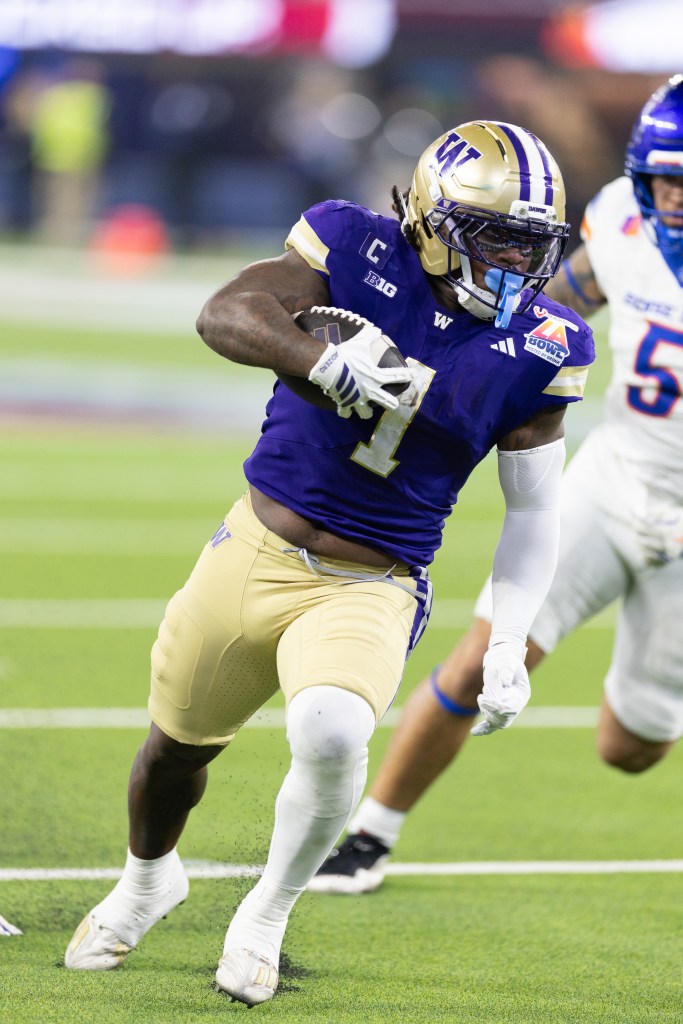
He definitely proved his worth in college (two years at Arizona, and two years at Washington). Coleman, solidly built at 5-foot-8 and 220 pounds, had 2,939 rushing yards and 800 receiving yards. He values the ball (he lost one fumble in four years and dropped one pass on 123 career targets). He’s elusive (he forced 33 missed tackles and averaged 3.3 yards after contact).
And he makes plays that are jaw-dropping.
Soon, the NFL will give Coleman a new outlet. But he will forever feel grateful to Stockton and his dad, as both were instrumental in providing Coleman with his edge.
Jonah Coleman
There was a time back in the day when Jamon Coleman was that dude. He was a three-sport athlete at Stockton’s Bear Creek High School, where he ran track, wrestled and played football. He played football in junior college, putting up points at San Joaquin Delta College.
“I was one of those athletes that people thought could do great,” Jamon Coleman said. “But I was also straddling the fence.”
The elder Coleman was an athlete, but he was also about that life — a life that included gang membership.
“How old was I when I joined a gang? I want to say I was about 10,” Jamon Coleman said. “By the time I was 12, I’d already been shot three times.”
By the time he entered high school in the early 1990s, the headlines in the Modesto Bee were dominated by the news of gang violence — headlines in Stockton that are still prevalent today.
“As a student, I did just enough to play,” Jamon Coleman said. “I was involved with the wrong type of crowd. That’s just what we did at the time.”
But Jamon Coleman said something changed when his son was born. He was tired of running the streets as an active gang member. The pull of the streets lessened when he saw that his middle child had inherited his athletic gene.
When a few of Jonah’s friends started playing organized football, he joined them one day. He was the fastest kid and mastered the various drills the coaches put the players through.
After practice, Jonah walked up to the coach and asked, “Do you have anything else to do?”
The coach responded: “Who are you?”
“I’m just out here with my friends,” Jonah said. “And I’m good at this.”
Coleman was told he could play with the proper paperwork. He raced home and told his father he was going to be a football player.
“Just hearing him say that,” Jamon Coleman said. “It was like I cried inside.”
As Jonah was drawn more into the sport that would dictate his life, Jamon began to withdraw from the gang life that largely defined his existence.
He became the football coach that Coleman needed, and the life coach in Stockton that he required. When Coleman was cutting up with his friends in school, his dad leaned on him.
When Coleman’s grades didn’t meet the standards that his father established — standards well above the just-enough-to-play minimum that Jamon had set for himself — his dad threatened to take football away from him.
“My father was getting the calls from when I was messing up,” Coleman said. “When it came to my grades in school, he demanded that I always did my best.”
Outside of school, Jamon Coleman only wanted his son to be safe from the streets. It’s a message that’s announced on his Facebook page: “Through the Grace of God, the hood will not raise my kids.”
“I was around it because that’s the community I grew up in,” Jonah Coleman said. “In Stockton, a brother might have an issue with a brother, a family with another family member. It’s scary and confusing because you never know who’s cool with who. You can ultimately be in the wrong place at the wrong time, and that’s something my dad didn’t want.”
His dad played a huge role in determining where Coleman could go and who he could hang with.
“He had a village that helped raise him — his Pop Warner program, his coaches, his trainer, Vince Carter [local gym owner] and the people at Lincoln High School,” said Natello Howard, who coached Coleman at Lincoln from 10th grade to his senior year. “I work as a probation officer, and I was impressed by the fact that he had people around him who would not let him fail. I’ve seen many players come through these doors in handcuffs. He never got anywhere close to that.”
To see where Coleman came from and where he’s about to go gives Howard pride.
“We all come to that fork in the road where your entire life could go left,” Howard said. “At his core, he is a good person. And that’s a testament of who his family raised him to be.”
Jonah Coleman
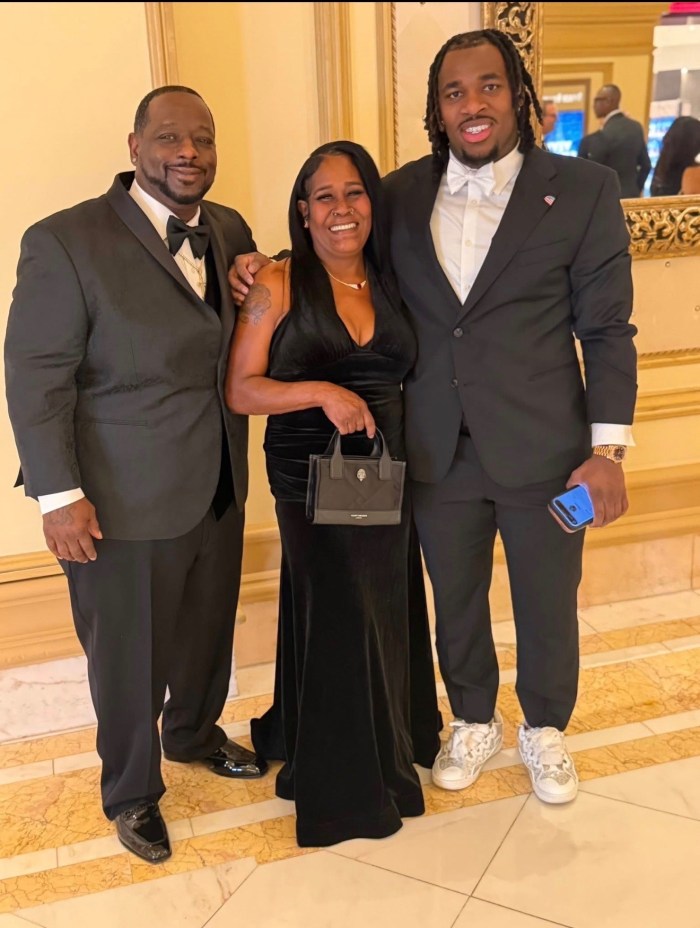
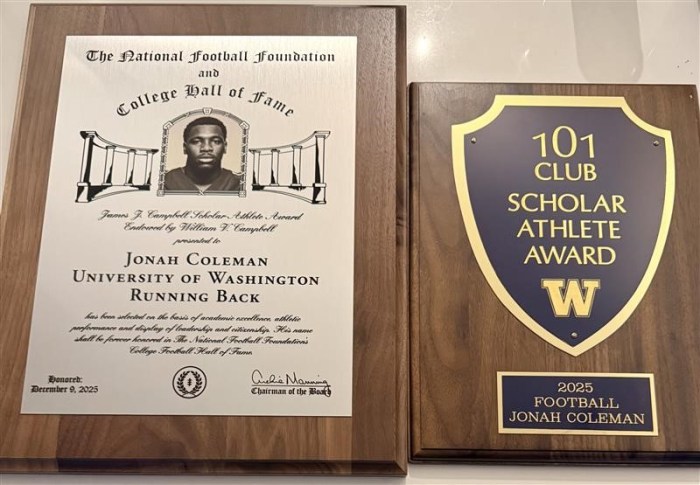
Just four days before his final college football game, Jonah Coleman took a side trip to Las Vegas, where he was joined by his parents, Jamon Coleman and Marcella Johnson. The occasion was the presentation of the William V. Campbell Trophy, an award given to college football’s premier student-athlete.
At the time, Coleman boasted a 3.91 GPA.
It was a special moment for Coleman, one of 16 finalists for the award, and his family as they met former NFL stars Michael Vick and Eddie George and former Alabama head coach Nick Saban at the trophy presentation that was part of the National Football Foundation Annual Awards dinner at the Bellagio Resort.
At one point that evening, Coleman walked over to check on his dad, whom he saw becoming emotional.
“You OK?” Coleman asked. “Dude, what’s wrong?”
“There’s nothing wrong with me. These are actually tears of joy,” Jamon Coleman recalled of his response. “I’m happy for you. I’m so proud of you. There are people who probably didn’t think you would make it. You defied all odds.”
It takes a certain level of grit to survive a place like Stockton, often listed among the nation’s worst cities to live as well as one of the most dangerous. Stockton didn’t ask who you were. It asked what you could endure.
For Jonah Coleman, endurance had a face.
It was his father.